

396
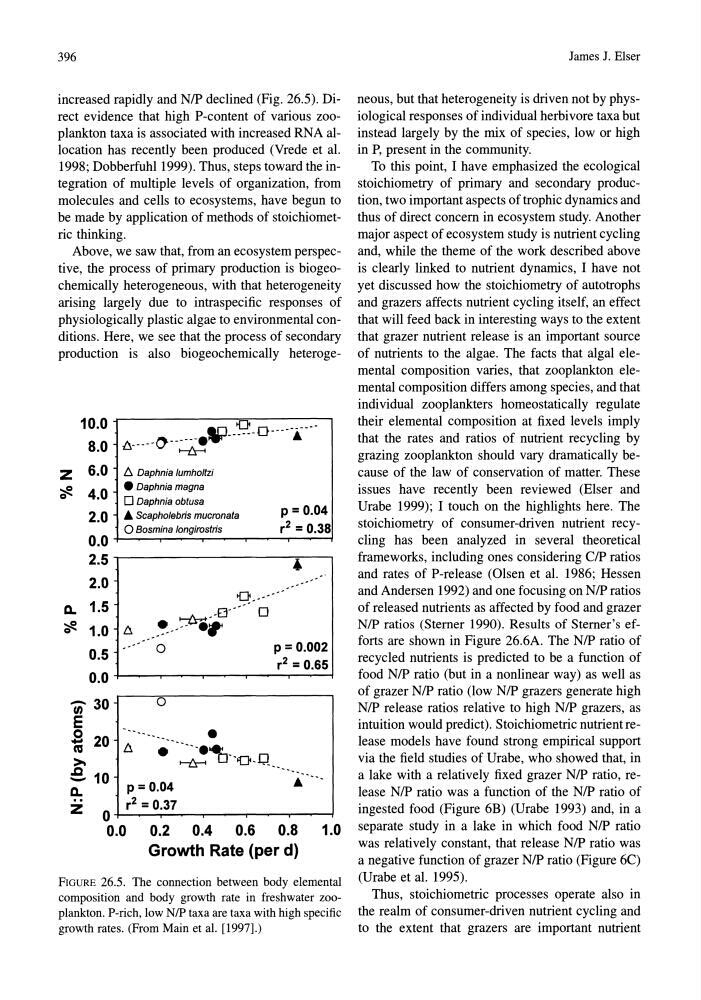
increased rapidly and NIP declined (Fig. 26.5). Direct evidence that high P-content of various zooplankton taxa is associated with increased RNA allocation has recently been produced (Vrede et al.
1998; DobberfuhI1999). Thus, steps toward the integration of multiple levels of organization, from
molecules and cells to ecosystems, have begun to
be made by application of methods of stoichiometric thinking.
Above, we saw that, from an ecosystem perspective, the process of primary production is biogeochemically heterogeneous, with that heterogeneity
arising largely due to intraspecific responses of
physiologically plastic algae to environmental conditions. Here, we see that the process of secondary
production is also biogeochemically heteroge10.0
8.0
Z 6.0
~
0
4.0
2.0
0.0
2.5
2.0
D.. 1.5
~ 0
1.0
0.5
0.0
en 30
E
/).------~
/::;. Daphnia lumholtzi
• Daphnia magna
o Daphnia obtusa
• Scapholebris mucronata
p = 0.04
o Bosmina longirostris
r2 = 0.38
,
'9 .......
.0- .
0
/::;.
!-_ . >::&e,.
0
p = 0.002
r2 = 0.65
o
.s CU 20 t,
•
-----....
• >---fr-t O--o-f~t_
>B 10
D..
p = 0.04
r2 = 0.37
--Z
o+-~~--~--~~~--~
0.0
0.2 0.4 0.6 0.8
Growth Rate (per d)
1.0
FIGURE 26.5. The connection between body elemental
composition and body growth rate in freshwater zooplankton. P-rich, low NIP taxa are taxa with high specific
growth rates. (From Main et al. [1997].)
James 1. Elser
neous, but that heterogeneity is driven not by physiological responses of individual herbivore taxa but
instead largely by the mix of species, low or high
in P, present in the community.
To this point, I have emphasized the ecological
stoichiometry of primary and secondary production, two important aspects of trophic dynamics and
thus of direct concern in ecosystem study. Another
major aspect of ecosystem study is nutrient cycling
and, while the theme of the work described above
is clearly linked to nutrient dynamics, I have not
yet discussed how the stoichiometry of autotrophs
and grazers affects nutrient cycling itself, an effect
that will feed back in interesting ways to the extent
that grazer nutrient release is an important source
of nutrients to the algae. The facts that algal elemental composition varies, that zooplankton elemental composition differs among species, and that
individual zooplankters homeostatically regulate
their elemental composition at fixed levels imply
that the rates and ratios of nutrient recycling by
grazing zooplankton should vary dramatically because of the law of conservation of matter. These
issues have recently been reviewed (Elser and
Urabe 1999); I touch on the highlights here. The
stoichiometry of consumer-driven nutrient recycling has been analyzed in several theoretical
frameworks, including ones considering CIP ratios
and rates of P-release (Olsen et al. 1986; Hessen
and Andersen 1992) and one focusing on NIP ratios
of released nutrients as affected by food and grazer
NIP ratios (Sterner 1990). Results of Sterner's efforts are shown in Figure 26.6A. The NIP ratio of
recycled nutrients is predicted to be a function of
food NIP ratio (but in a nonlinear way) as well as
of grazer NIP ratio (low NIP grazers generate high
NIP release ratios relative to high NIP grazers, as
intuition would predict). Stoichiometric nutrient release models have found strong empirical support
via the field studies of Urabe, who showed that, in
a lake with a relatively fixed grazer NIP ratio, release NIP ratio was a function of the NIP ratio of
ingested food (Figure 6B) (Urabe 1993) and, in a
separate study in a lake in which food NIP ratio
was relatively constant, that release NIP ratio was
a negative function of grazer NIP ratio (Figure 6C)
(Urabe et al. 1995).
Thus, stoichiometric processes operate also in
the realm of consumer-driven nutrient cycling and
to the extent that grazers are important nutrient
increased rapidly and NIP declined (Fig. 26.5). Direct evidence that high P-content of various zooplankton taxa is associated with increased RNA allocation has recently been produced (Vrede et al.
1998; DobberfuhI1999). Thus, steps toward the integration of multiple levels of organization, from
molecules and cells to ecosystems, have begun to
be made by application of methods of stoichiometric thinking.
Above, we saw that, from an ecosystem perspective, the process of primary production is biogeochemically heterogeneous, with that heterogeneity
arising largely due to intraspecific responses of
physiologically plastic algae to environmental conditions. Here, we see that the process of secondary
production is also biogeochemically heteroge10.0
8.0
Z 6.0
~
0
4.0
2.0
0.0
2.5
2.0
D.. 1.5
~ 0
1.0
0.5
0.0
en 30
E
/).------~
/::;. Daphnia lumholtzi
• Daphnia magna
o Daphnia obtusa
• Scapholebris mucronata
p = 0.04
o Bosmina longirostris
r2 = 0.38
,
'9 .......
.0- .
0
/::;.
!-_ . >::&e,.
0
p = 0.002
r2 = 0.65
o
.s CU 20 t,
•
-----....
• >---fr-t O--o-f~t_
>B 10
D..
p = 0.04
r2 = 0.37
--Z
o+-~~--~--~~~--~
0.0
0.2 0.4 0.6 0.8
Growth Rate (per d)
1.0
FIGURE 26.5. The connection between body elemental
composition and body growth rate in freshwater zooplankton. P-rich, low NIP taxa are taxa with high specific
growth rates. (From Main et al. [1997].)
James 1. Elser
neous, but that heterogeneity is driven not by physiological responses of individual herbivore taxa but
instead largely by the mix of species, low or high
in P, present in the community.
To this point, I have emphasized the ecological
stoichiometry of primary and secondary production, two important aspects of trophic dynamics and
thus of direct concern in ecosystem study. Another
major aspect of ecosystem study is nutrient cycling
and, while the theme of the work described above
is clearly linked to nutrient dynamics, I have not
yet discussed how the stoichiometry of autotrophs
and grazers affects nutrient cycling itself, an effect
that will feed back in interesting ways to the extent
that grazer nutrient release is an important source
of nutrients to the algae. The facts that algal elemental composition varies, that zooplankton elemental composition differs among species, and that
individual zooplankters homeostatically regulate
their elemental composition at fixed levels imply
that the rates and ratios of nutrient recycling by
grazing zooplankton should vary dramatically because of the law of conservation of matter. These
issues have recently been reviewed (Elser and
Urabe 1999); I touch on the highlights here. The
stoichiometry of consumer-driven nutrient recycling has been analyzed in several theoretical
frameworks, including ones considering CIP ratios
and rates of P-release (Olsen et al. 1986; Hessen
and Andersen 1992) and one focusing on NIP ratios
of released nutrients as affected by food and grazer
NIP ratios (Sterner 1990). Results of Sterner's efforts are shown in Figure 26.6A. The NIP ratio of
recycled nutrients is predicted to be a function of
food NIP ratio (but in a nonlinear way) as well as
of grazer NIP ratio (low NIP grazers generate high
NIP release ratios relative to high NIP grazers, as
intuition would predict). Stoichiometric nutrient release models have found strong empirical support
via the field studies of Urabe, who showed that, in
a lake with a relatively fixed grazer NIP ratio, release NIP ratio was a function of the NIP ratio of
ingested food (Figure 6B) (Urabe 1993) and, in a
separate study in a lake in which food NIP ratio
was relatively constant, that release NIP ratio was
a negative function of grazer NIP ratio (Figure 6C)
(Urabe et al. 1995).
Thus, stoichiometric processes operate also in
the realm of consumer-driven nutrient cycling and
to the extent that grazers are important nutrient