

380
(a)
(b)
Light not
Absorbed
by Plants
1290000
1
14472
p . . . . . . . . . .
·
· •
· •
'1
Xl (Plants) 2874
20810
3421
Inside the System
Outside the System
Community
Respiration
18796
(Fish)
Herman H. Shugart
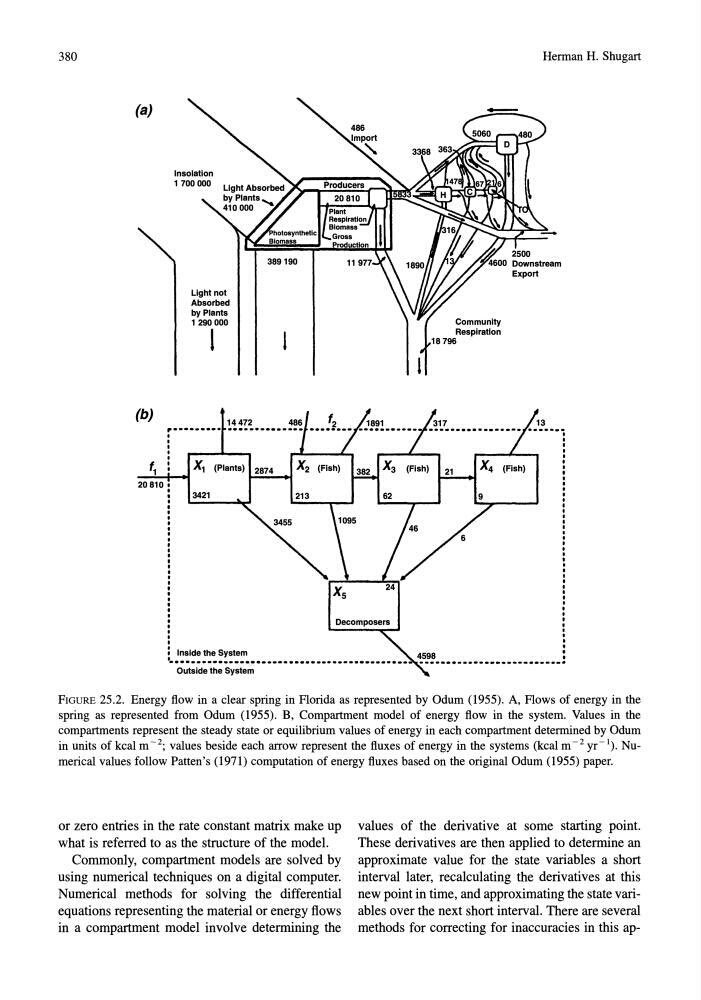
FIGURE 25.2. Energy flow in a clear spring in Florida as represented by Odum (1955). A, Flows of energy in the
spring as represented from Odum (1955). B, Compartment model of energy flow in the system. Values in the
compartments represent the steady state or equilibrium values of energy in each compartment determined by Odum
in units of kcal m - 2; values beside each arrow represent the fluxes of energy in the systems (kcal m - 2 yr - I). Numerical values follow Patten's (1971) computation of energy fluxes based on the original Odum (1955) paper.
or zero entries in the rate constant matrix make up
what is referred to as the structure of the model.
Commonly, compartment models are solved by
using numerical techniques on a digital computer.
Numerical methods for solving the differential
equations representing the material or energy flows
in a compartment model involve determining the
values of the derivative at some starting point.
These derivatives are then applied to determine an
approximate value for the state variables a short
interval later, recalculating the derivatives at this
new point in time, and approximating the state variables over the next short interval. There are several
methods for correcting for inaccuracies in this ap-
(a)
(b)
Light not
Absorbed
by Plants
1290000
1
14472
p . . . . . . . . . .
·
· •
· •
'1
Xl (Plants) 2874
20810
3421
Inside the System
Outside the System
Community
Respiration
18796
(Fish)
Herman H. Shugart
FIGURE 25.2. Energy flow in a clear spring in Florida as represented by Odum (1955). A, Flows of energy in the
spring as represented from Odum (1955). B, Compartment model of energy flow in the system. Values in the
compartments represent the steady state or equilibrium values of energy in each compartment determined by Odum
in units of kcal m - 2; values beside each arrow represent the fluxes of energy in the systems (kcal m - 2 yr - I). Numerical values follow Patten's (1971) computation of energy fluxes based on the original Odum (1955) paper.
or zero entries in the rate constant matrix make up
what is referred to as the structure of the model.
Commonly, compartment models are solved by
using numerical techniques on a digital computer.
Numerical methods for solving the differential
equations representing the material or energy flows
in a compartment model involve determining the
values of the derivative at some starting point.
These derivatives are then applied to determine an
approximate value for the state variables a short
interval later, recalculating the derivatives at this
new point in time, and approximating the state variables over the next short interval. There are several
methods for correcting for inaccuracies in this ap-