

25. Ecosystem Modeling
Logistic Equation Dynamics
120
100
.a 80
'" •
,J 60
.!!
• Do
0
40
Iloo
20
0
377
The population moves to
K (often called the carrying
capacity).
The slope of the line at any point is:
dN
1
d/=rN(l- KN)
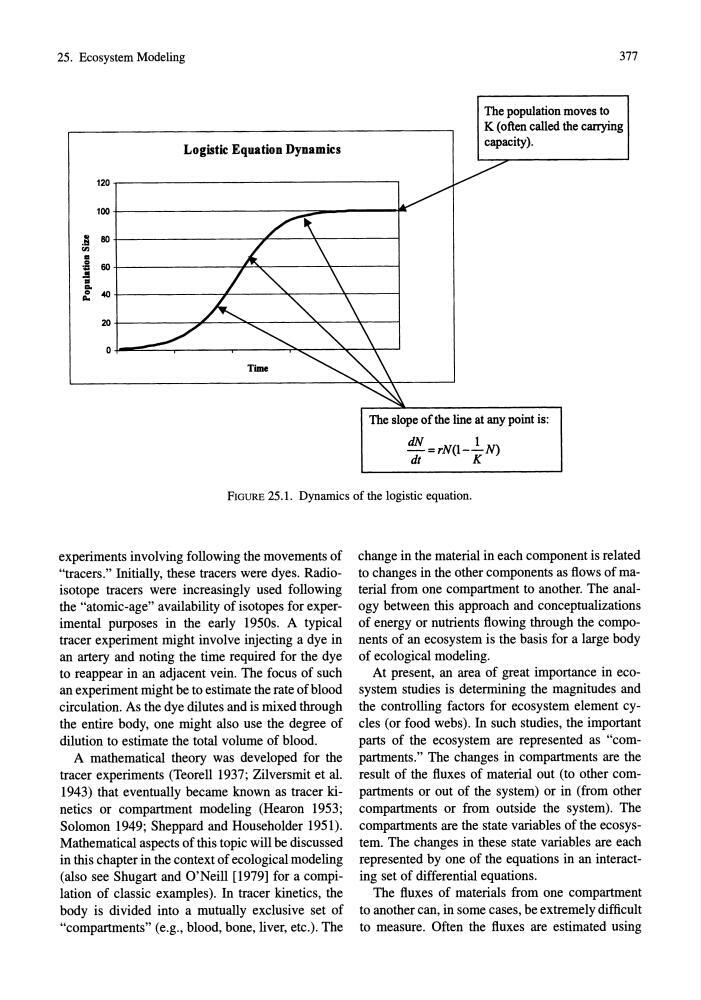
FIGURE 25.1. Dynamics of the logistic equation.
experiments involving following the movements of
"tracers." Initially, these tracers were dyes. Radioisotope tracers were increasingly used following
the "atomic-age" availability of isotopes for experimental purposes in the early 1950s. A typical
tracer experiment might involve injecting a dye in
an artery and noting the time required for the dye
to reappear in an adjacent vein. The focus of such
an experiment might be to estimate the rate of blood
circulation. As the dye dilutes and is mixed through
the entire body, one might also use the degree of
dilution to estimate the total volume of blood.
A mathematical theory was developed for the
tracer experiments (Teorell 1937; Zilversmit et al.
1943) that eventually became known as tracer kinetics or compartment modeling (Hearon 1953;
Solomon 1949; Sheppard and Householder 1951).
Mathematical aspects of this topic will be discussed
in this chapter in the context of ecological modeling
(also see Shugart and O'Neill [1979] for a compilation of classic examples). In tracer kinetics, the
body is divided into a mutually exclusive set of
"compartments" (e.g., blood, bone, liver, etc.). The
change in the material in each component is related
to changes in the other components as flows of material from one compartment to another. The analogy between this approach and conceptualizations
of energy or nutrients flowing through the components of an ecosystem is the basis for a large body
of ecological modeling.
At present, an area of great importance in ecosystem studies is determining the magnitudes and
the controlling factors for ecosystem element cycles (or food webs). In such studies, the important
parts of the ecosystem are represented as "compartments." The changes in compartments are the
result of the fluxes of material out (to other compartments or out of the system) or in (from other
compartments or from outside the system). The
compartments are the state variables of the ecosystem. The changes in these state variables are each
represented by one of the equations in an interacting set of differential equations.
The fluxes of materials from one compartment
to another can, in some cases, be extremely difficult
to measure. Often the fluxes are estimated using
Logistic Equation Dynamics
120
100
.a 80
'" •
,J 60
.!!
• Do
0
40
Iloo
20
0
377
The population moves to
K (often called the carrying
capacity).
The slope of the line at any point is:
dN
1
d/=rN(l- KN)
FIGURE 25.1. Dynamics of the logistic equation.
experiments involving following the movements of
"tracers." Initially, these tracers were dyes. Radioisotope tracers were increasingly used following
the "atomic-age" availability of isotopes for experimental purposes in the early 1950s. A typical
tracer experiment might involve injecting a dye in
an artery and noting the time required for the dye
to reappear in an adjacent vein. The focus of such
an experiment might be to estimate the rate of blood
circulation. As the dye dilutes and is mixed through
the entire body, one might also use the degree of
dilution to estimate the total volume of blood.
A mathematical theory was developed for the
tracer experiments (Teorell 1937; Zilversmit et al.
1943) that eventually became known as tracer kinetics or compartment modeling (Hearon 1953;
Solomon 1949; Sheppard and Householder 1951).
Mathematical aspects of this topic will be discussed
in this chapter in the context of ecological modeling
(also see Shugart and O'Neill [1979] for a compilation of classic examples). In tracer kinetics, the
body is divided into a mutually exclusive set of
"compartments" (e.g., blood, bone, liver, etc.). The
change in the material in each component is related
to changes in the other components as flows of material from one compartment to another. The analogy between this approach and conceptualizations
of energy or nutrients flowing through the components of an ecosystem is the basis for a large body
of ecological modeling.
At present, an area of great importance in ecosystem studies is determining the magnitudes and
the controlling factors for ecosystem element cycles (or food webs). In such studies, the important
parts of the ecosystem are represented as "compartments." The changes in compartments are the
result of the fluxes of material out (to other compartments or out of the system) or in (from other
compartments or from outside the system). The
compartments are the state variables of the ecosystem. The changes in these state variables are each
represented by one of the equations in an interacting set of differential equations.
The fluxes of materials from one compartment
to another can, in some cases, be extremely difficult
to measure. Often the fluxes are estimated using