

314
Daniel E. Schindler, Brian R. Herwig, and Stephen R. Carpenter
(Hilborn et al. 1995). Fisheries management involves fishers, fish, and the ecosystems in which
they are embedded. Therefore, management experiments inevitably include the human dimension.
People are highly responsive top predators capable of restructuring lake fish communities and
creating trophic cascades that alter entire food webs
and ecosystem processes (Kitchell 1992; Carpenter
and Kitchell 1993a). Lake Mendota, Wisconsin,
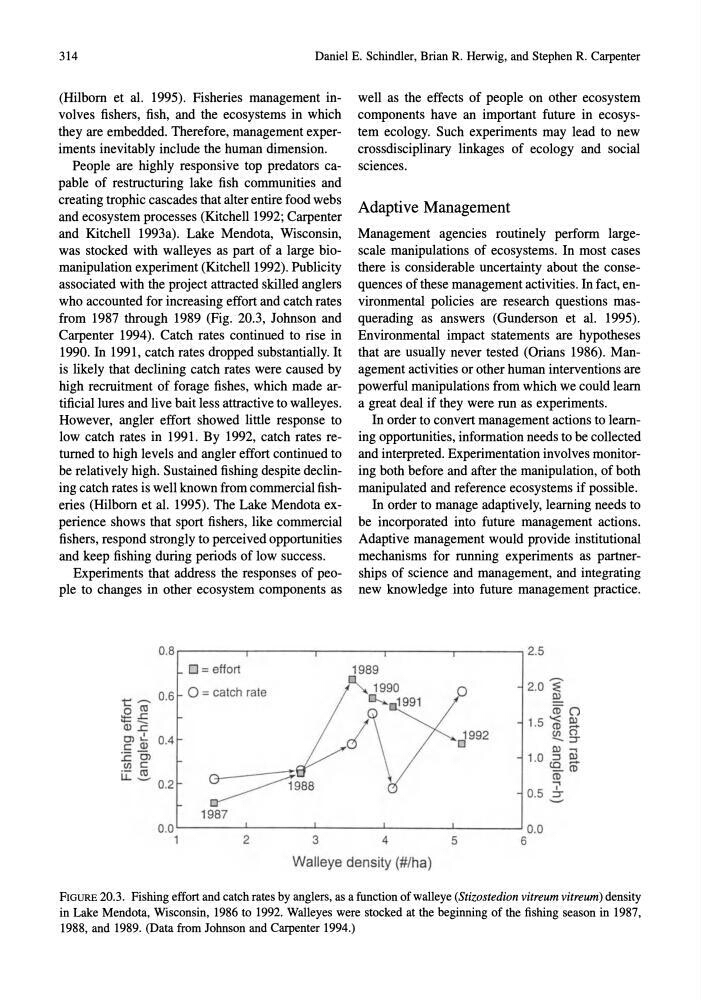
was stocked with walleyes as part of a large biomanipulation experiment (Kitchell 1992). Publicity
associated with the project attracted skilled anglers
who accounted for increasing effort and catch rates
from 1987 through 1989 (Fig. 20.3, Johnson and
Carpenter 1994). Catch rates continued to rise in
1990. In 1991, catch rates dropped substantially. It
is likely that declining catch rates were caused by
high recruitment of forage fishes, which made artificiallures and live bait less attractive to walleyes.
However, angler effort showed little response to
low catch rates in 1991. By 1992, catch rates returned to high levels and angler effort continued to
be relatively high. Sustained fishing despite declining catch rates is well known from commercial fisheries (Hilborn et al. 1995). The Lake Mendota experience shows that sport fishers, like commercial
fishers, respond strongly to perceived opportunities
and keep fishing during periods of low success.
Experiments that address the responses of people to changes in other ecosystem components as
0.8
0= effort
0.6 o = catch rate
t -
o co
:;j:;.c
Q)J::
Ol.!.
.£ .£?
0.4
.cOl
(J) C
.- co
LL_ 0.2
0.0 1
2
3
well as the effects of people on other ecosystem
components have an important future in ecosystem ecology. Such experiments may lead to new
crossdisciplinary linkages of ecology and social
sciences.
Adaptive Management
Management agencies routinely perform largescale manipulations of ecosystems. In most cases
there is considerable uncertainty about the consequences of these management activities. In fact, environmental policies are research questions masquerading as answers (Gunderson et al. 1995).
Environmental impact statements are hypotheses
that are usually never tested (Orians 1986). Management activities or other human interventions are
powerful manipulations from which we could learn
a great deal if they were run as experiments.
In order to convert management actions to learning opportunities, information needs to be collected
and interpreted. Experimentation involves monitoring both before and after the manipulation, of both
manipulated and reference ecosystems if possible.
In order to manage adaptively, learning needs to
be incorporated into future management actions.
Adaptive management would provide institutional
mechanisms for running experiments as partnerships of science and management, and integrating
new knowledge into future management practice.
2.5
1989
Px 1990
0
2.0 "?
o...... 1991
~
1\
roo
1.5 ~ ~
d 992
(J) ('l
-- ::r
OJ ....
1.0 cE ~
_ctl
ctl
.....
0.5 :::,..
0.0
4
5
6
Walleye density (#/ha)
FIGURE 20.3. Fishing effort and catch rates by anglers, as a function of walleye (Stizostedion vitreum vitreum) density
in Lake Mendota, Wisconsin, 1986 to 1992. Walleyes were stocked at the beginning of the fishing season in 1987,
1988, and 1989. (Data from Johnson and Carpenter 1994.)
Daniel E. Schindler, Brian R. Herwig, and Stephen R. Carpenter
(Hilborn et al. 1995). Fisheries management involves fishers, fish, and the ecosystems in which
they are embedded. Therefore, management experiments inevitably include the human dimension.
People are highly responsive top predators capable of restructuring lake fish communities and
creating trophic cascades that alter entire food webs
and ecosystem processes (Kitchell 1992; Carpenter
and Kitchell 1993a). Lake Mendota, Wisconsin,
was stocked with walleyes as part of a large biomanipulation experiment (Kitchell 1992). Publicity
associated with the project attracted skilled anglers
who accounted for increasing effort and catch rates
from 1987 through 1989 (Fig. 20.3, Johnson and
Carpenter 1994). Catch rates continued to rise in
1990. In 1991, catch rates dropped substantially. It
is likely that declining catch rates were caused by
high recruitment of forage fishes, which made artificiallures and live bait less attractive to walleyes.
However, angler effort showed little response to
low catch rates in 1991. By 1992, catch rates returned to high levels and angler effort continued to
be relatively high. Sustained fishing despite declining catch rates is well known from commercial fisheries (Hilborn et al. 1995). The Lake Mendota experience shows that sport fishers, like commercial
fishers, respond strongly to perceived opportunities
and keep fishing during periods of low success.
Experiments that address the responses of people to changes in other ecosystem components as
0.8
0= effort
0.6 o = catch rate
t -
o co
:;j:;.c
Q)J::
Ol.!.
.£ .£?
0.4
.cOl
(J) C
.- co
LL_ 0.2
0.0 1
2
3
well as the effects of people on other ecosystem
components have an important future in ecosystem ecology. Such experiments may lead to new
crossdisciplinary linkages of ecology and social
sciences.
Adaptive Management
Management agencies routinely perform largescale manipulations of ecosystems. In most cases
there is considerable uncertainty about the consequences of these management activities. In fact, environmental policies are research questions masquerading as answers (Gunderson et al. 1995).
Environmental impact statements are hypotheses
that are usually never tested (Orians 1986). Management activities or other human interventions are
powerful manipulations from which we could learn
a great deal if they were run as experiments.
In order to convert management actions to learning opportunities, information needs to be collected
and interpreted. Experimentation involves monitoring both before and after the manipulation, of both
manipulated and reference ecosystems if possible.
In order to manage adaptively, learning needs to
be incorporated into future management actions.
Adaptive management would provide institutional
mechanisms for running experiments as partnerships of science and management, and integrating
new knowledge into future management practice.
2.5
1989
Px 1990
0
2.0 "?
o...... 1991
~
1\
roo
1.5 ~ ~
d 992
(J) ('l
-- ::r
OJ ....
1.0 cE ~
_ctl
ctl
.....
0.5 :::,..
0.0
4
5
6
Walleye density (#/ha)
FIGURE 20.3. Fishing effort and catch rates by anglers, as a function of walleye (Stizostedion vitreum vitreum) density
in Lake Mendota, Wisconsin, 1986 to 1992. Walleyes were stocked at the beginning of the fishing season in 1987,
1988, and 1989. (Data from Johnson and Carpenter 1994.)