

12. Assessing Ecosystem-Level Water Relations Through Stable Isotope Ratio Analyses
191
Using (5D and (5 18 0 Water Pulses
and Interpretation of Mixing Models
Even though the soil forms a continuum of moisture availabilities, it is often appropriate to distinguish two distinct soil water sources for plants (see
above and Dawson and Ehleringer 1998; Dawson
et al. 1998). One, the rain-fed shallow soil layer is
dominated by pulse dynamics, where generally low
soil moisture availability is punctuated by short episodes of high soil moisture availability. These
pulses may occur naturally or artificially by augmenting the irrigation water with either 2H_ or 18 0_
enriched water (both readily available commercially). Second, the deeper soil layer is not or is
very little affected by single rainfall events and is
dominated instead by seasonal dynamics in which
soil moisture is depleted during spring and summer
and replenished during fall and winter. In many
ecosystems, such as grasslands and deserts, the division of soil space and its resources among plants
is central to explaining competitive relationships
among plants and the community consequences of
a changing climate. Stable isotope methods can
help quantify the absolute and relative division of
o
shallow and deep soil moisture sources among
plant species.
Shallow and deep soil water pools often have
distinct isotopic composition, particularly in temperate ecosystems and ecosystems receiving bimodal precipitation. If minimal isotopic differences
exist within the soil profile, they can also be enhanced, creating artificial moisture pulses with 2H_
or 180-enriched irrigation water. As stated above,
plants do not discriminate between isotopically different forms of water (Ehleringer and Dawson
1992). Thus, the isotopic composition of xylem water reveals the relative contribution from two distinct water sources. The question becomes how
much ecologically relevant information can we obtain from the xylem signal?
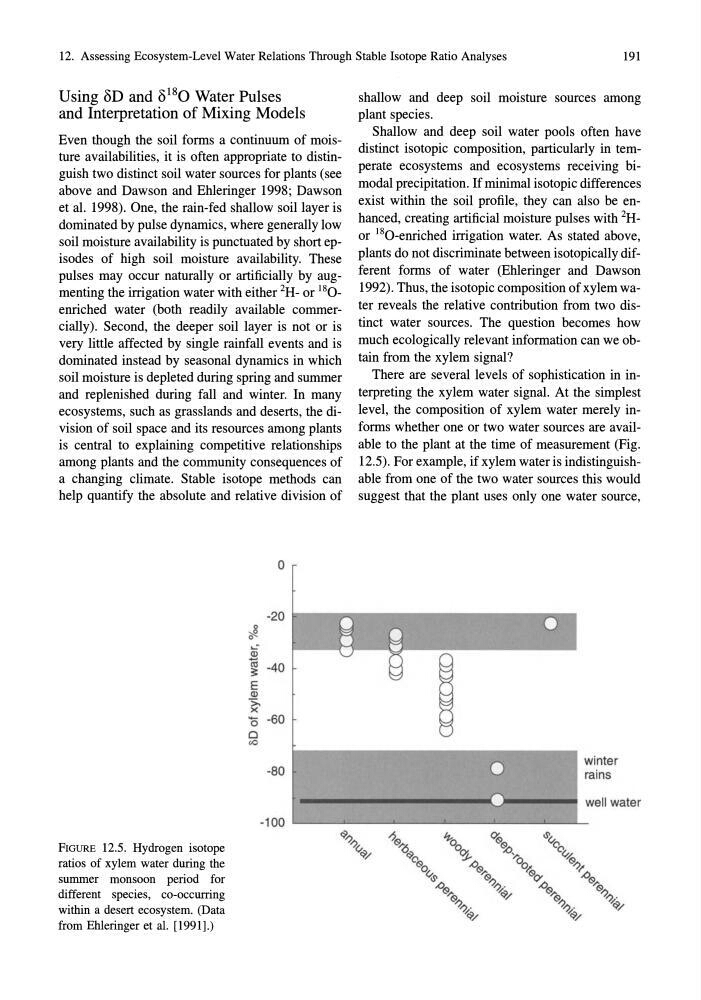
There are several levels of sophistication in interpreting the xylem water signal. At the simplest
level, the composition of xylem water merely informs whether one or two water sources are available to the plant at the time of measurement (Fig.
12.5). For example, if xylem water is indistinguishable from one of the two water sources this would
suggest that the plant uses only one water source,
-20 ~----,,=-------------=----.
FIGURE 12.5. Hydrogen isotope
ratios of xylem water during the
summer monsoon period for
different species, co-occurring
within a desert ecosystem. (Data
from Ehleringer et al. [1991J.)
J o .... .
2
~ -40
E
Q)
~
'0 -60
o co
-80
winter
rains
well water
-100 ...... '-'-'"-........ _ _ _ _ -..... ........ _ _ ....... _ _ .1.....---1_
191
Using (5D and (5 18 0 Water Pulses
and Interpretation of Mixing Models
Even though the soil forms a continuum of moisture availabilities, it is often appropriate to distinguish two distinct soil water sources for plants (see
above and Dawson and Ehleringer 1998; Dawson
et al. 1998). One, the rain-fed shallow soil layer is
dominated by pulse dynamics, where generally low
soil moisture availability is punctuated by short episodes of high soil moisture availability. These
pulses may occur naturally or artificially by augmenting the irrigation water with either 2H_ or 18 0_
enriched water (both readily available commercially). Second, the deeper soil layer is not or is
very little affected by single rainfall events and is
dominated instead by seasonal dynamics in which
soil moisture is depleted during spring and summer
and replenished during fall and winter. In many
ecosystems, such as grasslands and deserts, the division of soil space and its resources among plants
is central to explaining competitive relationships
among plants and the community consequences of
a changing climate. Stable isotope methods can
help quantify the absolute and relative division of
o
shallow and deep soil moisture sources among
plant species.
Shallow and deep soil water pools often have
distinct isotopic composition, particularly in temperate ecosystems and ecosystems receiving bimodal precipitation. If minimal isotopic differences
exist within the soil profile, they can also be enhanced, creating artificial moisture pulses with 2H_
or 180-enriched irrigation water. As stated above,
plants do not discriminate between isotopically different forms of water (Ehleringer and Dawson
1992). Thus, the isotopic composition of xylem water reveals the relative contribution from two distinct water sources. The question becomes how
much ecologically relevant information can we obtain from the xylem signal?
There are several levels of sophistication in interpreting the xylem water signal. At the simplest
level, the composition of xylem water merely informs whether one or two water sources are available to the plant at the time of measurement (Fig.
12.5). For example, if xylem water is indistinguishable from one of the two water sources this would
suggest that the plant uses only one water source,
-20 ~----,,=-------------=----.
FIGURE 12.5. Hydrogen isotope
ratios of xylem water during the
summer monsoon period for
different species, co-occurring
within a desert ecosystem. (Data
from Ehleringer et al. [1991J.)
J o .... .
2
~ -40
E
Q)
~
'0 -60
o co
-80
winter
rains
well water
-100 ...... '-'-'"-........ _ _ _ _ -..... ........ _ _ ....... _ _ .1.....---1_