

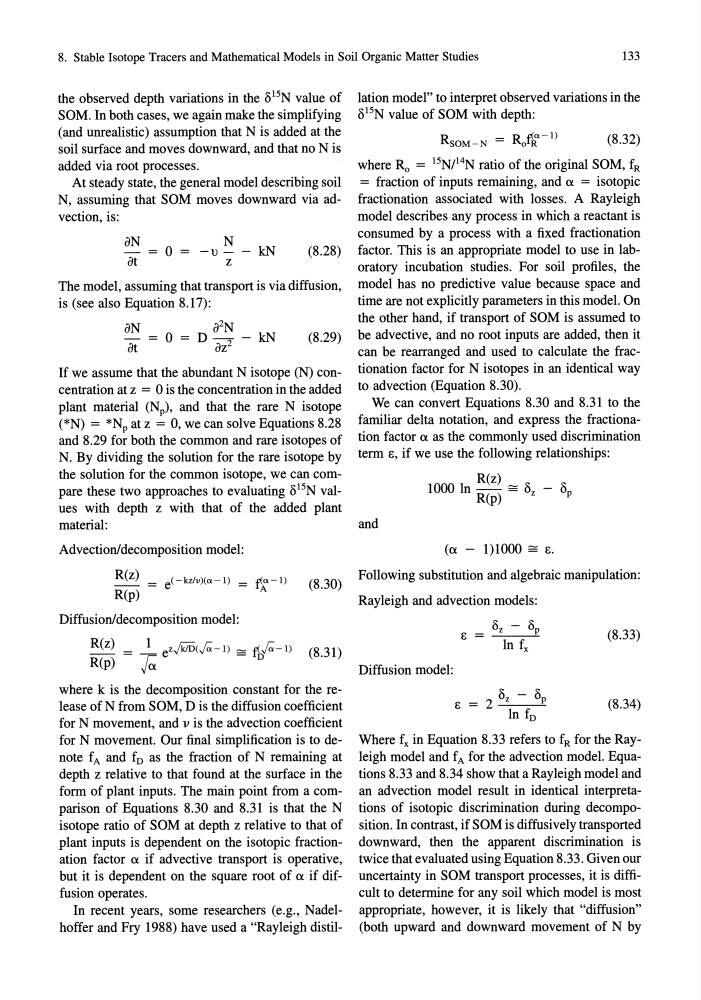
8. Stable Isotope Tracers and Mathematical Models in Soil Organic Matter Studies
133
the observed depth variations in the 0 15 N value of
SOM. In both cases, we again make the simplifying
(and unrealistic) assumption that N is added at the
soil surface and moves downward, and that no N is
added via root processes.
At steady state, the general model describing soil
N, assuming that SOM moves downward via advection, is:
aN
N
- = 0 = -\) - - kN
at
z
(8.28)
The model, assuming that transport is via diffusion,
is (see also Equation 8.17):
aN
a 2 N
at = 0 = D az2 - kN
(8.29)
If we assume that the abundant N isotope (N) concentration at z = 0 is the concentration in the added
plant material (N p ), and that the rare N isotope
(*N) = *Np at z = 0, we can solve Equations 8.28
and 8.29 for both the common and rare isotopes of
N. By dividing the solution for the rare isotope by
the solution for the common isotope, we can compare these two approaches to evaluating 0 15 N values with depth z with that of the added plant
material:
Advection/decomposition model:
R(z) = e(-kzlv)(a-l) = fA-I)
R(p)
Diffusion/decomposition model:
R(z) = ~ ezjkiD(Fa-l) = :t1Fa-l)
R(p).fa
- D
(8.30)
(8.31)
where k is the decomposition constant for the release of N from SOM, D is the diffusion coefficient
for N movement, and v is the advection coefficient
for N movement. Our final simplification is to denote fA and fD as the fraction of N remaining at
depth z relative to that found at the surface in the
form of plant inputs. The main point from a comparison of Equations 8.30 and 8.31 is that the N
isotope ratio of SOM at depth z relative to that of
plant inputs is dependent on the isotopic fractionation factor a if advective transport is operative,
but it is dependent on the square root of a if diffusion operates.
In recent years, some researchers (e.g., Nadelhoffer and Fry 1988) have used a "Rayleigh distillation model" to interpret observed variations in the
0 15 N value of SOM with depth:
(8.32)
where R., = 15N/14N ratio of the original SOM, fR
= fraction of inputs remaining, and a = isotopic
fractionation associated with losses. A Rayleigh
model describes any process in which a reactant is
consumed by a process with a fixed fractionation
factor. This is an appropriate model to use in laboratory incubation studies. For soil profiles, the
model has no predictive value because space and
time are not explicitly parameters in this model. On
the other hand, if transport of SOM is assumed to
be advective, and no root inputs are added, then it
can be rearranged and used to calculate the fractionation factor for N isotopes in an identical way
to advection (Equation 8.30).
We can convert Equations 8.30 and 8.31 to the
familiar delta notation, and express the fractionation factor a as the commonly used discrimination
term E, if we use the following relationships:
1000 In R(z) =:; 0 - Op
R(p)
z
and
(a - 1)1000 =:; E.
Following substitution and algebraic manipulation:
Rayleigh and advection models:
Diffusion model:
E = 8z - 8p
In fx
_ 2 0. - op
E -
In fD
(8.33)
(8.34)
Where fx in Equation 8.33 refers to fR for the Rayleigh model and fA for the advection model. Equations 8.33 and 8.34 show that a Rayleigh model and
an advection model result in identical interpretations of isotopic discrimination during decomposition. In contrast, if SOM is diffusively transported
downward, then the apparent discrimination is
twice that evaluated using Equation 8.33. Given our
uncertainty in SOM transport processes, it is difficult to determine for any soil which model is most
appropriate, however, it is likely that "diffusion"
(both upward and downward movement of N by
133
the observed depth variations in the 0 15 N value of
SOM. In both cases, we again make the simplifying
(and unrealistic) assumption that N is added at the
soil surface and moves downward, and that no N is
added via root processes.
At steady state, the general model describing soil
N, assuming that SOM moves downward via advection, is:
aN
N
- = 0 = -\) - - kN
at
z
(8.28)
The model, assuming that transport is via diffusion,
is (see also Equation 8.17):
aN
a 2 N
at = 0 = D az2 - kN
(8.29)
If we assume that the abundant N isotope (N) concentration at z = 0 is the concentration in the added
plant material (N p ), and that the rare N isotope
(*N) = *Np at z = 0, we can solve Equations 8.28
and 8.29 for both the common and rare isotopes of
N. By dividing the solution for the rare isotope by
the solution for the common isotope, we can compare these two approaches to evaluating 0 15 N values with depth z with that of the added plant
material:
Advection/decomposition model:
R(z) = e(-kzlv)(a-l) = fA-I)
R(p)
Diffusion/decomposition model:
R(z) = ~ ezjkiD(Fa-l) = :t1Fa-l)
R(p).fa
- D
(8.30)
(8.31)
where k is the decomposition constant for the release of N from SOM, D is the diffusion coefficient
for N movement, and v is the advection coefficient
for N movement. Our final simplification is to denote fA and fD as the fraction of N remaining at
depth z relative to that found at the surface in the
form of plant inputs. The main point from a comparison of Equations 8.30 and 8.31 is that the N
isotope ratio of SOM at depth z relative to that of
plant inputs is dependent on the isotopic fractionation factor a if advective transport is operative,
but it is dependent on the square root of a if diffusion operates.
In recent years, some researchers (e.g., Nadelhoffer and Fry 1988) have used a "Rayleigh distillation model" to interpret observed variations in the
0 15 N value of SOM with depth:
(8.32)
where R., = 15N/14N ratio of the original SOM, fR
= fraction of inputs remaining, and a = isotopic
fractionation associated with losses. A Rayleigh
model describes any process in which a reactant is
consumed by a process with a fixed fractionation
factor. This is an appropriate model to use in laboratory incubation studies. For soil profiles, the
model has no predictive value because space and
time are not explicitly parameters in this model. On
the other hand, if transport of SOM is assumed to
be advective, and no root inputs are added, then it
can be rearranged and used to calculate the fractionation factor for N isotopes in an identical way
to advection (Equation 8.30).
We can convert Equations 8.30 and 8.31 to the
familiar delta notation, and express the fractionation factor a as the commonly used discrimination
term E, if we use the following relationships:
1000 In R(z) =:; 0 - Op
R(p)
z
and
(a - 1)1000 =:; E.
Following substitution and algebraic manipulation:
Rayleigh and advection models:
Diffusion model:
E = 8z - 8p
In fx
_ 2 0. - op
E -
In fD
(8.33)
(8.34)
Where fx in Equation 8.33 refers to fR for the Rayleigh model and fA for the advection model. Equations 8.33 and 8.34 show that a Rayleigh model and
an advection model result in identical interpretations of isotopic discrimination during decomposition. In contrast, if SOM is diffusively transported
downward, then the apparent discrimination is
twice that evaluated using Equation 8.33. Given our
uncertainty in SOM transport processes, it is difficult to determine for any soil which model is most
appropriate, however, it is likely that "diffusion"
(both upward and downward movement of N by