

124
tonic increase. More often, it is a rapid increase of
approximately 1%0 over litter values in the first 20
cm of the mineral soil, followed by a slower increase. This trend is particularly typical of temperate deciduous forests (Balesdent et al. 1993), but
may be interrupted by a sharp decrease in ol3C values in the E horizons of podzols (Bertram and
Schleser 1982). Because the l3C enrichment of
SOM as a function of depth does not always begin
to appear during the initial phases of litter decomposition (Melillo et aI, 1989; Balesdent et al.,
1993), this observation is difficult to study mechanistically. Thus, models that explain the observed
trends in C isotopes represent a useful method for
identifying the processes responsible for this soil
property.
Generalized C Isotope Model
Introducing depth into the model as a continuous
variable has two important implications. First, in
the mass balance expression, C concentration is
now a function of both time and depth, which
makes the overall expression a partial differential
equation. Second, boundary conditions at the upper
and lower limit of the soil profile must be considered. Introducing z as depth in cm, and following
the work of Elzein and Balesdent (1995), we begin
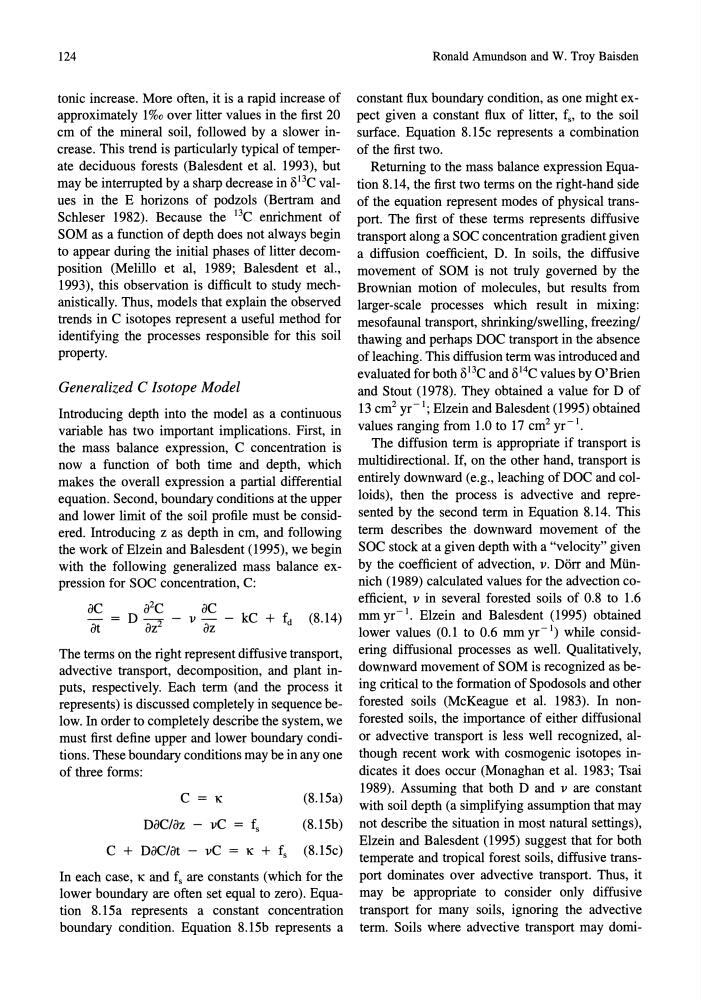
with the following generalized mass balance expression for SOC concentration, C:
ac
a 2 c
ac
at = D az2 - v az - kC + fd (8.14)
The terms on the right represent diffusive transport,
advective transport, decomposition, and plant inputs, respectively. Each term (and the process it
represents) is discussed completely in sequence below. In order to completely describe the system, we
must first define upper and lower boundary conditions. These boundary conditions may be in anyone
of three forms:
C = 1C
(8.15a)
DaC/az - vC = fs
(8.15b)
C + DaC/at - vC = 1C + fs (8.15c)
In each case, 1C and fs are constants (which for the
lower boundary are often set equal to zero). Equation 8.15a represents a constant concentration
boundary condition. Equation 8.15b represents a
Ronald Amundson and W. Troy Baisden
constant flux boundary condition, as one might expect given a constant flux of litter, fs' to the soil
surface. Equation 8.15c represents a combination
of the first two.
Returning to the mass balance expression Equation 8.14, the first two terms on the right-hand side
of the equation represent modes of physical transport. The first of these terms represents diffusive
transport along a SOC concentration gradient given
a diffusion coefficient, D. In soils, the diffusive
movement of SOM is not truly governed by the
Brownian motion of molecules, but results from
larger-scale processes which result in mixing:
mesofaunal transport, shrinking/swelling, freezing!
thawing and perhaps DOC transport in the absence
of leaching. This diffusion term was introduced and
evaluated for both ol3C and Ol4C values by O'Brien
and Stout (1978). They obtained a value for D of
13 cm 2 yr- I ; Elzein and Balesdent (1995) obtained
values ranging from 1.0 to 17 cm 2 yr - I.
The diffusion term is appropriate if transport is
multidirectional. If, on the other hand, transport is
entirely downward (e.g., leaching of DOC and colloids), then the process is advective and represented by the second term in Equation 8.14. This
term describes the downward movement of the
SOC stock at a given depth with a "velocity" given
by the coefficient of advection, v. Dorr and Miinnich (1989) calculated values for the advection coefficient, v in several forested soils of 0.8 to 1.6
mm yr - I. Elzein and Balesdent (1995) obtained
lower values (0.1 to 0.6 mm yr -I) while considering diffusional processes as well. Qualitatively,
downward movement of SOM is recognized as being critical to the formation of Spodosols and other
forested soils (McKeague et al. 1983). In nonforested soils, the importance of either diffusional
or advective transport is less well recognized, although recent work with cosmogenic isotopes indicates it does occur (Monaghan et al. 1983; Tsai
1989). Assuming that both D and v are constant
with soil depth (a simplifying assumption that may
not describe the situation in most natural settings),
Elzein and Balesdent (1995) suggest that for both
temperate and tropical forest soils, diffusive transport dominates over advective transport. Thus, it
may be appropriate to consider only diffusive
transport for many soils, ignoring the advective
term. Soils where advective transport may domi-
tonic increase. More often, it is a rapid increase of
approximately 1%0 over litter values in the first 20
cm of the mineral soil, followed by a slower increase. This trend is particularly typical of temperate deciduous forests (Balesdent et al. 1993), but
may be interrupted by a sharp decrease in ol3C values in the E horizons of podzols (Bertram and
Schleser 1982). Because the l3C enrichment of
SOM as a function of depth does not always begin
to appear during the initial phases of litter decomposition (Melillo et aI, 1989; Balesdent et al.,
1993), this observation is difficult to study mechanistically. Thus, models that explain the observed
trends in C isotopes represent a useful method for
identifying the processes responsible for this soil
property.
Generalized C Isotope Model
Introducing depth into the model as a continuous
variable has two important implications. First, in
the mass balance expression, C concentration is
now a function of both time and depth, which
makes the overall expression a partial differential
equation. Second, boundary conditions at the upper
and lower limit of the soil profile must be considered. Introducing z as depth in cm, and following
the work of Elzein and Balesdent (1995), we begin
with the following generalized mass balance expression for SOC concentration, C:
ac
a 2 c
ac
at = D az2 - v az - kC + fd (8.14)
The terms on the right represent diffusive transport,
advective transport, decomposition, and plant inputs, respectively. Each term (and the process it
represents) is discussed completely in sequence below. In order to completely describe the system, we
must first define upper and lower boundary conditions. These boundary conditions may be in anyone
of three forms:
C = 1C
(8.15a)
DaC/az - vC = fs
(8.15b)
C + DaC/at - vC = 1C + fs (8.15c)
In each case, 1C and fs are constants (which for the
lower boundary are often set equal to zero). Equation 8.15a represents a constant concentration
boundary condition. Equation 8.15b represents a
Ronald Amundson and W. Troy Baisden
constant flux boundary condition, as one might expect given a constant flux of litter, fs' to the soil
surface. Equation 8.15c represents a combination
of the first two.
Returning to the mass balance expression Equation 8.14, the first two terms on the right-hand side
of the equation represent modes of physical transport. The first of these terms represents diffusive
transport along a SOC concentration gradient given
a diffusion coefficient, D. In soils, the diffusive
movement of SOM is not truly governed by the
Brownian motion of molecules, but results from
larger-scale processes which result in mixing:
mesofaunal transport, shrinking/swelling, freezing!
thawing and perhaps DOC transport in the absence
of leaching. This diffusion term was introduced and
evaluated for both ol3C and Ol4C values by O'Brien
and Stout (1978). They obtained a value for D of
13 cm 2 yr- I ; Elzein and Balesdent (1995) obtained
values ranging from 1.0 to 17 cm 2 yr - I.
The diffusion term is appropriate if transport is
multidirectional. If, on the other hand, transport is
entirely downward (e.g., leaching of DOC and colloids), then the process is advective and represented by the second term in Equation 8.14. This
term describes the downward movement of the
SOC stock at a given depth with a "velocity" given
by the coefficient of advection, v. Dorr and Miinnich (1989) calculated values for the advection coefficient, v in several forested soils of 0.8 to 1.6
mm yr - I. Elzein and Balesdent (1995) obtained
lower values (0.1 to 0.6 mm yr -I) while considering diffusional processes as well. Qualitatively,
downward movement of SOM is recognized as being critical to the formation of Spodosols and other
forested soils (McKeague et al. 1983). In nonforested soils, the importance of either diffusional
or advective transport is less well recognized, although recent work with cosmogenic isotopes indicates it does occur (Monaghan et al. 1983; Tsai
1989). Assuming that both D and v are constant
with soil depth (a simplifying assumption that may
not describe the situation in most natural settings),
Elzein and Balesdent (1995) suggest that for both
temperate and tropical forest soils, diffusive transport dominates over advective transport. Thus, it
may be appropriate to consider only diffusive
transport for many soils, ignoring the advective
term. Soils where advective transport may domi-