

8. Stable Isotope Tracers and Mathematical Models in Soil Organic Matter Studies
121
In other words, the ol3C value of soil matter is time
invariant and is the same as the Ol3C value of the
plant inputs.
While this simplification describes much about
the ol3C value of SOM (i.e., it is commonly similar
isotopically to that of the standing biomass), it is
not entirely accurate. For example, the isotopic
composition of plants is usually a few per mil less
than that of the pooled SOM (e.g., Balesdent et al.
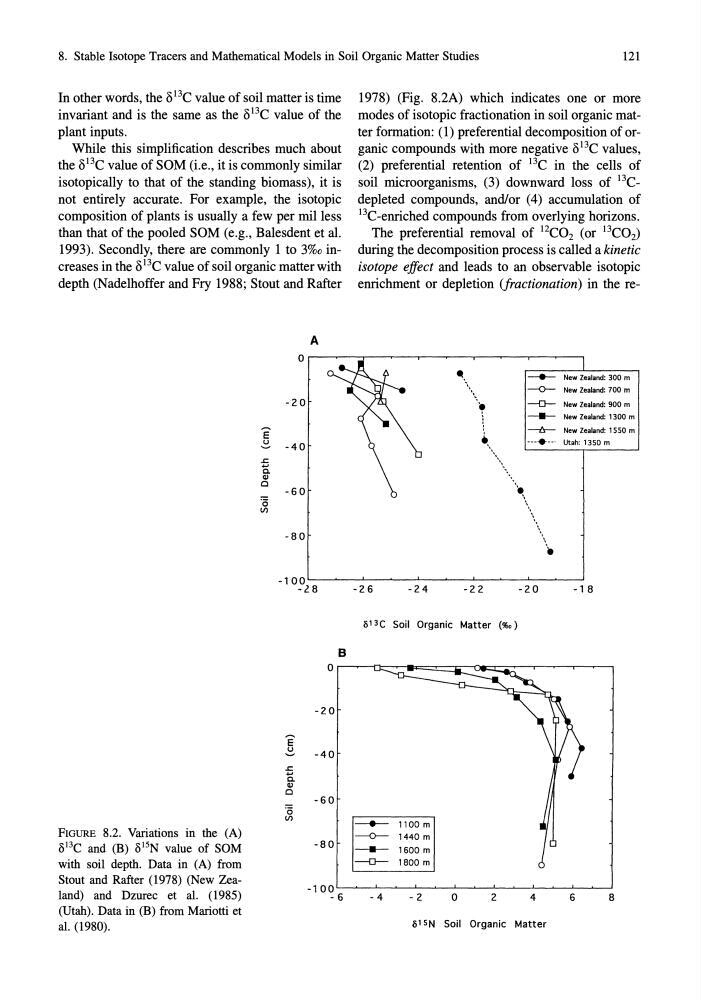
1993). Secondly, there are commonly 1 to 3%0 increases in the Ol3C value of soil organic matter with
depth (Nadelhoffer and Fry 1988; Stout and Rafter
A
0
-20
E
~
-40
.s:: ..,
C.
Q)
Q
- 6 0
'0
Vl
- 80
-100
-l8
B
0
- 2 0
E
~
-40
.s:: ..,
c.
Q)
Q
- 6 0
'0
Vl
FIGURE 8.2. Variations in the (A)
/i l3 e and (B) /i 15 N value of SOM
-80
with soil depth. Data in (A) from
Stout and Rafter (1978) (New Zea-100
land) and Dzurec et al. (1985)
- 6
(Utah). Data in (B) from Mariotti et
al. (1980).
1978) (Fig. 8.2A) which indicates one or more
modes of isotopic fractionation in soil organic matter formation: (1) preferential decomposition of organic compounds with more negative ol3C values,
(2) preferential retention of l3C in the cells of
soil microorganisms, (3) downward loss of l3C_
depleted compounds, and/or (4) accumulation of
l3C-enriched compounds from overlying horizons.
The preferential removal of 12C02 (or l3C02)
during the decomposition process is called a kinetic
isotope effect and leads to an observable isotopic
enrichment or depletion (fractionation) in the re~
~ New Zealand: 300 m
- 0 - New Zealand: 700 m
\
-D- New Zealand: 900 m
--New Zealand: 1300 m
---fr- New Zealand: 1550 m
., ._-.-., Utah: '350 m
~,
\
\
\ ' .
- 2 6
- 2 4
- 2 2
- 2 0
-1 8
Il 13 C Soil Organic Matter (%,)
-.- 1100 m
- - 0 - 1440 m
---1600 m
- - 0 - 1800 m
- 4
- 2
0
2
4
6
8
1l'5N Soil Organic Matter
121
In other words, the ol3C value of soil matter is time
invariant and is the same as the Ol3C value of the
plant inputs.
While this simplification describes much about
the ol3C value of SOM (i.e., it is commonly similar
isotopically to that of the standing biomass), it is
not entirely accurate. For example, the isotopic
composition of plants is usually a few per mil less
than that of the pooled SOM (e.g., Balesdent et al.
1993). Secondly, there are commonly 1 to 3%0 increases in the Ol3C value of soil organic matter with
depth (Nadelhoffer and Fry 1988; Stout and Rafter
A
0
-20
E
~
-40
.s:: ..,
C.
Q)
Q
- 6 0
'0
Vl
- 80
-100
-l8
B
0
- 2 0
E
~
-40
.s:: ..,
c.
Q)
Q
- 6 0
'0
Vl
FIGURE 8.2. Variations in the (A)
/i l3 e and (B) /i 15 N value of SOM
-80
with soil depth. Data in (A) from
Stout and Rafter (1978) (New Zea-100
land) and Dzurec et al. (1985)
- 6
(Utah). Data in (B) from Mariotti et
al. (1980).
1978) (Fig. 8.2A) which indicates one or more
modes of isotopic fractionation in soil organic matter formation: (1) preferential decomposition of organic compounds with more negative ol3C values,
(2) preferential retention of l3C in the cells of
soil microorganisms, (3) downward loss of l3C_
depleted compounds, and/or (4) accumulation of
l3C-enriched compounds from overlying horizons.
The preferential removal of 12C02 (or l3C02)
during the decomposition process is called a kinetic
isotope effect and leads to an observable isotopic
enrichment or depletion (fractionation) in the re~
~ New Zealand: 300 m
- 0 - New Zealand: 700 m
\
-D- New Zealand: 900 m
--New Zealand: 1300 m
---fr- New Zealand: 1550 m
., ._-.-., Utah: '350 m
~,
\
\
\ ' .
- 2 6
- 2 4
- 2 2
- 2 0
-1 8
Il 13 C Soil Organic Matter (%,)
-.- 1100 m
- - 0 - 1440 m
---1600 m
- - 0 - 1800 m
- 4
- 2
0
2
4
6
8
1l'5N Soil Organic Matter