

Fish and Bioindicators in the Pontine Lakes
69
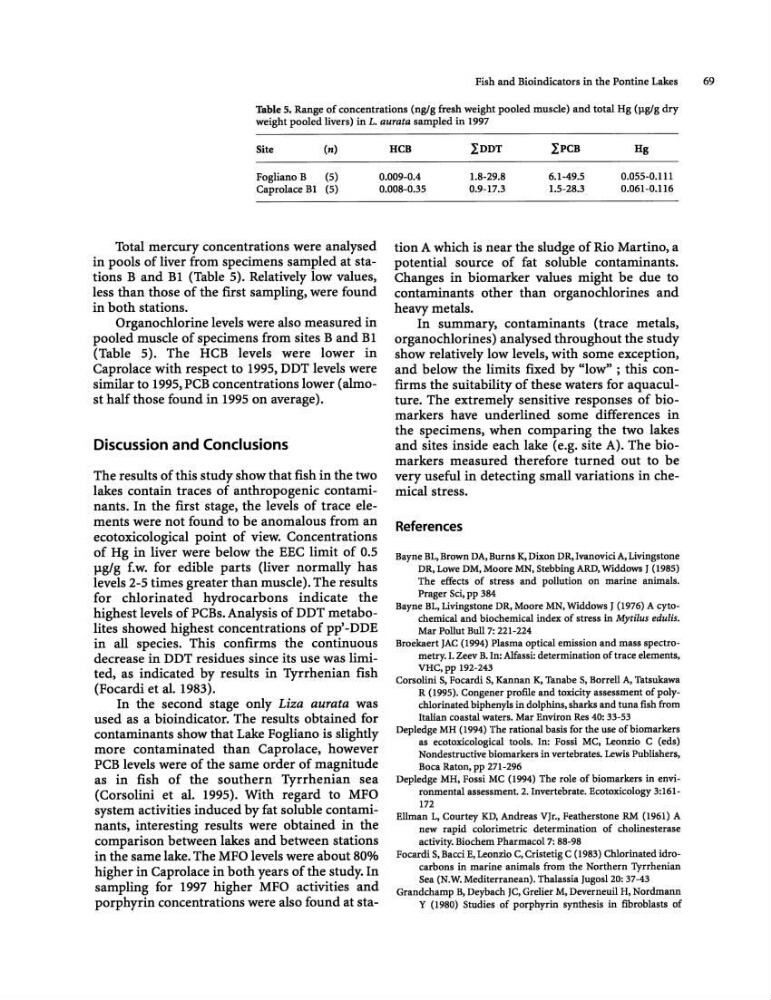
Table 5. Range of concentrations (ng/g fresh weight pooled muscle) and total Hg (JIgfg dry
weight pooled livers) in L. aurata sampled in 1997
Site
(n)
Fogliano B
(5)
Caprolace Bl (5)
Total mercury concentrations were analysed
in pools of liver from specimens sampled at stations Band Bl (Table 5). Relatively low values,
less than those of the first sampling, were found
in both stations.
Organochlorine levels were also measured in
pooled muscle of specimens from sites Band B 1
(Table 5), The HCB levels were lower in
Caprolace with respect to 1995, DDT levels were
similar to 1995, PCB concentrations lower (almost half those found in 1995 on average).
Discussion and Conclusions
The results of this study show that fish in the two
lakes contain traces of anthropogenic contaminants. In the first stage, the levels of trace elements were not found to be anomalous from an
ecotoxicological point of view. Concentrations
of Hg in liver were below the EEC limit of 0.5
llg/g f.w. for edible parts (liver normally has
levels 2-5 times greater than muscle). The results
for chlorinated hydrocarbons indicate the
highest levels of PCBs. Analysis of DDT metabolites showed highest concentrations of pp' -DDE
in all species. This confirms the continuous
decrease in DDT residues since its use was limited, as indicated by results in Tyrrhenian fish
(Focardi et aI. 1983).
In the second stage only Liza aurata was
used as a bioindicator. The results obtained for
contaminants show that Lake Fogliano is slightly
more contaminated than Caprolace, however
PCB levels were of the same order of magnitude
as in fish of the southern Tyrrhenian sea
(Corsolini et aI. 1995). With regard to MFO
system activities induced by fat soluble contaminants, interesting results were obtained in the
comparison between lakes and between stations
in the same lake. The MFO levels were about 80%
higher in Caprolace in both years of the study. In
sampling for 1997 higher MFO activities and
porphyrin concentrations were also found at staBCB
0.009-0.4
0.008-0.35
lDDT
1.8-29.8
0.9-17.3
!PCB
6.1-49.5
1.5-28.3
Bg
0.055-0.111
0.061-0.116
tion A which is near the sludge of Rio Martino, a
potential source of fat soluble contaminants.
Changes in biomarker values might be due to
contaminants other than organochlorines and
heavy metals.
In summary, contaminants (trace metals,
organochlorines) analysed throughout the study
show relatively low levels, with some exception,
and below the limits fixed by "low" ; this conftrms the suitability of these waters for aquaculture. The extremely sensitive responses of biomarkers have underlined some differences in
the specimens, when comparing the two lakes
and sites inside each lake (e.g. site A). The biomarkers measured therefore turned out to be
very useful in detecting small variations in chemical stress.
References
Bayne BL,Brown DA. Burns K, Dixon DR, lvanovici A. Livingstone
DR, Lowe DM, Moore MN, Stebbing ARD, WiddOWll J (1985)
The effects of stress and pollution on marine animals.
Prager Sd, pp 384
Bayne BL, Livingstone DR, Moore MN, Widdows J (1976) A cytochemical and biochemical index of stress in Mytilus edulis.
Mar Pouut Bull 7: 221-224
Broekaert lAC (1994) Plasma optical emission and mass spectrometry. 1. Zeev B.ln: Alfassi: determination of trace elements,
VHC, pp 192-243
Corsolini S, Focardi S, Kannan K, Tanabe S, Borrell A. Tatsukawa
R (1995). Congener profile and toxicity assessment of polychlorinated biphenyls in dolphins, sharks and tuna fish from
Italian coastal waters. Mar Environ Res 40: 33-53
Depledge MH (1994) The rational basis for th.e use of biomarkers
as ecotoxicological tools. In: Fossi MC, Leonzio C Ceds}
Nondestructive biomarkers in vertebrates. Lewis Publishers,
Boca Raton, pp 271-296
Depledge MH, Possi MC (1994) The role of biomarkers in environmental assessment. 2. Invertebrate. Ecotoxicology 3:161172
Ellman 1, Courtey KD, Andreas VJr., Featherstone RM (1961) A
new rapid colorimetric determination of cholinesterase
activity. Biochem Pharmacal 7: 88-98
Focardi S, Bacci E, Leonzio C, Cristetig C (1983) Chlorinated idrocarbons in marine animals from the Northern Tyrrhenian
Sea (N.W. Mediterranean). Thalassia Jugos120: 37-43
Grandchamp B. Deybach JC, Greller M, Deverneuil H. Nordmann
Y (1980) Studies of porphyrin synthesis in fibroblasts of
69
Table 5. Range of concentrations (ng/g fresh weight pooled muscle) and total Hg (JIgfg dry
weight pooled livers) in L. aurata sampled in 1997
Site
(n)
Fogliano B
(5)
Caprolace Bl (5)
Total mercury concentrations were analysed
in pools of liver from specimens sampled at stations Band Bl (Table 5). Relatively low values,
less than those of the first sampling, were found
in both stations.
Organochlorine levels were also measured in
pooled muscle of specimens from sites Band B 1
(Table 5), The HCB levels were lower in
Caprolace with respect to 1995, DDT levels were
similar to 1995, PCB concentrations lower (almost half those found in 1995 on average).
Discussion and Conclusions
The results of this study show that fish in the two
lakes contain traces of anthropogenic contaminants. In the first stage, the levels of trace elements were not found to be anomalous from an
ecotoxicological point of view. Concentrations
of Hg in liver were below the EEC limit of 0.5
llg/g f.w. for edible parts (liver normally has
levels 2-5 times greater than muscle). The results
for chlorinated hydrocarbons indicate the
highest levels of PCBs. Analysis of DDT metabolites showed highest concentrations of pp' -DDE
in all species. This confirms the continuous
decrease in DDT residues since its use was limited, as indicated by results in Tyrrhenian fish
(Focardi et aI. 1983).
In the second stage only Liza aurata was
used as a bioindicator. The results obtained for
contaminants show that Lake Fogliano is slightly
more contaminated than Caprolace, however
PCB levels were of the same order of magnitude
as in fish of the southern Tyrrhenian sea
(Corsolini et aI. 1995). With regard to MFO
system activities induced by fat soluble contaminants, interesting results were obtained in the
comparison between lakes and between stations
in the same lake. The MFO levels were about 80%
higher in Caprolace in both years of the study. In
sampling for 1997 higher MFO activities and
porphyrin concentrations were also found at staBCB
0.009-0.4
0.008-0.35
lDDT
1.8-29.8
0.9-17.3
!PCB
6.1-49.5
1.5-28.3
Bg
0.055-0.111
0.061-0.116
tion A which is near the sludge of Rio Martino, a
potential source of fat soluble contaminants.
Changes in biomarker values might be due to
contaminants other than organochlorines and
heavy metals.
In summary, contaminants (trace metals,
organochlorines) analysed throughout the study
show relatively low levels, with some exception,
and below the limits fixed by "low" ; this conftrms the suitability of these waters for aquaculture. The extremely sensitive responses of biomarkers have underlined some differences in
the specimens, when comparing the two lakes
and sites inside each lake (e.g. site A). The biomarkers measured therefore turned out to be
very useful in detecting small variations in chemical stress.
References
Bayne BL,Brown DA. Burns K, Dixon DR, lvanovici A. Livingstone
DR, Lowe DM, Moore MN, Stebbing ARD, WiddOWll J (1985)
The effects of stress and pollution on marine animals.
Prager Sd, pp 384
Bayne BL, Livingstone DR, Moore MN, Widdows J (1976) A cytochemical and biochemical index of stress in Mytilus edulis.
Mar Pouut Bull 7: 221-224
Broekaert lAC (1994) Plasma optical emission and mass spectrometry. 1. Zeev B.ln: Alfassi: determination of trace elements,
VHC, pp 192-243
Corsolini S, Focardi S, Kannan K, Tanabe S, Borrell A. Tatsukawa
R (1995). Congener profile and toxicity assessment of polychlorinated biphenyls in dolphins, sharks and tuna fish from
Italian coastal waters. Mar Environ Res 40: 33-53
Depledge MH (1994) The rational basis for th.e use of biomarkers
as ecotoxicological tools. In: Fossi MC, Leonzio C Ceds}
Nondestructive biomarkers in vertebrates. Lewis Publishers,
Boca Raton, pp 271-296
Depledge MH, Possi MC (1994) The role of biomarkers in environmental assessment. 2. Invertebrate. Ecotoxicology 3:161172
Ellman 1, Courtey KD, Andreas VJr., Featherstone RM (1961) A
new rapid colorimetric determination of cholinesterase
activity. Biochem Pharmacal 7: 88-98
Focardi S, Bacci E, Leonzio C, Cristetig C (1983) Chlorinated idrocarbons in marine animals from the Northern Tyrrhenian
Sea (N.W. Mediterranean). Thalassia Jugos120: 37-43
Grandchamp B. Deybach JC, Greller M, Deverneuil H. Nordmann
Y (1980) Studies of porphyrin synthesis in fibroblasts of