

a
c
Spring ' 95: Rimini Transect
W
Salinily
E
801 802 B03 804 B05 806 B07 808 B09 B10 BII B12
o~~~~~~~--~~--~--~~--~-+o
~6· "r
37.9
20
40
L)' J~o
,
, .
o 10 20 30 40 50 50 70 eo 90 100
Distance (kin)
Aulumn '95: Rimini Transect
W
Salinily
E
20
40
BOI
803 804 805 B06 B07 B08 B09 Bl0 B11 812
o
0
.J"
/0- 3-7' .,
8
.J
!>7,
20
20
38./
J8.0
40
40
60 f--....---,...--..,.....--,...-."'-T--"""T""--..,.....--r-----,.--..L60
o 10 20 30 40 50 50 70 80 90
Distance (kin)
Seasonal Variability of the Adriatic Sea Hydrography
49
Summer ' 95: Rimini Transect
b
W
Salinily
E
801 802 803 804 805 806 807 B08 B09 B10 811 812
o
..L
0
20
40
-;'0.'
3 6.<
-:.Y
~1.4
20
Jl. 6
378
W
20
30
40
50
60
ro 50 90 100
D,stance (km)
Winter '96: Rimini Transect
W
Salini ty
E
40
d
BOI
B03 B04 B05 806 807 BOO B09 Bl0 811 812
O+-~_rL--L--7-~--~~--~--~--L--r O
20
2(1
40
4(1
50
10
20
30
40
50
60
70
50
90
100
Distance I~m)
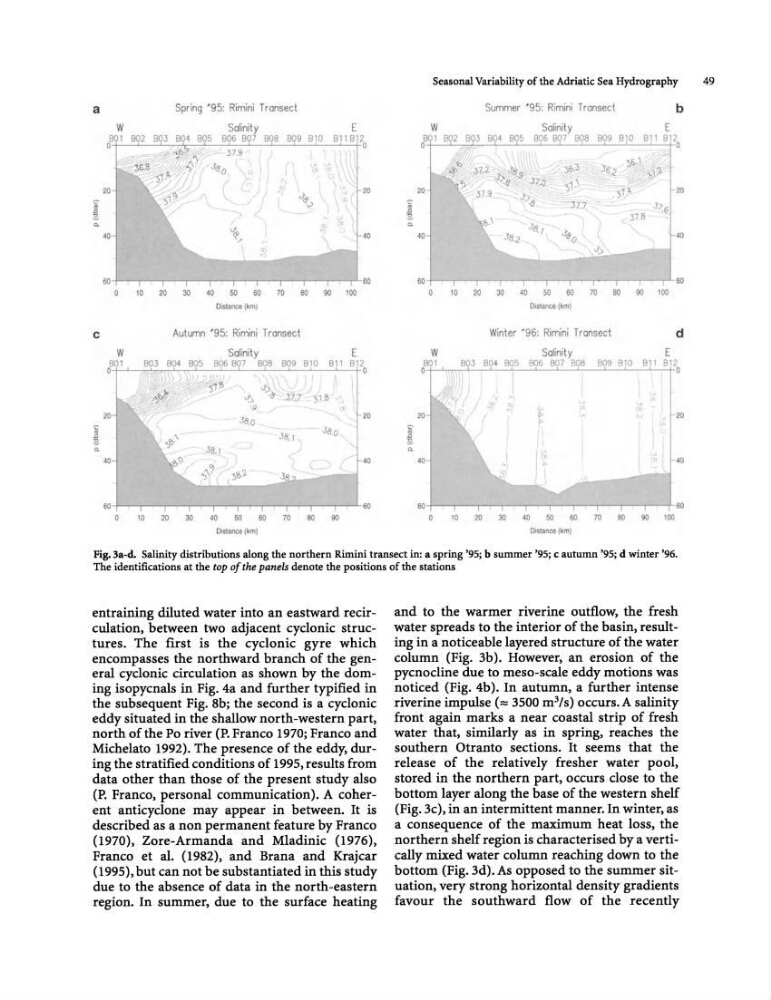
Fig.3a-d. Salinity distributions along the northern Rimini transect in: a spring '95; b summer '95; c autumn '95; d winter '96.
The identifications at the top of the panels denote the positions of the stations
entraining diluted water into an eastward recirculation, between two adjacent cyclonic structures. The first is the cyclonic gyre which
encompasses the northward branch of the general cyclonic circulation as shown by the doming isopycnals in Fig. 4a and further typified in
the subsequent Fig. 8b; the second is a cyclonic
eddy situated in the shallow north-western part,
north of the Po river (P. Franco 1970; Franco and
Michelato 1992). The presence of the eddy, during the stratified conditions of 1995, results from
data other than those of the present study also
(P. Franco, personal communication). A coherent anticyclone may appear in between. It is
described as a non permanent feature by Franco
(1970), Zore-Armanda and Mladinic (1976),
Franco et al. (1982), and Brana and Krajcar
(1995), but can not be substantiated in this study
due to the absence of data in the north-eastern
region. In summer, due to the surface heating
and to the warmer riverine outflow, the fresh
water spreads to the interior of the basin, resulting in a noticeable layered structure of the water
column (Fig. 3b). However, an erosion of the
pycnocline due to meso-scale eddy motions was
noticed (Fig. 4b). In autumn, a further intense
riverine impulse (::::: 3500 m 3 /s) occurs. A salinity
front again marks a near coastal strip of fresh
water that, similarly as in spring, reaches the
southern Otranto sections. It seems that the
release of the relatively fresher water pool,
stored in the northern part, occurs close to the
bottom layer along the base of the western shelf
(Fig. 3c), in an intermittent manner. In winter, as
a consequence of the maximum heat loss, the
northern shelf region is characterised by a vertically mixed water column reaching down to the
bottom (Fig. 3d). As opposed to the summer situation, very strong horizontal density gradients
favour the southward flow of the recently
c
Spring ' 95: Rimini Transect
W
Salinily
E
801 802 B03 804 B05 806 B07 808 B09 B10 BII B12
o~~~~~~~--~~--~--~~--~-+o
~6· "r
37.9
20
40
L)' J~o
,
, .
o 10 20 30 40 50 50 70 eo 90 100
Distance (kin)
Aulumn '95: Rimini Transect
W
Salinily
E
20
40
BOI
803 804 805 B06 B07 B08 B09 Bl0 B11 812
o
0
.J"
/0- 3-7' .,
8
.J
!>7,
20
20
38./
J8.0
40
40
60 f--....---,...--..,.....--,...-."'-T--"""T""--..,.....--r-----,.--..L60
o 10 20 30 40 50 50 70 80 90
Distance (kin)
Seasonal Variability of the Adriatic Sea Hydrography
49
Summer ' 95: Rimini Transect
b
W
Salinily
E
801 802 803 804 805 806 807 B08 B09 B10 811 812
o
..L
0
20
40
-;'0.'
3 6.<
-:.Y
~1.4
20
Jl. 6
378
W
20
30
40
50
60
ro 50 90 100
D,stance (km)
Winter '96: Rimini Transect
W
Salini ty
E
40
d
BOI
B03 B04 B05 806 807 BOO B09 Bl0 811 812
O+-~_rL--L--7-~--~~--~--~--L--r O
20
2(1
40
4(1
50
10
20
30
40
50
60
70
50
90
100
Distance I~m)
Fig.3a-d. Salinity distributions along the northern Rimini transect in: a spring '95; b summer '95; c autumn '95; d winter '96.
The identifications at the top of the panels denote the positions of the stations
entraining diluted water into an eastward recirculation, between two adjacent cyclonic structures. The first is the cyclonic gyre which
encompasses the northward branch of the general cyclonic circulation as shown by the doming isopycnals in Fig. 4a and further typified in
the subsequent Fig. 8b; the second is a cyclonic
eddy situated in the shallow north-western part,
north of the Po river (P. Franco 1970; Franco and
Michelato 1992). The presence of the eddy, during the stratified conditions of 1995, results from
data other than those of the present study also
(P. Franco, personal communication). A coherent anticyclone may appear in between. It is
described as a non permanent feature by Franco
(1970), Zore-Armanda and Mladinic (1976),
Franco et al. (1982), and Brana and Krajcar
(1995), but can not be substantiated in this study
due to the absence of data in the north-eastern
region. In summer, due to the surface heating
and to the warmer riverine outflow, the fresh
water spreads to the interior of the basin, resulting in a noticeable layered structure of the water
column (Fig. 3b). However, an erosion of the
pycnocline due to meso-scale eddy motions was
noticed (Fig. 4b). In autumn, a further intense
riverine impulse (::::: 3500 m 3 /s) occurs. A salinity
front again marks a near coastal strip of fresh
water that, similarly as in spring, reaches the
southern Otranto sections. It seems that the
release of the relatively fresher water pool,
stored in the northern part, occurs close to the
bottom layer along the base of the western shelf
(Fig. 3c), in an intermittent manner. In winter, as
a consequence of the maximum heat loss, the
northern shelf region is characterised by a vertically mixed water column reaching down to the
bottom (Fig. 3d). As opposed to the summer situation, very strong horizontal density gradients
favour the southward flow of the recently