

492
R. La Ferla et al.
70
60
a.
50
0
40
.D
"a
E 30
!';l
20
10
0
60
50
40
a.
,g 30
"a
E 20
!';l
10
o
-
Jun-96
-
j un-96
-
n
feb·97
jun-97
.---n
feb -97
jun-97
A Area
0_8
0.7
.---0.6
-!::: 0.5
a. (,) 0_ 4
J:J
0.3
0.2
0. 1
0.0
fe b-98
jun-96
feb-97
l un-97
feb-98
B Area
0 .9
-
0 _8
0.7
0,6
'- 0.5
-- Cl. OA
(,)
.c 0. 3
0.2
0.1
0,0
feb-98
jun-96
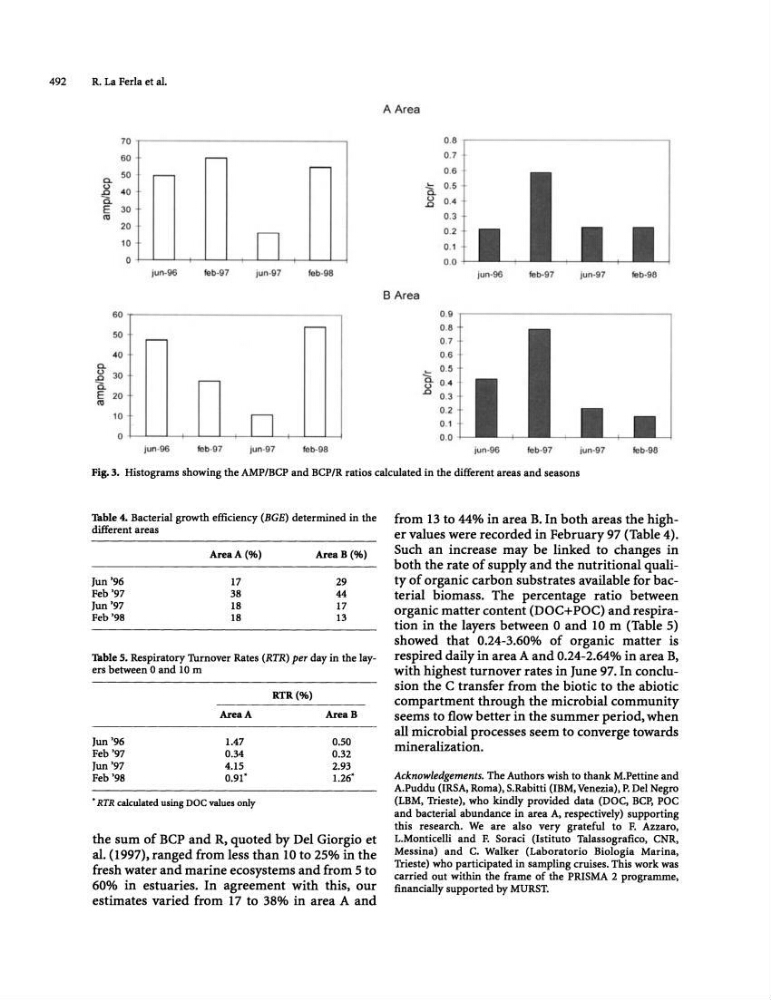
Fig.3. Histograms showing the AMP/BCP and BCP/R ratios calculated in the different areas and seasons
Table 4. Bacterial growth efficiency (BGE) determined in the
different areas
Area A (%)
AreaB (%)
Iun '96
17
29
Feb'97
38
44
Iun '97
18
17
Feb '98
18
13
Table 5. Respiratory lUrnover Rates (RTR) per day in the layers between 0 and 10m
RTR(%)
Area A
AreaB
Iun '96
1.47
0.50
Feb'97
0.34
0.32
Iun '97
4.15
2.93
Feb '98
0.91"
1.26"
• RTR calculated using DOC values only
the sum of BCP and R, quoted by Del Giorgio et
al. (1997), ranged from less than 10 to 25% in the
fresh water and marine ecosystems and from 5 to
60% in estuaries. In agreement with this, our
estimates varied from 17 to 38% in area A and
from 13 to 44% in area B. In both areas the higher values were recorded in February 97 (Table 4).
Such an increase may be linked to changes in
both the rate of supply and the nutritional quality of organic carbon substrates available for bacterial biomass. The percentage ratio between
organic matter content (DOC+ POC) and respiration in the layers between 0 and 10 m (Table 5)
showed that 0.24-3.60% of organic matter is
respired daily in area A and 0.24-2.64% in area B,
with highest turnover rates in June 97. In conclusion the C transfer from the biotic to the abiotic
compartment through the microbial community
seems to flow better in the summer period, when
all microbial processes seem to converge towards
mineralization.
Acknowledgements. The Authors wish to thank M.Pettine and
A.Puddu (IRSA, Roma), S.Rabitti (IBM, Venezia), P. Del Negro
(LBM, Trieste), who kindly provided data (DOC, BCP, POC
and bacterial abundance in area A, respectively) supporting
this research. We are also very grateful to F. Azzaro,
L.Monticelli and F. Soraci (Istituto Talassografico, CNR,
Messina) and C_ Walker (Laboratorio Biologia Marina,
Trieste) who participated in sampling cruises. This work was
carried out within the frame of the PRISMA 2 programme,
financially supported by MURST.
R. La Ferla et al.
70
60
a.
50
0
40
.D
"a
E 30
!';l
20
10
0
60
50
40
a.
,g 30
"a
E 20
!';l
10
o
-
Jun-96
-
j un-96
-
n
feb·97
jun-97
.---n
feb -97
jun-97
A Area
0_8
0.7
.---0.6
-!::: 0.5
a. (,) 0_ 4
J:J
0.3
0.2
0. 1
0.0
fe b-98
jun-96
feb-97
l un-97
feb-98
B Area
0 .9
-
0 _8
0.7
0,6
'- 0.5
-- Cl. OA
(,)
.c 0. 3
0.2
0.1
0,0
feb-98
jun-96
Fig.3. Histograms showing the AMP/BCP and BCP/R ratios calculated in the different areas and seasons
Table 4. Bacterial growth efficiency (BGE) determined in the
different areas
Area A (%)
AreaB (%)
Iun '96
17
29
Feb'97
38
44
Iun '97
18
17
Feb '98
18
13
Table 5. Respiratory lUrnover Rates (RTR) per day in the layers between 0 and 10m
RTR(%)
Area A
AreaB
Iun '96
1.47
0.50
Feb'97
0.34
0.32
Iun '97
4.15
2.93
Feb '98
0.91"
1.26"
• RTR calculated using DOC values only
the sum of BCP and R, quoted by Del Giorgio et
al. (1997), ranged from less than 10 to 25% in the
fresh water and marine ecosystems and from 5 to
60% in estuaries. In agreement with this, our
estimates varied from 17 to 38% in area A and
from 13 to 44% in area B. In both areas the higher values were recorded in February 97 (Table 4).
Such an increase may be linked to changes in
both the rate of supply and the nutritional quality of organic carbon substrates available for bacterial biomass. The percentage ratio between
organic matter content (DOC+ POC) and respiration in the layers between 0 and 10 m (Table 5)
showed that 0.24-3.60% of organic matter is
respired daily in area A and 0.24-2.64% in area B,
with highest turnover rates in June 97. In conclusion the C transfer from the biotic to the abiotic
compartment through the microbial community
seems to flow better in the summer period, when
all microbial processes seem to converge towards
mineralization.
Acknowledgements. The Authors wish to thank M.Pettine and
A.Puddu (IRSA, Roma), S.Rabitti (IBM, Venezia), P. Del Negro
(LBM, Trieste), who kindly provided data (DOC, BCP, POC
and bacterial abundance in area A, respectively) supporting
this research. We are also very grateful to F. Azzaro,
L.Monticelli and F. Soraci (Istituto Talassografico, CNR,
Messina) and C_ Walker (Laboratorio Biologia Marina,
Trieste) who participated in sampling cruises. This work was
carried out within the frame of the PRISMA 2 programme,
financially supported by MURST.