

Suspended and Sedimentary Organic Matter in the Northern Adriatic
453
a
Water
Water
b
15%
32%
38%
EY:~
25%
60%
EQ
30%
a
sediment
b
Sediment
' ES?I ~
16%
8%8=~~
78%
76%
o Proteins
o Carbohydrates
D Lipids
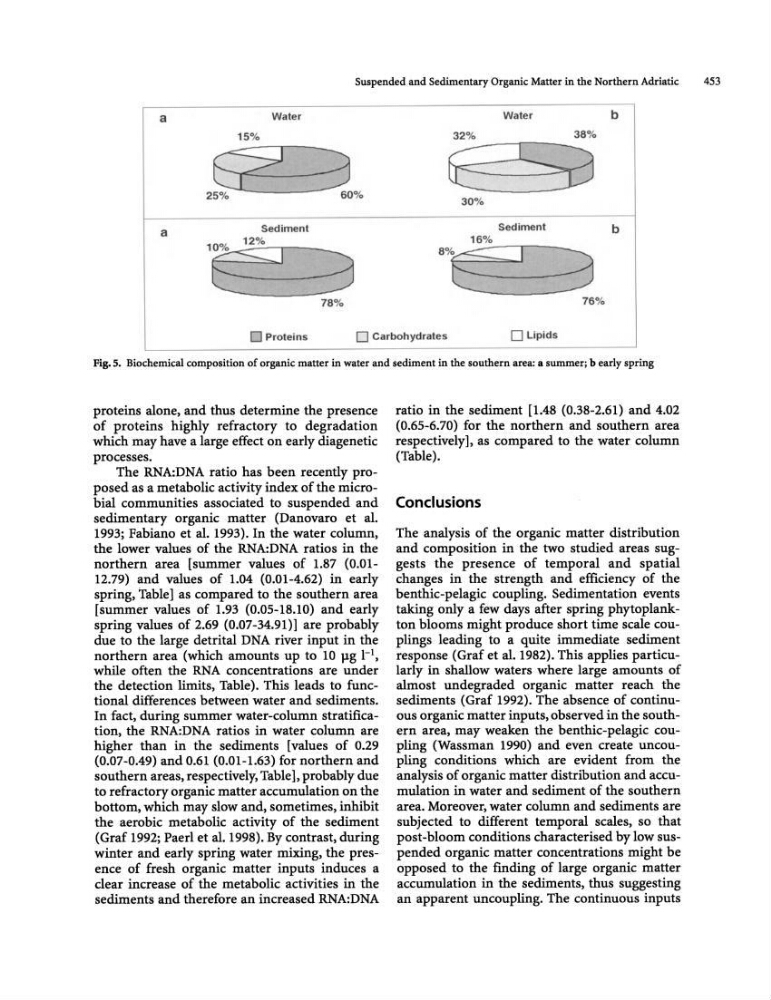
Fig. 5. Biochemical composition of organic matter in water and sediment in the southern area: a summer; b early spring
proteins alone, and thus determine the presence
of proteins highly refractory to degradation
which may have a large effect on early diagenetic
processes.
The RNA:DNA ratio has been recently proposed as a metabolic activity index of the microbial communities associated to suspended and
sedimentary organic matter (Danovaro et al.
1993; Fabiano et al. 1993). In the water column,
the lower values of the RNA:DNA ratios in the
northern area [summer values of 1.87 (0.01l2.79) and values of 1.04 (0.01-4.62) in early
spring, Table] as compared to the southern area
[summer values of 1.93 (0.05-18.10) and early
spring values of 2.69 (0.07-34.91)] are probably
due to the large detrital DNA river input in the
northern area (which amounts up to 10 }lg 1-1,
while often the RNA concentrations are under
the detection limits, Table). This leads to functional differences between water and sediments.
In fact, during summer water-column stratification, the RNA:DNA ratios in water column are
higher than in the sediments [values of 0.29
(0.07-0.49) and 0.61 (0.01-1.63) for northern and
southern areas, respectively, Table], probably due
to refractory organic matter accumulation on the
bottom, which may slow and, sometimes, inhibit
the aerobic metabolic activity of the sediment
(Graf 1992; Paerl et al. 1998). By contrast, during
winter and early spring water mixing, the presence of fresh organic matter inputs induces a
clear increase of the metabolic activities in the
sediments and therefore an increased RNA:DNA
ratio in the sediment [1.48 (0.38-2.61) and 4.02
(0.65-6.70) for the northern and southern area
respectively], as compared to the water column
(Table).
Conclusions
The analysis of the organic matter distribution
and composition in the two studied areas suggests the presence of temporal and spatial
changes in the strength and efficiency of the
benthic-pelagic coupling. Sedimentation events
taking only a few days after spring phytoplankton blooms might produce short time scale couplings leading to a quite immediate sediment
response (Graf et al. 1982). This applies particularly in shallow waters where large amounts of
almost undegraded organic matter reach the
sediments (Graf 1992). The absence of continuous organic matter inputs, observed in the southern area, may weaken the benthic-pelagic coupling (Wassman 1990) and even create uncoupling conditions which are evident from the
analysis of organic matter distribution and accumulation in water and sediment of the southern
area. Moreover, water column and sediments are
subjected to different temporal scales, so that
post-bloom conditions characterised by low suspended organic matter concentrations might be
opposed to the finding of large organic matter
accumulation in the sediments, thus suggesting
an apparent uncoupling. The continuous inputs
453
a
Water
Water
b
15%
32%
38%
EY:~
25%
60%
EQ
30%
a
sediment
b
Sediment
' ES?I ~
16%
8%8=~~
78%
76%
o Proteins
o Carbohydrates
D Lipids
Fig. 5. Biochemical composition of organic matter in water and sediment in the southern area: a summer; b early spring
proteins alone, and thus determine the presence
of proteins highly refractory to degradation
which may have a large effect on early diagenetic
processes.
The RNA:DNA ratio has been recently proposed as a metabolic activity index of the microbial communities associated to suspended and
sedimentary organic matter (Danovaro et al.
1993; Fabiano et al. 1993). In the water column,
the lower values of the RNA:DNA ratios in the
northern area [summer values of 1.87 (0.01l2.79) and values of 1.04 (0.01-4.62) in early
spring, Table] as compared to the southern area
[summer values of 1.93 (0.05-18.10) and early
spring values of 2.69 (0.07-34.91)] are probably
due to the large detrital DNA river input in the
northern area (which amounts up to 10 }lg 1-1,
while often the RNA concentrations are under
the detection limits, Table). This leads to functional differences between water and sediments.
In fact, during summer water-column stratification, the RNA:DNA ratios in water column are
higher than in the sediments [values of 0.29
(0.07-0.49) and 0.61 (0.01-1.63) for northern and
southern areas, respectively, Table], probably due
to refractory organic matter accumulation on the
bottom, which may slow and, sometimes, inhibit
the aerobic metabolic activity of the sediment
(Graf 1992; Paerl et al. 1998). By contrast, during
winter and early spring water mixing, the presence of fresh organic matter inputs induces a
clear increase of the metabolic activities in the
sediments and therefore an increased RNA:DNA
ratio in the sediment [1.48 (0.38-2.61) and 4.02
(0.65-6.70) for the northern and southern area
respectively], as compared to the water column
(Table).
Conclusions
The analysis of the organic matter distribution
and composition in the two studied areas suggests the presence of temporal and spatial
changes in the strength and efficiency of the
benthic-pelagic coupling. Sedimentation events
taking only a few days after spring phytoplankton blooms might produce short time scale couplings leading to a quite immediate sediment
response (Graf et al. 1982). This applies particularly in shallow waters where large amounts of
almost undegraded organic matter reach the
sediments (Graf 1992). The absence of continuous organic matter inputs, observed in the southern area, may weaken the benthic-pelagic coupling (Wassman 1990) and even create uncoupling conditions which are evident from the
analysis of organic matter distribution and accumulation in water and sediment of the southern
area. Moreover, water column and sediments are
subjected to different temporal scales, so that
post-bloom conditions characterised by low suspended organic matter concentrations might be
opposed to the finding of large organic matter
accumulation in the sediments, thus suggesting
an apparent uncoupling. The continuous inputs