

depth (mean= 131 shootslm 2 ). No other data on
temporal colonisation of polychaete borers can
be compared with these results. However, the
temporal analysis pointed out a certain degree of
variability in borer abundance and colonisation,
and the opportunity to sample at least on a seasonal basis better to assess the incidence of the
boring phenomenon in a specific Posidonia
meadow.
Boring of living leaf bases and leaf meristem
(with evident tissue necrosis and detachment of
the entire living shoot), and of the adjacent leaf
tissues were sometime observed (Fig. Ib). The
phenomenon of consumption of the living tissues was very limited in the shallow stations
(Castello and Laceo 3-5 m: mean index of herbivory= 0.6 and 0.8%, respectively), while it was
relatively more important in the deep site (Lacco
22 m: mean index of herbivory= 2.6%) (Gambi et
al. 2000). Direct herbivores of P. oceanica are
quite rare (Mazzella et al. 1992), and in regard to
polychaetes the only known species able to graze
on living Posidonia tissue is the nereidid
Platynereis dumerilii (Audouin and MilneEdwards) (Gambi and Di Meglio 1996; Gambi et
al. in press). However, the direct grazing of this
nereidid was observed only under experimental
Polychaete Borers of Posidonia oceanica Scales
403
laboratory conditions (Gambi and Di Meglio
1996). Thus, the two species of Lysidice borers of
the scales, represent the first documented polychaetes that graze on Posidonia in natural conditions.
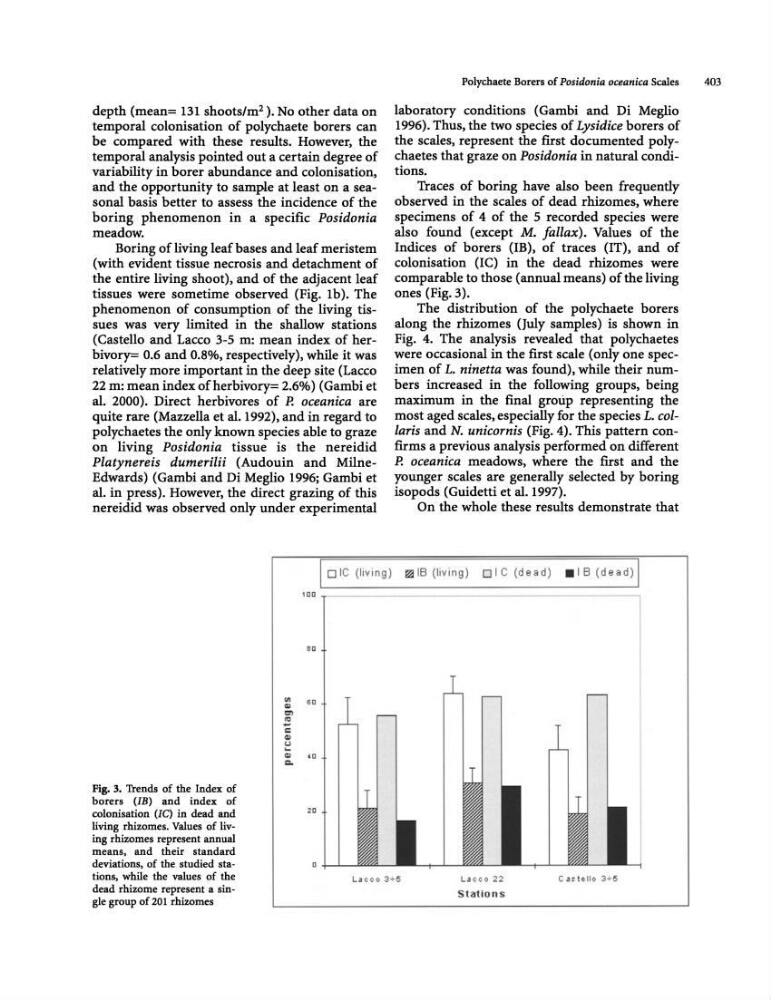
'Traces of boring have also been frequently
observed in the scales of dead rhizomes, where
specimens of 4 of the 5 recorded species were
also found (except M. fallax). Values of the
Indices of borers (IB), of traces (IT), and of
colonisation (IC) in the dead rhizomes were
comparable to those (annual means) of the living
ones (Fig. 3).
The distribution of the polychaete borers
along the rhizomes (July samples) is shown in
Fig. 4. The analysis revealed that polychaetes
were occasional in the first scale (only one specimen of L. ninetta was found), while their numbers increased in the following groups, being
maximum in the final group representing the
most aged scales, especially for the species L. collaris and N. unicornis (Fig. 4). This pattern confirms a previous analysis performed on different
P. oceanica meadows, where the first and the
younger scales are generally selected by boring
isopods (Guidetti et al. 1997).
On the whole these results demonstrate that
OIC( living) ~ IB( li ving) D IC(dead) . IB(dead)
' 00 , -________________________________________ - ,
6 0
'0
2D
Fig. 3. Trends of the Index of
borers (IB) and index of
colonisation (Ie) in dead and
living rhizomes. Values of living rhizomes represent annual
means, and their standard
deviations, of the studied stations, while the values of the
dead rhizome represent a single group of 201 rhizomes
Laeeo 3+5
L deco 22
Castello 3.;. 5
Statio n s
temporal colonisation of polychaete borers can
be compared with these results. However, the
temporal analysis pointed out a certain degree of
variability in borer abundance and colonisation,
and the opportunity to sample at least on a seasonal basis better to assess the incidence of the
boring phenomenon in a specific Posidonia
meadow.
Boring of living leaf bases and leaf meristem
(with evident tissue necrosis and detachment of
the entire living shoot), and of the adjacent leaf
tissues were sometime observed (Fig. Ib). The
phenomenon of consumption of the living tissues was very limited in the shallow stations
(Castello and Laceo 3-5 m: mean index of herbivory= 0.6 and 0.8%, respectively), while it was
relatively more important in the deep site (Lacco
22 m: mean index of herbivory= 2.6%) (Gambi et
al. 2000). Direct herbivores of P. oceanica are
quite rare (Mazzella et al. 1992), and in regard to
polychaetes the only known species able to graze
on living Posidonia tissue is the nereidid
Platynereis dumerilii (Audouin and MilneEdwards) (Gambi and Di Meglio 1996; Gambi et
al. in press). However, the direct grazing of this
nereidid was observed only under experimental
Polychaete Borers of Posidonia oceanica Scales
403
laboratory conditions (Gambi and Di Meglio
1996). Thus, the two species of Lysidice borers of
the scales, represent the first documented polychaetes that graze on Posidonia in natural conditions.
'Traces of boring have also been frequently
observed in the scales of dead rhizomes, where
specimens of 4 of the 5 recorded species were
also found (except M. fallax). Values of the
Indices of borers (IB), of traces (IT), and of
colonisation (IC) in the dead rhizomes were
comparable to those (annual means) of the living
ones (Fig. 3).
The distribution of the polychaete borers
along the rhizomes (July samples) is shown in
Fig. 4. The analysis revealed that polychaetes
were occasional in the first scale (only one specimen of L. ninetta was found), while their numbers increased in the following groups, being
maximum in the final group representing the
most aged scales, especially for the species L. collaris and N. unicornis (Fig. 4). This pattern confirms a previous analysis performed on different
P. oceanica meadows, where the first and the
younger scales are generally selected by boring
isopods (Guidetti et al. 1997).
On the whole these results demonstrate that
OIC( living) ~ IB( li ving) D IC(dead) . IB(dead)
' 00 , -________________________________________ - ,
6 0
'0
2D
Fig. 3. Trends of the Index of
borers (IB) and index of
colonisation (Ie) in dead and
living rhizomes. Values of living rhizomes represent annual
means, and their standard
deviations, of the studied stations, while the values of the
dead rhizome represent a single group of 201 rhizomes
Laeeo 3+5
L deco 22
Castello 3.;. 5
Statio n s