

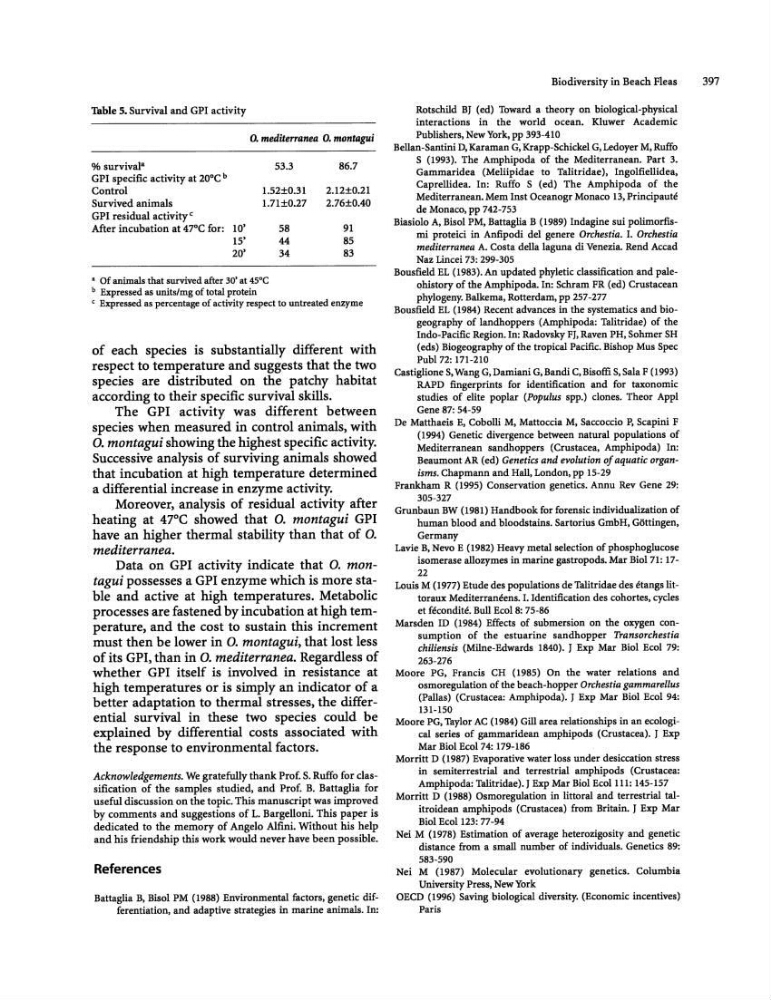
Table 5. Survival and GPI activity
O. mediterranea O. montagui
% survival 4
53.3
GPI specific activity at 20°C b
Control
1.52±0.31
Survived animals
1.71±O.27
GPI residual activity"
After incubation at 47°C for: 10'
58
15'
44
20'
34
• Of animals that survived after 30' at 4S°C
b Expressed as units/mg of total protein
86.7
2.12±O.21
2.76±0.40
91
85
83
C Expressed as percentage of activity respect to untreated enzyme
of each species is substantially different with
respect to temperature and suggests that the two
species are distributed on the patchy habitat
according to their specific survival skills.
The GPI activity was different between
species when measured in control animals, with
O. montagui showing the highest specific activity.
Successive analysis of surviving animals showed
that incubation at high temperature determined
a differential increase in enzyme activity.
Moreover, analysis of residual activity after
heating at 47°C showed that O. montagui GPI
have an higher thermal stability than that of o.
mediterranea.
Data on GPI activity indicate that O. montagui possesses a GPI enzyme which is more stable and active at high temperatures. Metabolic
processes are fastened by incubation at high temperature, and the cost to sustain this increment
must then be lower in O. montagui, that lost less
of its GPI, than in O. mediterranea. Regardless of
whether GPI itself is involved in resistance at
high temperatures or is simply an indicator of a
better adaptation to thermal stresses, the differential survival in these two species could be
explained by differential costs associated with
the response to environmental factors.
Acknowledgements. We gratefully thank Prof. S. Ruffo for classification of the samples studied, and Prof. B. Battaglia for
useful discussion on the topic. This manuscript was improved
by comments and suggestions of L. Bargelloni. This paper is
dedicated to the memory of Angelo Alfini. Without his help
and his friendship this work would never have been possible.
References
Battaglia B, Bisol PM (1988) Environmental factors. genetic differentiation, and adaptive strategies in marine animals. In:
Biodiversity in Beach Fleas
397
Rotschild BJ (ed) Toward a theory on biological-physical
interactions in the world ocean. Kluwer Academic
Publishers, New York, pp 393-410
BeHan-Santini 1), Karaman G, Krapp-Schickel G, Ledoyer M, Ruffo
S (1993). The Amphipoda of the Mediterranean. Part 3.
Gammaridea (Meliipidae to Talitridae), IngolfieIlidea.
Caprellidea. In: Ruffo S (ed) The Amphipoda of the
Mediterranean. Mem Inst Oceanogr Monaco 13, Prindpaute
de Monaco, pp 742-753
Biasiolo A, Bisol PM, Battaglia B (1989) Indagine sui polimorfismi proteid in Anfipodi del genere Orr:nestia. I. Orchestia
mediterranea A. Costa della laguna di Venezia. Rend Accad
Naz Lincei 73: 299-305
Bousfield EL (1983). An updated phyletic classification and paleohistory of the Amphipoda. In: Schram FR (ed) Crustacean
phylogeny. Balkema, Rotterdam, pp 257-277
Bousfield EL (1984) Recent advances in the systematics and biogeography of landhoppers (Amphipoda: Talitridae) of the
Indo-Pacific Region. In: Radovsky FI, Raven PH, Sohmer SH
(eds) Biogeography of the tropical Pacific. Bishop Mus Spec
Publ72: 171-210
Castiglione S, Wang G, Damiani G, Bandi C, Hisoffi S, Sala F (1993)
RAPD fingerprints for identification and for taxonomic
studies of elite poplar (Populus spp.) clones. Theor Appl
Gene 87: 54-59
De Matthaeis E, Cobolli M, Mattoccia M, Saccoccio P, Scapini F
(1994) Genetic divergence between natural populations of
Mediterranean sandhoppers (Crustacea. Amphipoda) In:
Beaumont AR (ed) Genetics and evolution of aquatic organisms. Chapmann and Hall, London, pp 15-29
Frankham R (1995) Conservation genetics. Annu Rev Gene 29:
305-327
Grunbaun BW (1981) Handbook for forensic individualization of
human blood and bloodstains. Sartorius GmbH, Gottingen,
Germany
Lavie H, Nevo E (1982) Heavy metal selection of phosphoglucose
isomerase allozymes in marine gastropods. Mar Biol 71: 1722
Louis M (1977) Etude des populations de Talitridae des etangs Iittoraux Meruterraneens. 1. Identification des cohortes, cycles
et fecondite. Bull Ecol 8: 75-86
Marsden ID (1984) Effects of submersion on the oxygen consumption of the estuarine sandhopper Transorchestia
chiliensis (Milne-Edwards 1840). J Exp Mar BioI Bcol 79:
263-276
Moore PG. Francis CH (1985) On the water relations and
osmoregulation of the beach-hopper Orchestia gammarellus
(Pallas) (Crustacea: Amphipoda). J Exp Mar Biol Ecol 94:
131-150
Moore PG, Taylor AC (1984) Gill area relationships in an ecological series of gammaridean amphipods (Crustacea). J Exp
Mar BioI Eco174: 179-186
Morritt D (1987) Evaporative water loss under desiccation stress
in semiterrestrial and terrestrial amphipods (Crustacea:
Amphipoda: Talitridae). J Exp Mar BioI Ecol 111: 145-157
Morritt D (1988) Osmoregulation in littoral and terrestrial talitroidean amphipods (Crustacea) from Britain. J Exp Mar
BioI Ecol 123: 77-94
Nei M (1978) Estimation of average heterozigosity and genetic
distance from a small number of individuals. Genetics 89:
583-590
Nei M (1987) Molecular evolutionary genetics. Columbia
University Press, New York
OEeD (1996) Saving biological diversity. (Economic incentives)
Paris
O. mediterranea O. montagui
% survival 4
53.3
GPI specific activity at 20°C b
Control
1.52±0.31
Survived animals
1.71±O.27
GPI residual activity"
After incubation at 47°C for: 10'
58
15'
44
20'
34
• Of animals that survived after 30' at 4S°C
b Expressed as units/mg of total protein
86.7
2.12±O.21
2.76±0.40
91
85
83
C Expressed as percentage of activity respect to untreated enzyme
of each species is substantially different with
respect to temperature and suggests that the two
species are distributed on the patchy habitat
according to their specific survival skills.
The GPI activity was different between
species when measured in control animals, with
O. montagui showing the highest specific activity.
Successive analysis of surviving animals showed
that incubation at high temperature determined
a differential increase in enzyme activity.
Moreover, analysis of residual activity after
heating at 47°C showed that O. montagui GPI
have an higher thermal stability than that of o.
mediterranea.
Data on GPI activity indicate that O. montagui possesses a GPI enzyme which is more stable and active at high temperatures. Metabolic
processes are fastened by incubation at high temperature, and the cost to sustain this increment
must then be lower in O. montagui, that lost less
of its GPI, than in O. mediterranea. Regardless of
whether GPI itself is involved in resistance at
high temperatures or is simply an indicator of a
better adaptation to thermal stresses, the differential survival in these two species could be
explained by differential costs associated with
the response to environmental factors.
Acknowledgements. We gratefully thank Prof. S. Ruffo for classification of the samples studied, and Prof. B. Battaglia for
useful discussion on the topic. This manuscript was improved
by comments and suggestions of L. Bargelloni. This paper is
dedicated to the memory of Angelo Alfini. Without his help
and his friendship this work would never have been possible.
References
Battaglia B, Bisol PM (1988) Environmental factors. genetic differentiation, and adaptive strategies in marine animals. In:
Biodiversity in Beach Fleas
397
Rotschild BJ (ed) Toward a theory on biological-physical
interactions in the world ocean. Kluwer Academic
Publishers, New York, pp 393-410
BeHan-Santini 1), Karaman G, Krapp-Schickel G, Ledoyer M, Ruffo
S (1993). The Amphipoda of the Mediterranean. Part 3.
Gammaridea (Meliipidae to Talitridae), IngolfieIlidea.
Caprellidea. In: Ruffo S (ed) The Amphipoda of the
Mediterranean. Mem Inst Oceanogr Monaco 13, Prindpaute
de Monaco, pp 742-753
Biasiolo A, Bisol PM, Battaglia B (1989) Indagine sui polimorfismi proteid in Anfipodi del genere Orr:nestia. I. Orchestia
mediterranea A. Costa della laguna di Venezia. Rend Accad
Naz Lincei 73: 299-305
Bousfield EL (1983). An updated phyletic classification and paleohistory of the Amphipoda. In: Schram FR (ed) Crustacean
phylogeny. Balkema, Rotterdam, pp 257-277
Bousfield EL (1984) Recent advances in the systematics and biogeography of landhoppers (Amphipoda: Talitridae) of the
Indo-Pacific Region. In: Radovsky FI, Raven PH, Sohmer SH
(eds) Biogeography of the tropical Pacific. Bishop Mus Spec
Publ72: 171-210
Castiglione S, Wang G, Damiani G, Bandi C, Hisoffi S, Sala F (1993)
RAPD fingerprints for identification and for taxonomic
studies of elite poplar (Populus spp.) clones. Theor Appl
Gene 87: 54-59
De Matthaeis E, Cobolli M, Mattoccia M, Saccoccio P, Scapini F
(1994) Genetic divergence between natural populations of
Mediterranean sandhoppers (Crustacea. Amphipoda) In:
Beaumont AR (ed) Genetics and evolution of aquatic organisms. Chapmann and Hall, London, pp 15-29
Frankham R (1995) Conservation genetics. Annu Rev Gene 29:
305-327
Grunbaun BW (1981) Handbook for forensic individualization of
human blood and bloodstains. Sartorius GmbH, Gottingen,
Germany
Lavie H, Nevo E (1982) Heavy metal selection of phosphoglucose
isomerase allozymes in marine gastropods. Mar Biol 71: 1722
Louis M (1977) Etude des populations de Talitridae des etangs Iittoraux Meruterraneens. 1. Identification des cohortes, cycles
et fecondite. Bull Ecol 8: 75-86
Marsden ID (1984) Effects of submersion on the oxygen consumption of the estuarine sandhopper Transorchestia
chiliensis (Milne-Edwards 1840). J Exp Mar BioI Bcol 79:
263-276
Moore PG. Francis CH (1985) On the water relations and
osmoregulation of the beach-hopper Orchestia gammarellus
(Pallas) (Crustacea: Amphipoda). J Exp Mar Biol Ecol 94:
131-150
Moore PG, Taylor AC (1984) Gill area relationships in an ecological series of gammaridean amphipods (Crustacea). J Exp
Mar BioI Eco174: 179-186
Morritt D (1987) Evaporative water loss under desiccation stress
in semiterrestrial and terrestrial amphipods (Crustacea:
Amphipoda: Talitridae). J Exp Mar BioI Ecol 111: 145-157
Morritt D (1988) Osmoregulation in littoral and terrestrial talitroidean amphipods (Crustacea) from Britain. J Exp Mar
BioI Ecol 123: 77-94
Nei M (1978) Estimation of average heterozigosity and genetic
distance from a small number of individuals. Genetics 89:
583-590
Nei M (1987) Molecular evolutionary genetics. Columbia
University Press, New York
OEeD (1996) Saving biological diversity. (Economic incentives)
Paris