

396
L. Zane et aI.
band that could be a homologous gene. in the
other two species.
Lack of shared bands between species provides compelling evidence against the existence
of hybridization among the three species, thus
indicating that Orchestia montagui. O. gammarella and O. mediterranea have evolved some
mechanism of reproductive isolation. An orthodox explanation for this situation (high degree of
genetic differentiation, no introgression and
present day sympatdc occurrence) is that the
three species diverged in the past in allopatric
conditions) and that the present day distribution
is the result of secondary overlapping of species
ranges of distribution.
Result of allozyme and RAPD analyses are
interesting as they provide an useful tool to reliably classify females, which are otherwise indistinguishable from a morphological point of view.
Protein electrophoresis of GPT, MPI or PK, or
one peR reaction with anyone of the 20 decamer
primers used in this study can correctly assign
females to one of the three species. The RAPD
analysis in particular allows to work with
ethanol-preserved specimens, thus providing an
useful field tool. The degree of confidence of a
RAPD "molecular classification" is high in the
populations analysed, due to the fact that each
primer amplified several independent speciesspecific bands. The confidence can however be
increased by selection of primers that produce
an easily scorable pattern and that amplify the
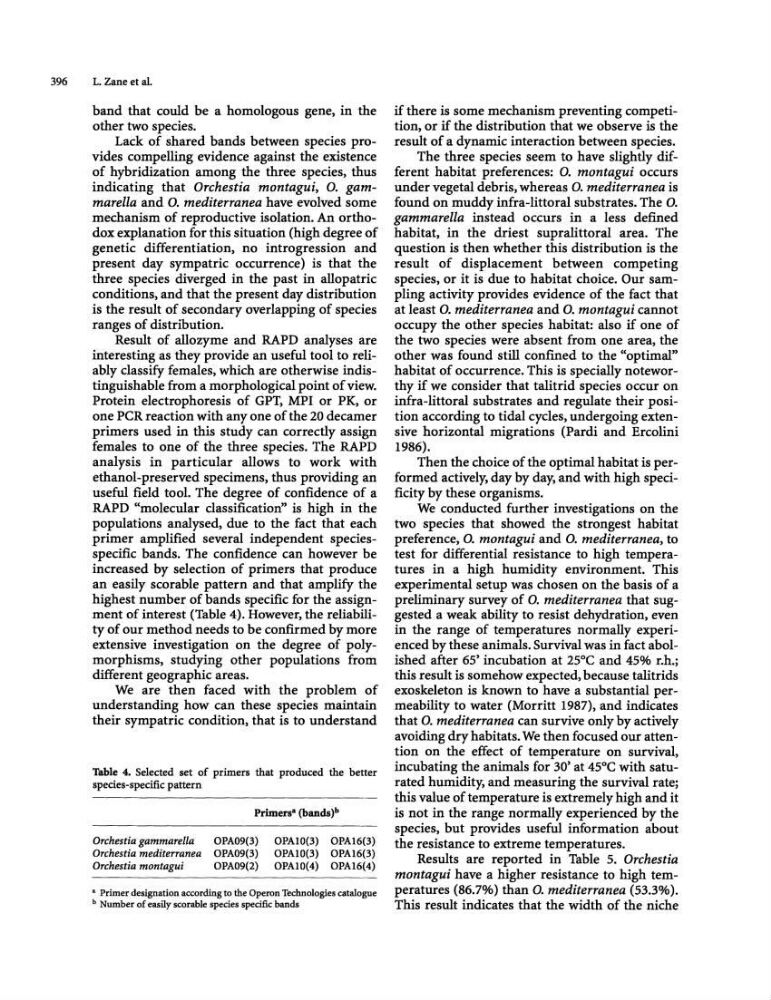
highest number of bands specific for the assignment of interest (Table 4). However, the reliability of our method needs to be confirmed by more
extensive investigation on the degree of polymorphisms, studying other populations from
different geographic areas.
We are then faced with the problem of
understanding how can these species maintain
their sympatric condition, that is to understand
Table 4. Selected set of primers that produced the better
species-specific pattern
Orchestia gammarella
Orchestia mediterranea
Orchestia montagui
OPA09(3)
OPA09(3)
OPA09(2)
OPAIO(3) OPA16(3)
OPAl 0(3) OPA16(3)
OPAl 0(4) OPA16(4)
• Primer designation according to the Operon Technologies catalogue
b Number of easily scarable species specific bands
if there is some mechanism preventing competition, or if the distribution that we observe is the
result of a dynamic interaction between species.
The three species seem to have slightly different habitat preferences: O. montagui occurs
under vegetal debris, whereas O. mediterranea is
found on muddy infra-littoral substrates. The O.
gammarella instead occurs in a less defined
habitat, in the driest supralittoral area. The
question is then whether this distribution is the
result of displacement between competing
species, or it is due to habitat choice. Our sampling activity provides evidence of the fact that
at least O. mediterranea and O. montagui cannot
occupy the other species habitat: also if one of
the two species were absent from one area, the
other was found still confined to the "optimal"
habitat of occurrence. This is specially noteworthy if we consider that talitrid species occur on
infra-littoral substrates and regulate their·position according to tidal cycles, undergoing extensive horizontal migrations (Pardi and Ercolini
1986).
Then the choice of the optimal habitat is performed actively, day by day, and with high specificity by these organisms.
We conducted further investigations on the
two species that showed the strongest habitat
preference, O. montagui and O. mediterranea, to
test for differential resistance to high temperatures in a high humidity environment. This
experimental setup was chosen on the basis of a
preliminary survey of O. mediterranea that suggested a weak ability to resist dehydration, even
in the range of temperatures normallyexperienced by these animals. Survival was in fact abolished after 65' incubation at 25°C and 45% r.h.;
this result is somehow expected, because talitrids
exoskeleton is known to have a substantial permeability to water (Morritt 1987), and indicates
that O. mediterranea can survive only by actively
avoiding dry habitats. We then focused our attention on the effect of temperature on survival,
incubating the animals for 30' at 45°C with saturated humidity, and measuring the survival rate;
this value of temperature is extremely high and it
is not in the range normally experienced by the
species, but provides useful information about
the resistance to extreme temperatures.
Results are reported in Table 5. Orchestia
montagui have a higher resistance to high temperatures (86.7%) than O. mediterranea (53.3%).
This result indicates that the width of the niche
L. Zane et aI.
band that could be a homologous gene. in the
other two species.
Lack of shared bands between species provides compelling evidence against the existence
of hybridization among the three species, thus
indicating that Orchestia montagui. O. gammarella and O. mediterranea have evolved some
mechanism of reproductive isolation. An orthodox explanation for this situation (high degree of
genetic differentiation, no introgression and
present day sympatdc occurrence) is that the
three species diverged in the past in allopatric
conditions) and that the present day distribution
is the result of secondary overlapping of species
ranges of distribution.
Result of allozyme and RAPD analyses are
interesting as they provide an useful tool to reliably classify females, which are otherwise indistinguishable from a morphological point of view.
Protein electrophoresis of GPT, MPI or PK, or
one peR reaction with anyone of the 20 decamer
primers used in this study can correctly assign
females to one of the three species. The RAPD
analysis in particular allows to work with
ethanol-preserved specimens, thus providing an
useful field tool. The degree of confidence of a
RAPD "molecular classification" is high in the
populations analysed, due to the fact that each
primer amplified several independent speciesspecific bands. The confidence can however be
increased by selection of primers that produce
an easily scorable pattern and that amplify the
highest number of bands specific for the assignment of interest (Table 4). However, the reliability of our method needs to be confirmed by more
extensive investigation on the degree of polymorphisms, studying other populations from
different geographic areas.
We are then faced with the problem of
understanding how can these species maintain
their sympatric condition, that is to understand
Table 4. Selected set of primers that produced the better
species-specific pattern
Orchestia gammarella
Orchestia mediterranea
Orchestia montagui
OPA09(3)
OPA09(3)
OPA09(2)
OPAIO(3) OPA16(3)
OPAl 0(3) OPA16(3)
OPAl 0(4) OPA16(4)
• Primer designation according to the Operon Technologies catalogue
b Number of easily scarable species specific bands
if there is some mechanism preventing competition, or if the distribution that we observe is the
result of a dynamic interaction between species.
The three species seem to have slightly different habitat preferences: O. montagui occurs
under vegetal debris, whereas O. mediterranea is
found on muddy infra-littoral substrates. The O.
gammarella instead occurs in a less defined
habitat, in the driest supralittoral area. The
question is then whether this distribution is the
result of displacement between competing
species, or it is due to habitat choice. Our sampling activity provides evidence of the fact that
at least O. mediterranea and O. montagui cannot
occupy the other species habitat: also if one of
the two species were absent from one area, the
other was found still confined to the "optimal"
habitat of occurrence. This is specially noteworthy if we consider that talitrid species occur on
infra-littoral substrates and regulate their·position according to tidal cycles, undergoing extensive horizontal migrations (Pardi and Ercolini
1986).
Then the choice of the optimal habitat is performed actively, day by day, and with high specificity by these organisms.
We conducted further investigations on the
two species that showed the strongest habitat
preference, O. montagui and O. mediterranea, to
test for differential resistance to high temperatures in a high humidity environment. This
experimental setup was chosen on the basis of a
preliminary survey of O. mediterranea that suggested a weak ability to resist dehydration, even
in the range of temperatures normallyexperienced by these animals. Survival was in fact abolished after 65' incubation at 25°C and 45% r.h.;
this result is somehow expected, because talitrids
exoskeleton is known to have a substantial permeability to water (Morritt 1987), and indicates
that O. mediterranea can survive only by actively
avoiding dry habitats. We then focused our attention on the effect of temperature on survival,
incubating the animals for 30' at 45°C with saturated humidity, and measuring the survival rate;
this value of temperature is extremely high and it
is not in the range normally experienced by the
species, but provides useful information about
the resistance to extreme temperatures.
Results are reported in Table 5. Orchestia
montagui have a higher resistance to high temperatures (86.7%) than O. mediterranea (53.3%).
This result indicates that the width of the niche