

362
C. CorseIli
Miocene (12-5 Ma B.P.)
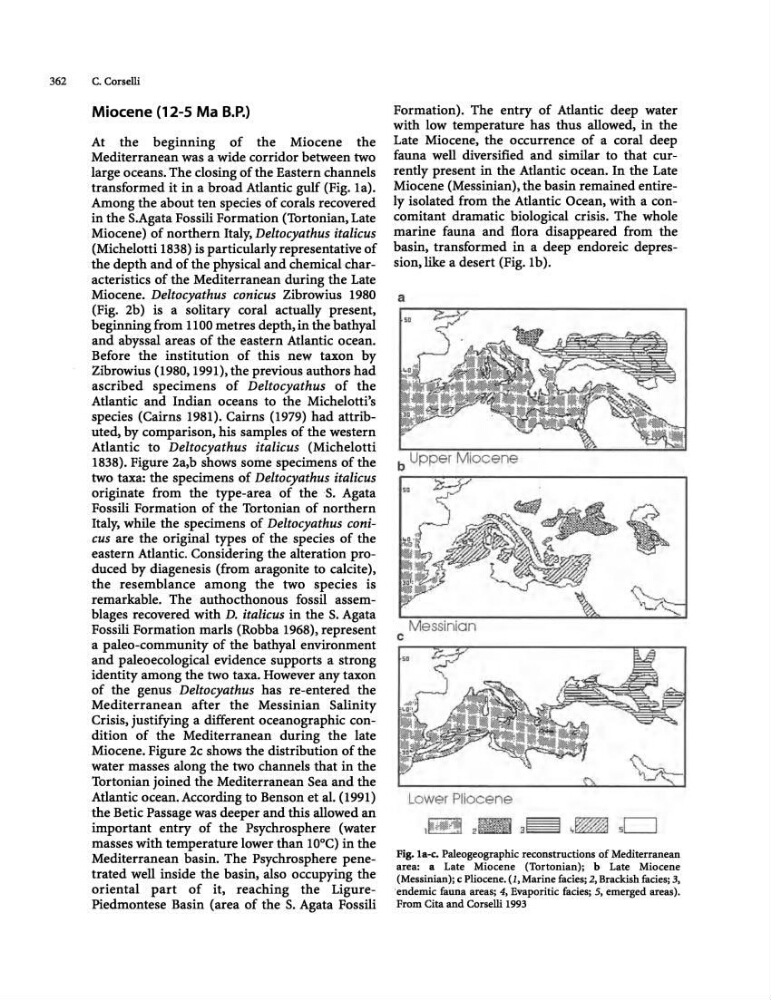
At the beginning of the Miocene the
Mediterranean was a wide corridor between two
large oceans. The closing of the Eastern channels
transformed it in a broad Atlantic gulf (Fig. la).
Among the about ten species of corals recovered
in the S.Agata Fossili Formation (Tortonian, Late
Miocene) of northern Italy, Deltocyathus italicus
(Michelotti 1838) is particularly representative of
the depth and of the physical and chemical characteristics of the Mediterranean during the Late
Miocene. Deltocyathus conicus Zibrowius 1980
(Fig. 2b) is a solitary coral actually present,
beginning from 1100 metres depth, in the bathyal
and abyssal areas of the eastern Atlantic ocean.
Before the institution of this new taxon by
Zibrowius (1980, 1991), the previous authors had
ascribed specimens of Deltocyathus of the
Atlantic and Indian oceans to the Michelotti's
species (Cairns 1981). Cairns (1979) had attributed, by comparison, his samples of the western
Atlantic to Deltocyathus italicus (Michelotti
1838). Figure 2a,b shows some specimens of the
two taxa: the specimens of Deltocyathus italicus
originate from the type-area of theS. Agata
Fossili Formation of the Tortonian of northern
Italy, while the specimens of Deltocyathus conicus are the original types of the species of the
eastern Atlantic. Considering the alteration produced by diagenesis (from aragonite to calcite),
the resemblance among the two species is
remarkable. The authocthonous fossil assemblages recovered with D. italicus in the S. Agata
Fossili Formation marls (Robba 1968), represent
a paleo-community of the bathyal environment
and paleoecological evidence supports a strong
identity among the two taxa. However any taxon
of the genus Deltocyathus has re-entered the
Mediterranean after the Messinian Salinity
Crisis, justifying a different oceanographic condition of the Mediterranean during the late
Miocene. Figure 2c shows the distribution of the
water masses along the two channels that in the
Tortonian joined the Mediterranean Sea and the
Atlantic ocean. According to Benson et al. (1991)
the Betic Passage was deeper and this allowed an
important entry of the Psychrosphere (water
masses with temperature lower than lO°C) in the
Mediterranean basin. The Psychrosphere penetrated well inside the basin, also occupying the
oriental part of it, reaching the LigurePiedmontese Basin (area of the S. Agata Fossili
Formation). The entry of Atlantic deep water
with low temperature has thus allowed, in the
Late Miocene, the occurrence of a coral deep
fauna well diversified and similar to that currently present in the Atlantic ocean. In the Late
Miocene (Messinian), the basin remained entirely isolated from the Atlantic Ocean, with a concomitant dramatic biological crisis. The whole
marine fauna and flora disappeared from the
basin, transformed in a deep endoreic depression, like a desert (Fig. Ib).
a
50
b Upper Miocene
Lower Pliocene
Fig. la-c. Paleogeographic reconstructions of Mediterranean
area: a Late Miocene (Tortonian); b Late Miocene
(Messinian); c Pliocene. (1, Marine facies; 2, Brackish facies; 3,
"endemic fauna areas; 4, Evaporitic facies; 5, emerged areas).
From Cita and Corselli 1993
C. CorseIli
Miocene (12-5 Ma B.P.)
At the beginning of the Miocene the
Mediterranean was a wide corridor between two
large oceans. The closing of the Eastern channels
transformed it in a broad Atlantic gulf (Fig. la).
Among the about ten species of corals recovered
in the S.Agata Fossili Formation (Tortonian, Late
Miocene) of northern Italy, Deltocyathus italicus
(Michelotti 1838) is particularly representative of
the depth and of the physical and chemical characteristics of the Mediterranean during the Late
Miocene. Deltocyathus conicus Zibrowius 1980
(Fig. 2b) is a solitary coral actually present,
beginning from 1100 metres depth, in the bathyal
and abyssal areas of the eastern Atlantic ocean.
Before the institution of this new taxon by
Zibrowius (1980, 1991), the previous authors had
ascribed specimens of Deltocyathus of the
Atlantic and Indian oceans to the Michelotti's
species (Cairns 1981). Cairns (1979) had attributed, by comparison, his samples of the western
Atlantic to Deltocyathus italicus (Michelotti
1838). Figure 2a,b shows some specimens of the
two taxa: the specimens of Deltocyathus italicus
originate from the type-area of theS. Agata
Fossili Formation of the Tortonian of northern
Italy, while the specimens of Deltocyathus conicus are the original types of the species of the
eastern Atlantic. Considering the alteration produced by diagenesis (from aragonite to calcite),
the resemblance among the two species is
remarkable. The authocthonous fossil assemblages recovered with D. italicus in the S. Agata
Fossili Formation marls (Robba 1968), represent
a paleo-community of the bathyal environment
and paleoecological evidence supports a strong
identity among the two taxa. However any taxon
of the genus Deltocyathus has re-entered the
Mediterranean after the Messinian Salinity
Crisis, justifying a different oceanographic condition of the Mediterranean during the late
Miocene. Figure 2c shows the distribution of the
water masses along the two channels that in the
Tortonian joined the Mediterranean Sea and the
Atlantic ocean. According to Benson et al. (1991)
the Betic Passage was deeper and this allowed an
important entry of the Psychrosphere (water
masses with temperature lower than lO°C) in the
Mediterranean basin. The Psychrosphere penetrated well inside the basin, also occupying the
oriental part of it, reaching the LigurePiedmontese Basin (area of the S. Agata Fossili
Formation). The entry of Atlantic deep water
with low temperature has thus allowed, in the
Late Miocene, the occurrence of a coral deep
fauna well diversified and similar to that currently present in the Atlantic ocean. In the Late
Miocene (Messinian), the basin remained entirely isolated from the Atlantic Ocean, with a concomitant dramatic biological crisis. The whole
marine fauna and flora disappeared from the
basin, transformed in a deep endoreic depression, like a desert (Fig. Ib).
a
50
b Upper Miocene
Lower Pliocene
Fig. la-c. Paleogeographic reconstructions of Mediterranean
area: a Late Miocene (Tortonian); b Late Miocene
(Messinian); c Pliocene. (1, Marine facies; 2, Brackish facies; 3,
"endemic fauna areas; 4, Evaporitic facies; 5, emerged areas).
From Cita and Corselli 1993