

334
L. Rossi and G. Mancinelli
Results and Discussion
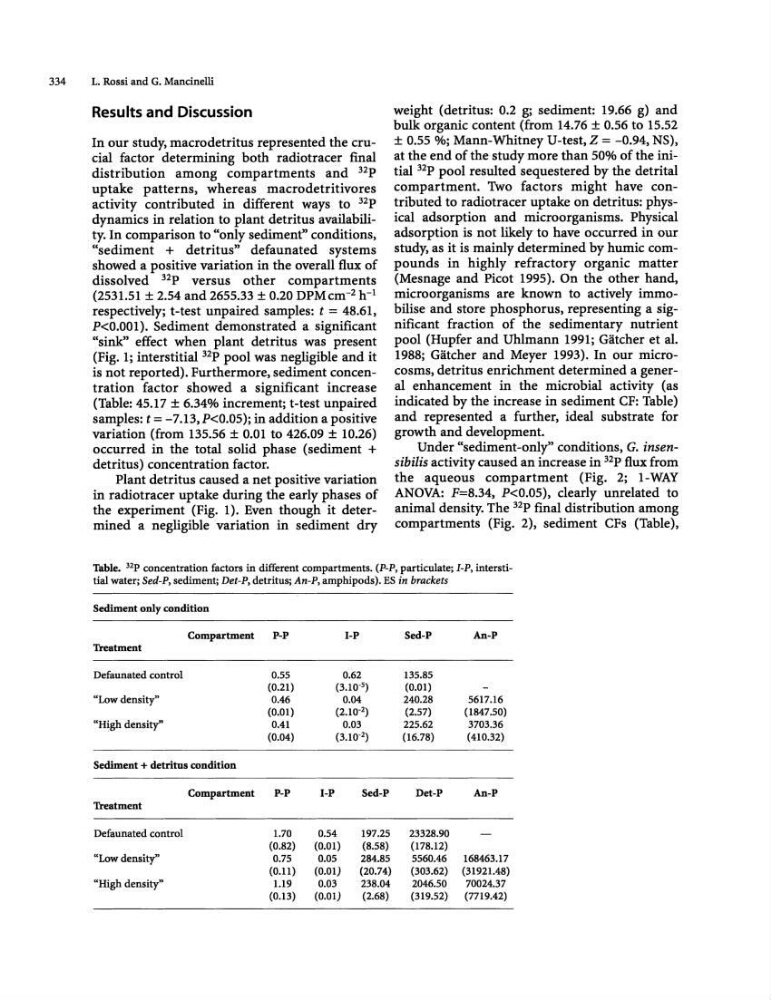
In our study, macrodetritus represented the crucial factor determining both radiotracer final
distribution among compartments and 32p
uptake patterns, whereas macrodetritivores
activity contributed in different ways to 32p
dynamics in relation to plant detritus availability. In comparison to "only sediment" conditions,
"sediment + detritus" defaunated systems
showed a positive variation in the overall flux of
dissolved 32p versus other compartments
(2531.51 ± 2.54 and 2655.33 ± 0.20 DPMcm- 2 h- 1
respectively; t-test unpaired samples: t = 48.61,
P
(Fig. 1; interstitial 32p pool was negligible and it
is not reported). Furthermore, sediment concentration factor showed a significant increase
(Table: 45.17 ± 6.34% increment; t-test unpaired
samples: t = -7.13, P
occurred in the total solid phase (sediment +
detritus) concentration factor.
Plant detritus caused a net positive variation
in radiotracer uptake during the early phases of
the experiment (Fig. 1). Even though it determined a negligible variation in sediment dry
weight (detritus: 0.2 g; sediment: 19.66 g) and
bulk organic content (from 14.76 ± 0.56 to 15.52
± 0.55 %; Mann-Whitney U-test, Z = -0.94, NS).
at the end of the study more than 50% of the initial 32p pool resulted sequestered by the detrital
compartment. Two factors might have contributed to radiotracer uptake on detritus: physical adsorption and microorganisms. Physical
adsorption is not likely to have occurred in our
study, as it is mainly determined by humic compounds in highly refractory organic matter
(Mesnage and Picot 1995). On the other hand,
microorganisms are known to actively immobilise and store phosphorus, representing a significant fraction of the sedimentary nutrient
pool (Hupfer and Uhlmann 1991; Gatcher et al.
1988; Gatcher and Meyer 1993), In our microcosms, detritus enrichment determined a general enhancement in the microbial activity (as
indicated by the increase in sediment CF: Table)
and represented a further, ideal substrate for
growth and development.
Under "sediment-only" conditions, G. insensibilis activity caused an increase in 32p flux from
the aqueous compartment (Fig. 2; I-WAY
ANOVA: F=8.34, P<0.05), clearly unrelated to
animal density. The 32p final distribution among
compartments (Fig. 2). sediment CFs (Table),
Table. 32p concentration factors in different compartments. (P-P, particulate; I-P, interstitial water; Sed-P, sediment; Det-P, detritus; An-P, amphipods). ES in brackets
Sediment only condition
Compartment
P-P
I-P
Sed-P
An·p
Treatment
Defaunated control
0.55
0.62
135.85
(0.21)
(3.1O- 5 )
(0.0l)
"Low density"
0.46
0.04
240.28
5617.16
(0.01)
(2.10- 2 )
(2.57)
(1847.50)
"High density"
0.41
0.03
225.62
3703.36
(0.04)
(3.10- 2 )
(16.78)
(41O.32)
Sediment + detritus condition
Compartment
P-P
I-P
Sed-P
Det-P
An-P
Treatment
Defaunated control
1.70
0.54
197.25
23328.90
(0.82)
(0.01)
(8.58)
(178.12)
"Low density"
0.75
0.05
284.85
5560.46
168463.17
(0.11)
(0.01)
(20.74)
(303.62) (31921.48)
"High density"
1.19
0.03
238.04
2046.50
70024.37
(0.13)
(0.01)
(2.68)
(319.52)
(7719.42)
L. Rossi and G. Mancinelli
Results and Discussion
In our study, macrodetritus represented the crucial factor determining both radiotracer final
distribution among compartments and 32p
uptake patterns, whereas macrodetritivores
activity contributed in different ways to 32p
dynamics in relation to plant detritus availability. In comparison to "only sediment" conditions,
"sediment + detritus" defaunated systems
showed a positive variation in the overall flux of
dissolved 32p versus other compartments
(2531.51 ± 2.54 and 2655.33 ± 0.20 DPMcm- 2 h- 1
respectively; t-test unpaired samples: t = 48.61,
P
(Fig. 1; interstitial 32p pool was negligible and it
is not reported). Furthermore, sediment concentration factor showed a significant increase
(Table: 45.17 ± 6.34% increment; t-test unpaired
samples: t = -7.13, P
occurred in the total solid phase (sediment +
detritus) concentration factor.
Plant detritus caused a net positive variation
in radiotracer uptake during the early phases of
the experiment (Fig. 1). Even though it determined a negligible variation in sediment dry
weight (detritus: 0.2 g; sediment: 19.66 g) and
bulk organic content (from 14.76 ± 0.56 to 15.52
± 0.55 %; Mann-Whitney U-test, Z = -0.94, NS).
at the end of the study more than 50% of the initial 32p pool resulted sequestered by the detrital
compartment. Two factors might have contributed to radiotracer uptake on detritus: physical adsorption and microorganisms. Physical
adsorption is not likely to have occurred in our
study, as it is mainly determined by humic compounds in highly refractory organic matter
(Mesnage and Picot 1995). On the other hand,
microorganisms are known to actively immobilise and store phosphorus, representing a significant fraction of the sedimentary nutrient
pool (Hupfer and Uhlmann 1991; Gatcher et al.
1988; Gatcher and Meyer 1993), In our microcosms, detritus enrichment determined a general enhancement in the microbial activity (as
indicated by the increase in sediment CF: Table)
and represented a further, ideal substrate for
growth and development.
Under "sediment-only" conditions, G. insensibilis activity caused an increase in 32p flux from
the aqueous compartment (Fig. 2; I-WAY
ANOVA: F=8.34, P<0.05), clearly unrelated to
animal density. The 32p final distribution among
compartments (Fig. 2). sediment CFs (Table),
Table. 32p concentration factors in different compartments. (P-P, particulate; I-P, interstitial water; Sed-P, sediment; Det-P, detritus; An-P, amphipods). ES in brackets
Sediment only condition
Compartment
P-P
I-P
Sed-P
An·p
Treatment
Defaunated control
0.55
0.62
135.85
(0.21)
(3.1O- 5 )
(0.0l)
"Low density"
0.46
0.04
240.28
5617.16
(0.01)
(2.10- 2 )
(2.57)
(1847.50)
"High density"
0.41
0.03
225.62
3703.36
(0.04)
(3.10- 2 )
(16.78)
(41O.32)
Sediment + detritus condition
Compartment
P-P
I-P
Sed-P
Det-P
An-P
Treatment
Defaunated control
1.70
0.54
197.25
23328.90
(0.82)
(0.01)
(8.58)
(178.12)
"Low density"
0.75
0.05
284.85
5560.46
168463.17
(0.11)
(0.01)
(20.74)
(303.62) (31921.48)
"High density"
1.19
0.03
238.04
2046.50
70024.37
(0.13)
(0.01)
(2.68)
(319.52)
(7719.42)