

Detritivore Ampbipods - Detritus Interactions and 32p Fluxes in Microcosm
333
pre-weighted filters (0.45 llm pore size). Filters
were oven dried, weighed, and analysed for 32p
content. At the same time, interstitial water samples (50 1l1,4 subsamples/microcosm) were taken
for radioactivity determination. Particulate
detritus ("sediment + detritus" treatments) was
separated from sediment by sieving (0.5 mm
mesh), oven-dried, and weighed.
Filters, animal and detritus samples were
weighed to the nearest 0.01 mg. Radioactivity
was determined in both aqueous and solid samples after NCS digestion by liquid scintillation
counting. Counts were corrected for colour
quenching and radiotracer decay, and expressed
as disintegration min- 1 (1 DPM = 4.55 10- 13
Curie).
In animal treatments, detritus processing
rates were determined as the per cent loss of
detritus dry weight during the experiment, and
expressed as % h- 1 ; amphipods mortality was
expressed as the loss of individuals per hour (n
individuals h- 1 ).
The following parameters were used: (1)
"activity density" (AD = DPM mg-l dry weight;
Whittaker 1961), as an index of 3 2 p concentration
per unit dry weight; (2) "concentration factor"
(CF) as an index of the intensity of 3 2 p transfer
between source compartments (water, sediment,
or detritus) and amphipods (CF = amphipods
AD source AD-I). The 32p fluxes from water
towards other compartments were estimated as
the loss in the dissolved radiotracer pool per unit
area of the water-sediment interface, and
expressed as DPM cm- 2 h- 1 •
Sediment
Sediment + Detritus
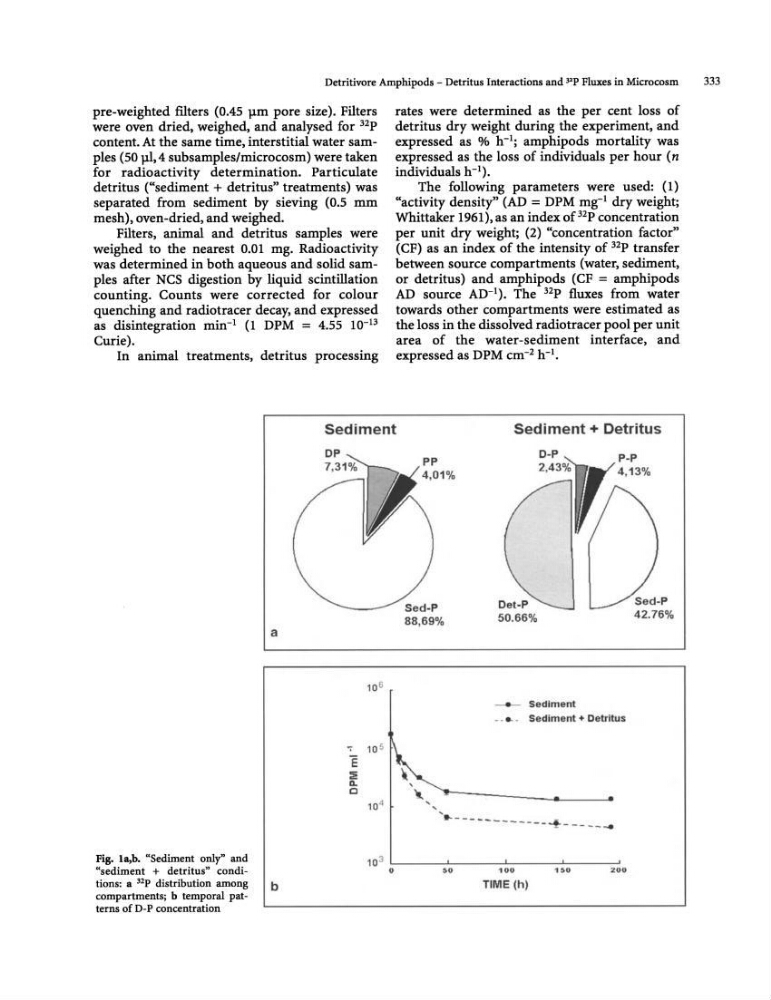
Fig. la,b. "Sediment only" and
"sediment + detritus" conditions: a 32p distribution among
compartments; b temporal patterns of D-P concentration
a
b
DP
7,31
Sed-P
8869%
50.66%
_
Sediment
- _ .. _ Sediment + Detritus
' ... - - - - - - - - - -- --+ - - - - - -
10 3 '------''------''-------'------'
o
100
150
200
TIME (h)
42.76%
333
pre-weighted filters (0.45 llm pore size). Filters
were oven dried, weighed, and analysed for 32p
content. At the same time, interstitial water samples (50 1l1,4 subsamples/microcosm) were taken
for radioactivity determination. Particulate
detritus ("sediment + detritus" treatments) was
separated from sediment by sieving (0.5 mm
mesh), oven-dried, and weighed.
Filters, animal and detritus samples were
weighed to the nearest 0.01 mg. Radioactivity
was determined in both aqueous and solid samples after NCS digestion by liquid scintillation
counting. Counts were corrected for colour
quenching and radiotracer decay, and expressed
as disintegration min- 1 (1 DPM = 4.55 10- 13
Curie).
In animal treatments, detritus processing
rates were determined as the per cent loss of
detritus dry weight during the experiment, and
expressed as % h- 1 ; amphipods mortality was
expressed as the loss of individuals per hour (n
individuals h- 1 ).
The following parameters were used: (1)
"activity density" (AD = DPM mg-l dry weight;
Whittaker 1961), as an index of 3 2 p concentration
per unit dry weight; (2) "concentration factor"
(CF) as an index of the intensity of 3 2 p transfer
between source compartments (water, sediment,
or detritus) and amphipods (CF = amphipods
AD source AD-I). The 32p fluxes from water
towards other compartments were estimated as
the loss in the dissolved radiotracer pool per unit
area of the water-sediment interface, and
expressed as DPM cm- 2 h- 1 •
Sediment
Sediment + Detritus
Fig. la,b. "Sediment only" and
"sediment + detritus" conditions: a 32p distribution among
compartments; b temporal patterns of D-P concentration
a
b
DP
7,31
Sed-P
8869%
50.66%
_
Sediment
- _ .. _ Sediment + Detritus
' ... - - - - - - - - - -- --+ - - - - - -
10 3 '------''------''-------'------'
o
100
150
200
TIME (h)
42.76%