

14
13
12
,
"
11
" "
":'
"
'tJ
10
"
' ;Ii!.
\
" "
9
" ,
" 1-0
8
"'t:=:::-:::~1
7
6
0
5
10
15
20
25
30
Days
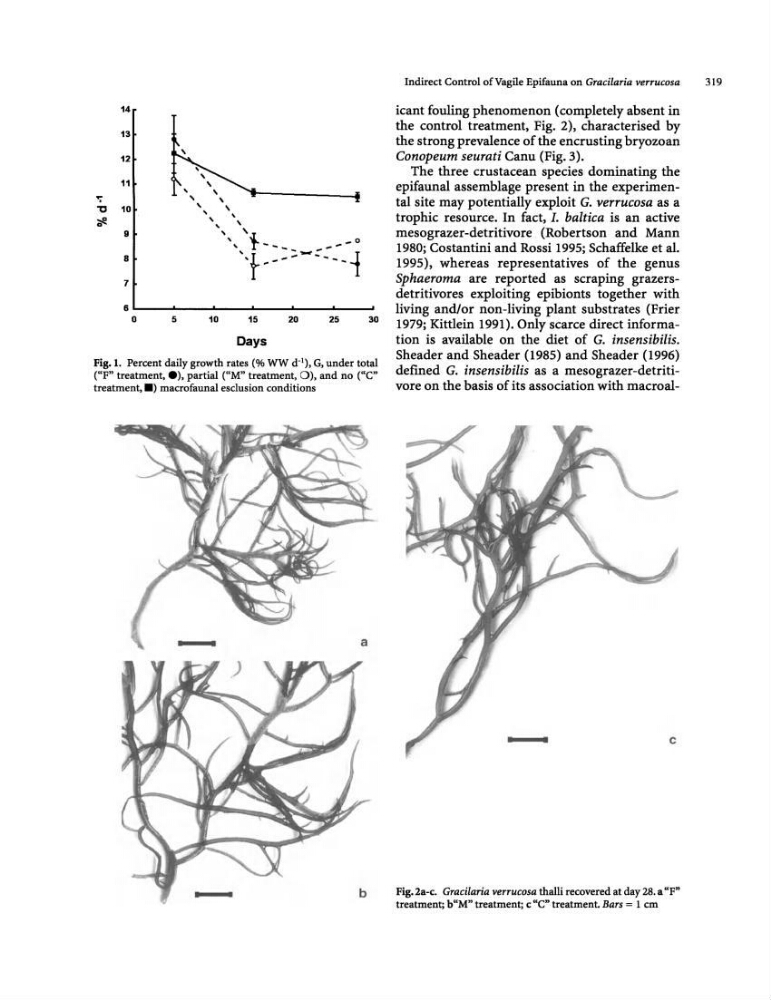
Fig.I. Percent daily growth rates (% WW d- 1 ), G, under total
("F" treatment, e), partial ("M" treatment, 0), and no ("C"
treatment, _) macrofaunal esc1usion conditions
Indirect Control of Vagile Epifauna on Gracilaria verrucosa
319
kant fouling phenomenon (completely absent in
the control treatment, Fig. 2), characterised by
the strong prevalence of the encrusting bryozoan
Conopeum seurati Canu (Fig. 3).
The three crustacean species dominating the
epifaunal assemblage present in the experimental site may potentially exploit G. verrucosa as a
trophic resource. In fact, I. baltica is an active
mesograzer-detritivore (Robertson and Mann
1980; Costantini and Rossi 1995; Schaffe1.ke et al.
1995), whereas representatives of the genus
Sphaeroma are reported as scraping grazersdetritivores exploiting epibionts together with
living and/or non-living plant substrates (Frier
1979; Kittlein 1991). Only scarce direct information is available on the diet of G. insensibilis.
Sheader and Sheader (1985) and Sheader (1996)
defined G. insensibilis as a mesograzer-detritivore on the basis of its association with macroalFig.2a-c. Graci/aria verrucosa thalli recovered at day 28. a "F"
treatment; bUM" treatment; c "C" treatment. BaTS =: 1 em
13
12
,
"
11
" "
":'
"
'tJ
10
"
' ;Ii!.
\
" "
9
" ,
" 1-0
8
"'t:=:::-:::~1
7
6
0
5
10
15
20
25
30
Days
Fig.I. Percent daily growth rates (% WW d- 1 ), G, under total
("F" treatment, e), partial ("M" treatment, 0), and no ("C"
treatment, _) macrofaunal esc1usion conditions
Indirect Control of Vagile Epifauna on Gracilaria verrucosa
319
kant fouling phenomenon (completely absent in
the control treatment, Fig. 2), characterised by
the strong prevalence of the encrusting bryozoan
Conopeum seurati Canu (Fig. 3).
The three crustacean species dominating the
epifaunal assemblage present in the experimental site may potentially exploit G. verrucosa as a
trophic resource. In fact, I. baltica is an active
mesograzer-detritivore (Robertson and Mann
1980; Costantini and Rossi 1995; Schaffe1.ke et al.
1995), whereas representatives of the genus
Sphaeroma are reported as scraping grazersdetritivores exploiting epibionts together with
living and/or non-living plant substrates (Frier
1979; Kittlein 1991). Only scarce direct information is available on the diet of G. insensibilis.
Sheader and Sheader (1985) and Sheader (1996)
defined G. insensibilis as a mesograzer-detritivore on the basis of its association with macroalFig.2a-c. Graci/aria verrucosa thalli recovered at day 28. a "F"
treatment; bUM" treatment; c "C" treatment. BaTS =: 1 em