

density was expressed both in terms of n individual m- 2 and mg AFDW m- 2 •
Together with sediment cores were retrieved
three trophic traps, deployed on the sea bottom
seven days before sediment sampling. Each trap
consisted of two plastic bags (40 x 80 cm. lOx 3
mm mesh size) fixed to a concrete base (0.36 m 2 )
loosely tethered to a buoy. Bags were filled with
1000 ± 1 g DW of mixed Cymodocea nodosa
Ascherson and Zostera marina Linnaeus leaf
detritus previously collected in the Venice
Lagoon. After retrieving, the detritus contained
in each bag was washed on board on 0.5 mmmesh sieves. Living specimens were separated
from inorganic particles and preserved in ca. 5%
buffered formalin. In the laboratory, specimens
were identified and counted. Individual dry weight was determined according to the aforementioned procedures. Consequently, individuals
were grouped on the basis of their DW in eleven
size classes determined on a log-2 scale.
Results and Discussion
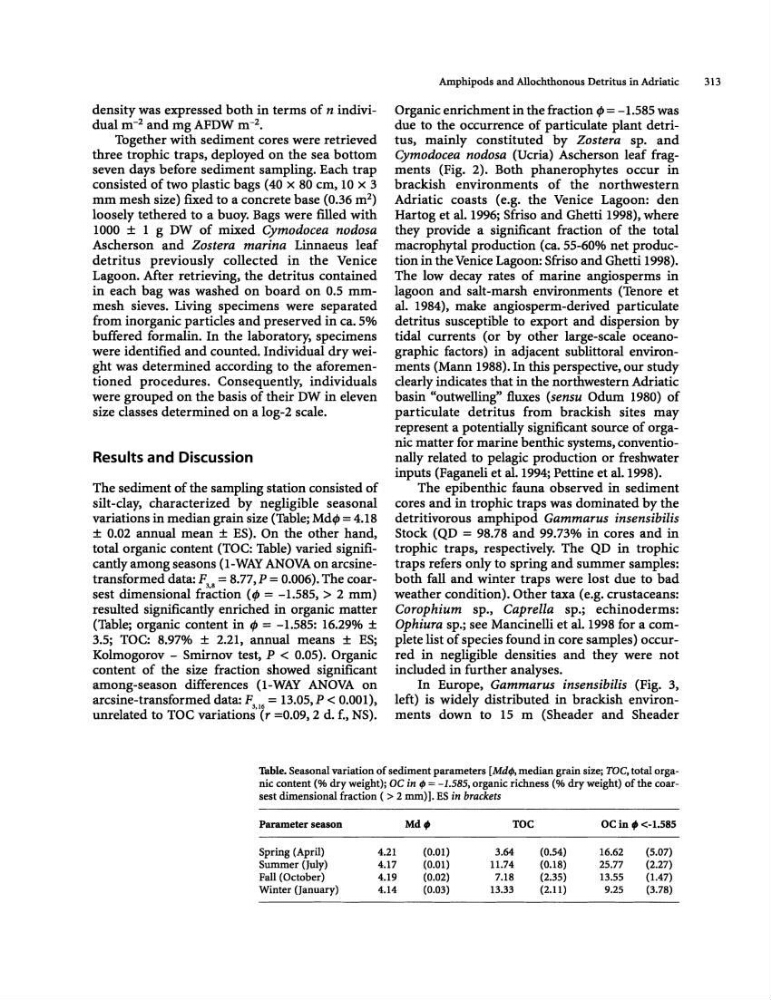
The sediment of the sampling station consisted of
silt-day, characterized by negligible seasonal
variations in median grain size (Table; Mdt/> = 4.18
± 0.02 annual mean ± ES). On the other hand,
total organic content (TOC: Table) varied significantly among seasons (1-WAY ANOVA on arcsinetransformed data: F 8 = 8.77, P = 0.006). The coar3,
sest dimensional fraction (t/> = -1.585, > 2 mm)
resulted significantly enriched in organic matter
(Table; organic content in t/> = -1.585: 16.29% ±
3.5; TOC: 8.97% ± 2.21, annual means ± ES;
Kolmogorov - Smirnov test, P < 0.05). Organic
content of the size fraction showed significant
among-season differences (I-WAY ANOVA on
arcsine-transformed data: F3 16 = 13.05, P < 0.001).
unrelated to TOC variations' (r =0.09, 2 d. f., NS).
Aropbipods and Allochthonous Detritus in Adriatic
313
Organic enrichment in the fraction .p = -1.585 was
due to the occurrence of particulate plant detritus, mainly constituted by Zostera sp. and
Cymodocea nodosa (Deria) Ascherson leaf fragments (Fig. 2). Both phanerophytes occur in
brackish environments of the northwestern
Adriatic coasts (e.g. the Venice Lagoon: den
Hartog et aI. 1996; Sfriso and Ghetti 1998), where
they provide a significant fraction of the total
macrophytal production (ca. 55-60% net production in the Venice Lagoon: Sfriso and Ghetti 1998).
The low decay rates of marine angiosperms in
lagoon and salt-marsh environments (Tenore et
al. 1984), make angiosperm-derived particulate
detritus susceptible to export and dispersion by
tidal currents (or by other large-scale oceanographic factors) in adjacent sublittoral environments (Mann 1988). In this perspective, our study
clearly indicates that in the northwestern Adriatic
basin "outwelling" fluxes (sensu Odum 1980) of
particulate detritus from brackish sites may
represent a potentially significant source of organic matter for marine benthic systems, conventionally related to pelagic production or freshwater
inputs (Faganeli et al. 1994; Pettine et al. 1998).
The epibenthic fauna observed in sediment
cores and in trophic traps was dominated by the
detritivorous amphipod Gammarus insensibilis
Stock (QD = 98.78 and 99.73% in cores and in
trophic traps, respectively. The QD in trophic
traps refers only to spring and summer samples:
both fall and winter traps were lost due to bad
weather condition), Other taxa (e.g. crustaceans:
Corophium sp., Caprella sp.; echinoderms:
Ophiura sp.; see Mancinelli et al. 1998 for a complete list of species found in core samples) occurred in negligible densities and they were not
included in further analyses.
In Europe, Gammarus insensibilis (Fig. 3,
left) is widely distributed in brackish environments down to 15 m (Sheader and Sheader
Table. Seasonal variation of sediment parameters [Md/f1, median grain size; TOC, total organic content (% dry weight); DC in 41= -1,585, organic richness (% dry weight) of the coarsest dimensional fraction ( > 2 rom)]. ES in brackets
Parameter season
Md,
Toe
OC in , <-1.585
Spring (April)
4.21
(0.01)
3.64
(0.54)
16.62
(5.07)
Summer (July)
4.17
(0.01)
11.74
(0.18)
25.77
(2.27)
Fall (October)
4.19
(0.02)
7.18
(2.35)
13.55
(1.47)
Winter (January)
4.14
(0.03)
13.33
(2.ll)
9.25
(3.78)
Together with sediment cores were retrieved
three trophic traps, deployed on the sea bottom
seven days before sediment sampling. Each trap
consisted of two plastic bags (40 x 80 cm. lOx 3
mm mesh size) fixed to a concrete base (0.36 m 2 )
loosely tethered to a buoy. Bags were filled with
1000 ± 1 g DW of mixed Cymodocea nodosa
Ascherson and Zostera marina Linnaeus leaf
detritus previously collected in the Venice
Lagoon. After retrieving, the detritus contained
in each bag was washed on board on 0.5 mmmesh sieves. Living specimens were separated
from inorganic particles and preserved in ca. 5%
buffered formalin. In the laboratory, specimens
were identified and counted. Individual dry weight was determined according to the aforementioned procedures. Consequently, individuals
were grouped on the basis of their DW in eleven
size classes determined on a log-2 scale.
Results and Discussion
The sediment of the sampling station consisted of
silt-day, characterized by negligible seasonal
variations in median grain size (Table; Mdt/> = 4.18
± 0.02 annual mean ± ES). On the other hand,
total organic content (TOC: Table) varied significantly among seasons (1-WAY ANOVA on arcsinetransformed data: F 8 = 8.77, P = 0.006). The coar3,
sest dimensional fraction (t/> = -1.585, > 2 mm)
resulted significantly enriched in organic matter
(Table; organic content in t/> = -1.585: 16.29% ±
3.5; TOC: 8.97% ± 2.21, annual means ± ES;
Kolmogorov - Smirnov test, P < 0.05). Organic
content of the size fraction showed significant
among-season differences (I-WAY ANOVA on
arcsine-transformed data: F3 16 = 13.05, P < 0.001).
unrelated to TOC variations' (r =0.09, 2 d. f., NS).
Aropbipods and Allochthonous Detritus in Adriatic
313
Organic enrichment in the fraction .p = -1.585 was
due to the occurrence of particulate plant detritus, mainly constituted by Zostera sp. and
Cymodocea nodosa (Deria) Ascherson leaf fragments (Fig. 2). Both phanerophytes occur in
brackish environments of the northwestern
Adriatic coasts (e.g. the Venice Lagoon: den
Hartog et aI. 1996; Sfriso and Ghetti 1998), where
they provide a significant fraction of the total
macrophytal production (ca. 55-60% net production in the Venice Lagoon: Sfriso and Ghetti 1998).
The low decay rates of marine angiosperms in
lagoon and salt-marsh environments (Tenore et
al. 1984), make angiosperm-derived particulate
detritus susceptible to export and dispersion by
tidal currents (or by other large-scale oceanographic factors) in adjacent sublittoral environments (Mann 1988). In this perspective, our study
clearly indicates that in the northwestern Adriatic
basin "outwelling" fluxes (sensu Odum 1980) of
particulate detritus from brackish sites may
represent a potentially significant source of organic matter for marine benthic systems, conventionally related to pelagic production or freshwater
inputs (Faganeli et al. 1994; Pettine et al. 1998).
The epibenthic fauna observed in sediment
cores and in trophic traps was dominated by the
detritivorous amphipod Gammarus insensibilis
Stock (QD = 98.78 and 99.73% in cores and in
trophic traps, respectively. The QD in trophic
traps refers only to spring and summer samples:
both fall and winter traps were lost due to bad
weather condition), Other taxa (e.g. crustaceans:
Corophium sp., Caprella sp.; echinoderms:
Ophiura sp.; see Mancinelli et al. 1998 for a complete list of species found in core samples) occurred in negligible densities and they were not
included in further analyses.
In Europe, Gammarus insensibilis (Fig. 3,
left) is widely distributed in brackish environments down to 15 m (Sheader and Sheader
Table. Seasonal variation of sediment parameters [Md/f1, median grain size; TOC, total organic content (% dry weight); DC in 41= -1,585, organic richness (% dry weight) of the coarsest dimensional fraction ( > 2 rom)]. ES in brackets
Parameter season
Md,
Toe
OC in , <-1.585
Spring (April)
4.21
(0.01)
3.64
(0.54)
16.62
(5.07)
Summer (July)
4.17
(0.01)
11.74
(0.18)
25.77
(2.27)
Fall (October)
4.19
(0.02)
7.18
(2.35)
13.55
(1.47)
Winter (January)
4.14
(0.03)
13.33
(2.ll)
9.25
(3.78)