

312
G. Mancinelli and L. Rossi
Lagoon
Venice (
Northern Adriatic Sea
... SAMPLING
•
.....SITE
N
.... """"'i .... ~ ........ 1 30Km
~o4U+-_ ___ -r ______ ~ ____ - ' ______ ~~ ____ ~ __ --+
12°00'
12"20'
12"40'
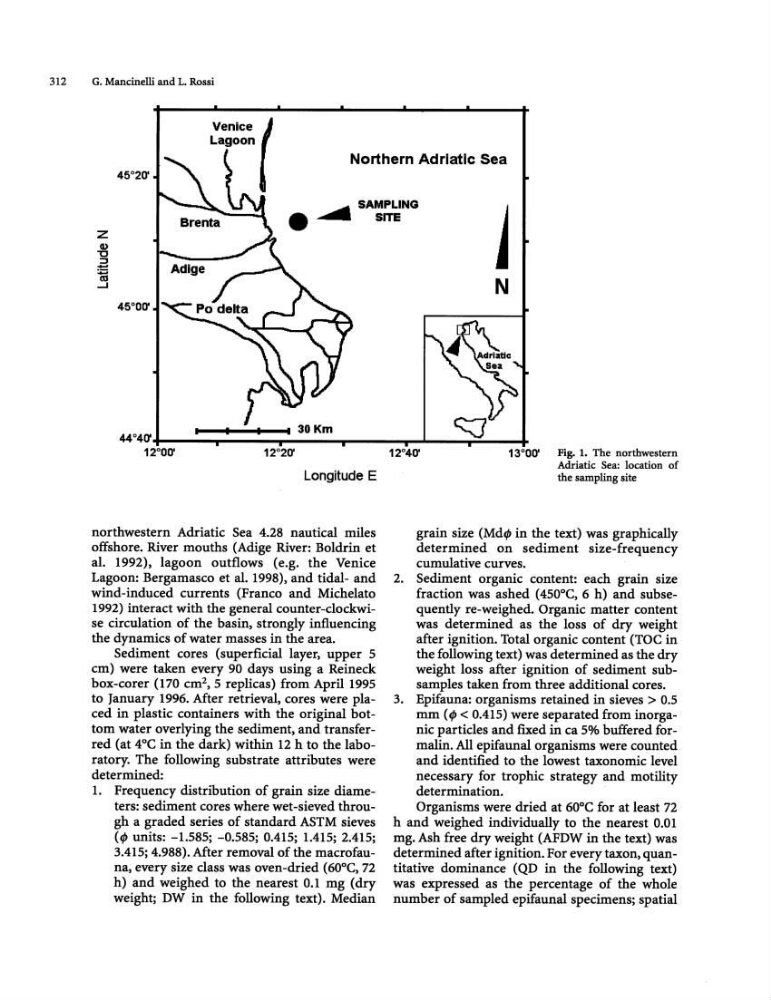
13"00' Fig. 1. The northwestern
Adriatic Sea: location of
Longitude E
the sampling site
northwestern Adriatic Sea 4.28 nautical miles
offshore. River mouths (Adige River: Boldrin et
al. 1992), lagoon outflows (e.g. the Venice
Lagoon: Bergamasco et al. 1998), and tidal- and
wind-induced currents (Franco and Michelato
1992) interact with the general counter-clockwise circulation of the basin, strongly influencing
the dynamics of water masses in the area.
Sediment cores (superficial layer, upper 5
cm) were taken every 90 days using a Reineck
box-corer (170 cm 2 ,5 replicas) from April 1995
to January 1996. After retrieval, cores were placed in plastic containers with the original bottom water overlying the sediment, and transferred (at 4"C in the dark) within 12 h to the laboratory. The following substrate attributes were
determined:
1. Frequency distribution of grain size diameters: sediment cores where wet-sieved through a graded series of standard ASTM sieves
(i/J units: -1.585; -0.585; 0.415; 1.415; 2.415;
3.415; 4.988). After removal of the macrofauna, every size class was oven-dried (60"C, 72
h) and weighed to the nearest 0.1 mg (dry
weight; DW in the following text). Median
grain size (Mdt; in the text) was graphically
determined on sediment size-frequency
cumulative curves.
2. Sediment organic content: each grain size
fraction was ashed (450"C, 6 h) and subsequently re-weighed. Organic matter content
was determined as the loss of dry weight
after ignition. Total organic content (TOC in
the following text) was determined as the dry
weight loss after ignition of sediment subsamples taken from three additional cores.
3. Epifauna: organisms retained in sieves> 0.5
mm (q, < 0.415) were separated from inorganic particles and fixed in ca 5% buffered formalin. All epifaunal organisms were counted
and identified to the lowest taxonomic level
necessary for trophic strategy and motility
determination.
Organisms were dried at 60"C for at least 72
h and weighed individually to the nearest 0.01
mg. Ash free dry weight (AFDW in the text) was
determined after ignition. For every taxon, quantitative dominance (QD in the following text)
was expressed as the percentage of the whole
number of sampled epifaunal specimens; spatial
G. Mancinelli and L. Rossi
Lagoon
Venice (
Northern Adriatic Sea
... SAMPLING
•
.....SITE
N
.... """"'i .... ~ ........ 1 30Km
~o4U+-_ ___ -r ______ ~ ____ - ' ______ ~~ ____ ~ __ --+
12°00'
12"20'
12"40'
13"00' Fig. 1. The northwestern
Adriatic Sea: location of
Longitude E
the sampling site
northwestern Adriatic Sea 4.28 nautical miles
offshore. River mouths (Adige River: Boldrin et
al. 1992), lagoon outflows (e.g. the Venice
Lagoon: Bergamasco et al. 1998), and tidal- and
wind-induced currents (Franco and Michelato
1992) interact with the general counter-clockwise circulation of the basin, strongly influencing
the dynamics of water masses in the area.
Sediment cores (superficial layer, upper 5
cm) were taken every 90 days using a Reineck
box-corer (170 cm 2 ,5 replicas) from April 1995
to January 1996. After retrieval, cores were placed in plastic containers with the original bottom water overlying the sediment, and transferred (at 4"C in the dark) within 12 h to the laboratory. The following substrate attributes were
determined:
1. Frequency distribution of grain size diameters: sediment cores where wet-sieved through a graded series of standard ASTM sieves
(i/J units: -1.585; -0.585; 0.415; 1.415; 2.415;
3.415; 4.988). After removal of the macrofauna, every size class was oven-dried (60"C, 72
h) and weighed to the nearest 0.1 mg (dry
weight; DW in the following text). Median
grain size (Mdt; in the text) was graphically
determined on sediment size-frequency
cumulative curves.
2. Sediment organic content: each grain size
fraction was ashed (450"C, 6 h) and subsequently re-weighed. Organic matter content
was determined as the loss of dry weight
after ignition. Total organic content (TOC in
the following text) was determined as the dry
weight loss after ignition of sediment subsamples taken from three additional cores.
3. Epifauna: organisms retained in sieves> 0.5
mm (q, < 0.415) were separated from inorganic particles and fixed in ca 5% buffered formalin. All epifaunal organisms were counted
and identified to the lowest taxonomic level
necessary for trophic strategy and motility
determination.
Organisms were dried at 60"C for at least 72
h and weighed individually to the nearest 0.01
mg. Ash free dry weight (AFDW in the text) was
determined after ignition. For every taxon, quantitative dominance (QD in the following text)
was expressed as the percentage of the whole
number of sampled epifaunal specimens; spatial