

272
P. Di Dam et al.
algorithms that are used by present-day ecologists.
A new analysis of this data set is also useful
because it provides a baseline for future studies
on recent data aimed at effectively assessing the
ecological changes that have occurred during
this lapse of time.
Materials and Methods
Data analysis was carried out on a subset of the
original data set. The subset included 256 stations and 274 taxa, as all the stations located
above the 50 m isobath amidst the Dalmatian
islands were excluded from the data analysis.
These stations were not taken into account both
because their benthic communities are much
more heterogeneous in space than in other areas
of the Adriatic basin and because the majority of
the newer data sets focused on the central and
western parts of the Adriatic Sea. The analysed
subset included only nine of the zoocoenoses
defined by Vatova (1949), which are listed in
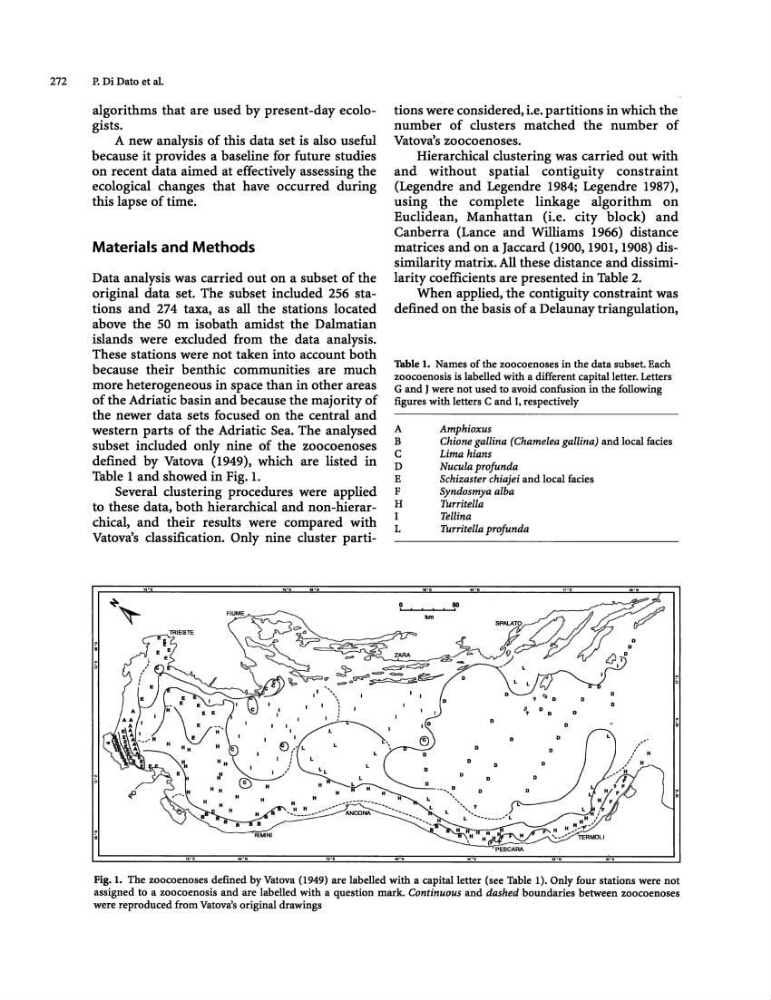
Table 1 and showed in Fig. 1.
Several clustering procedures were applied
to these data. both hierarchical and non-hierarchical, and their results were compared with
Vatova's classification. Only nine cluster partitions were considered, i.e. partitions in which the
number of clusters matched the number of
Vatova's zoocoenoses.
Hierarchical clustering was carried out with
and without spatial contiguity constraint
(Legendre and Legendre 1984; Legendre 1987),
using the complete linkage algorithm on
Euclidean, Manhattan (Le. city block) and
Canberra (Lance and Williams 1966) distance
matrices and on a Jaccard (1900, 1901, 1908) dissimilarity matrix. All these distance and dissimilarity coefficients are presented in Table 2.
When applied. the contiguity constraint was
defined on the basis of a Delaunay triangulation,
Table 1. Names of the zoocoenoses in the data subset. Each
zoocoenosis is labelled with a different capital letter. Letters
G and J were not used to avoid confusion in the following
figures with letters C and I, respectively
A
Amphioxus
B
Chione gallina (Chamelea gallina) and local facies
C
Lima hians
D
Nucula profunda
E
Schizaster chiajei and local facies
F
Syndosmya alba
H
Turritella
I
Tellina
L
Turritella profunda
D
D
Fig. 1. The zoocoenoses defined byVatova (1949) are labelled with a capital letter (see Table 1). Only four stations were not
assigned to a zoocoenosis and are labelled with a question mark. Continuous and dashed boundaries between zoocoenoses
were reproduced from Vatova's original drawings
P. Di Dam et al.
algorithms that are used by present-day ecologists.
A new analysis of this data set is also useful
because it provides a baseline for future studies
on recent data aimed at effectively assessing the
ecological changes that have occurred during
this lapse of time.
Materials and Methods
Data analysis was carried out on a subset of the
original data set. The subset included 256 stations and 274 taxa, as all the stations located
above the 50 m isobath amidst the Dalmatian
islands were excluded from the data analysis.
These stations were not taken into account both
because their benthic communities are much
more heterogeneous in space than in other areas
of the Adriatic basin and because the majority of
the newer data sets focused on the central and
western parts of the Adriatic Sea. The analysed
subset included only nine of the zoocoenoses
defined by Vatova (1949), which are listed in
Table 1 and showed in Fig. 1.
Several clustering procedures were applied
to these data. both hierarchical and non-hierarchical, and their results were compared with
Vatova's classification. Only nine cluster partitions were considered, i.e. partitions in which the
number of clusters matched the number of
Vatova's zoocoenoses.
Hierarchical clustering was carried out with
and without spatial contiguity constraint
(Legendre and Legendre 1984; Legendre 1987),
using the complete linkage algorithm on
Euclidean, Manhattan (Le. city block) and
Canberra (Lance and Williams 1966) distance
matrices and on a Jaccard (1900, 1901, 1908) dissimilarity matrix. All these distance and dissimilarity coefficients are presented in Table 2.
When applied. the contiguity constraint was
defined on the basis of a Delaunay triangulation,
Table 1. Names of the zoocoenoses in the data subset. Each
zoocoenosis is labelled with a different capital letter. Letters
G and J were not used to avoid confusion in the following
figures with letters C and I, respectively
A
Amphioxus
B
Chione gallina (Chamelea gallina) and local facies
C
Lima hians
D
Nucula profunda
E
Schizaster chiajei and local facies
F
Syndosmya alba
H
Turritella
I
Tellina
L
Turritella profunda
D
D
Fig. 1. The zoocoenoses defined byVatova (1949) are labelled with a capital letter (see Table 1). Only four stations were not
assigned to a zoocoenosis and are labelled with a question mark. Continuous and dashed boundaries between zoocoenoses
were reproduced from Vatova's original drawings