

Macro- and Meiobenthic Distribution in Anthropogenically Impacted Sediment
261
9
19
za
,...
3Q
...
~ 40
IE:
;;
12
50
...
S 6EI
I
....
i !i 5 7\\1
p:o
Ba
99
100
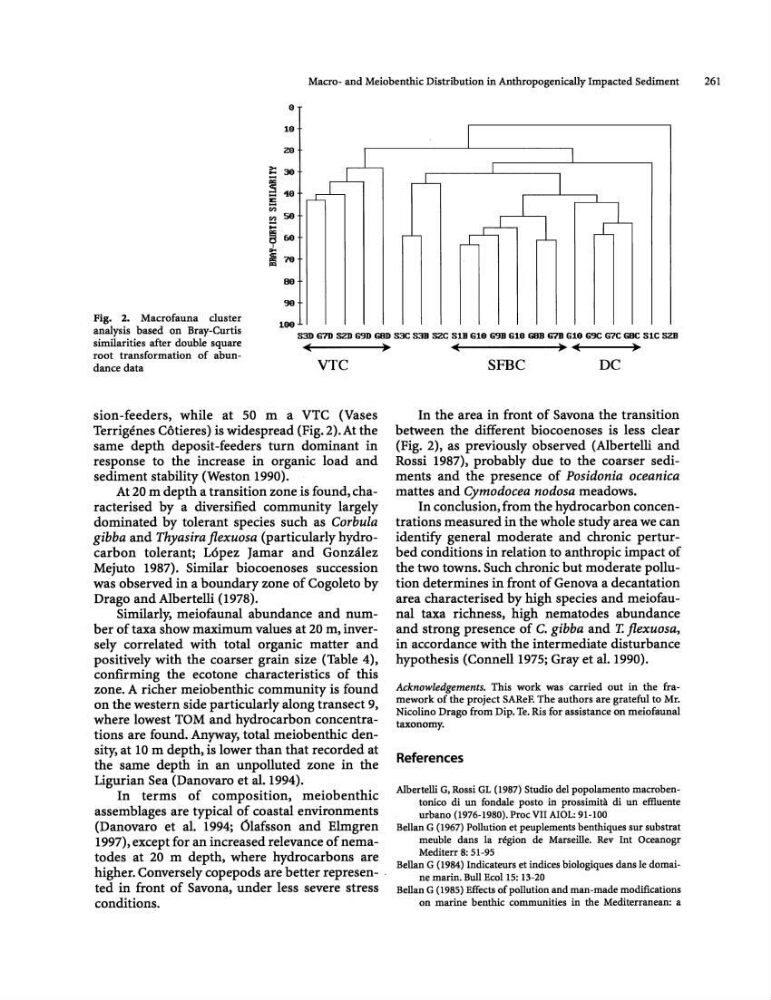
Fig. 2. Macrofauna cluster
analysis based on Bray-Curtis
similarities after double square
root transformation of abundance data
S3D G7D SZD G9D GOD S3C S3B SZC SiB GiG G9B G19 GOB G7B Gl0 G9C G7C G8C SiC SZB
. ) . ) . )
VTC
SFBC
DC
sion-feeders, while at 50 m a VTC (Vases
Terrigenes Cbtieres) is widespread {Fig. 2).At the
same depth deposit-feeders turn dominant in
response to the increase in organic load and
sediment stability (Weston 1990).
At 20 m depth a transition zone is found, characterised by a diversified community largely
dominated by tolerant species such as Corbula
gibba and Thyasira flexuosa (particularly hydrocarbon tolerant; L6pez Jamar and Gonzalez
Mejuto 1987). Similar biocoenoses succession
was observed in a boundary zone of Cogoleto by
Drago and Albertelli (1978).
Similarly, meiofaunal abundance and number of taxa show maximum values at 20 m, inversely correlated with total organic matter and
positively with the coarser grain size (Table 4),
confirming the ecotone characteristics of this
zone. A richer meiobenthic community is found
on the western side particularly along transect 9,
where lowest TOM and hydrocarbon concentrations are found. Anyway, total meiobenthic density, at 10m depth, is lower than that recorded at
the same depth in an unpolluted zone in the
Ligurian Sea (Danovaro et al. 1994).
In terms of composition, meiobenthic
assemblages are typical of coastal environments
(Danovaro et al 1994; CHafsson and Elmgren
1997), except for an increased relevance of nematodes at 20 m depth, where hydrocarbons are
higher. Conversely copepods are better represen- .
ted in front of Savona, under less severe stress
conditions.
In the area in front of Savona the transition
between the different biocoenoses is less dear
(Fig. 2), as previously observed (Albertelli and
Rossi 1987), probably due to the coarser sediments and the presence of Posidonia oceanica
mattes and Cymodocea nodosa meadows.
In conclusion, from the hydrocarbon concentrations measured in the whole study area we can
identify general moderate and chronic perturbed conditions in relation to anthropic impact of
the two towns. Such chronic but moderate pollution determines in front of Genova a decantation
area characterised by high species and meiofaunal taxa richness, high nematodes abundance
and strong presence of C. gibba and T. flexuosa,
in accordance with the intermediate disturbance
hypothesis (Connell 1975; Gray et al. 1990).
Acknowledgements. This work was carried out in the framework of the project SAReF. The authors are grateful to Mr.
Nicolino Drago from Dip. Te. Ris for assistance on meiofaunal
taxonomy.
References
Albertelli G, Rossi GL (1987) Studio del popolamento macrobentonico di un fondale posto in prossimita di un effiuente
urbano (1976-1980). Proc VII AlOL: 91-100
Bellan G (1967) Pollution et peuplements benthiques sur substrat
meuble dans la r~gion de Marseille. Rev lnt Oceanogr
Mediterr 8: 51-95
Bellan G (1984) Indicateurs et indices biologiques dans Ie domaine marin. Bull Eco115: 13-20
Bellan G (1985) Effects of pollution and man-made modifications
on marine benthic communities in the Mediterranean: a
261
9
19
za
,...
3Q
...
~ 40
IE:
;;
12
50
...
S 6EI
I
....
i !i 5 7\\1
p:o
Ba
99
100
Fig. 2. Macrofauna cluster
analysis based on Bray-Curtis
similarities after double square
root transformation of abundance data
S3D G7D SZD G9D GOD S3C S3B SZC SiB GiG G9B G19 GOB G7B Gl0 G9C G7C G8C SiC SZB
. ) . ) . )
VTC
SFBC
DC
sion-feeders, while at 50 m a VTC (Vases
Terrigenes Cbtieres) is widespread {Fig. 2).At the
same depth deposit-feeders turn dominant in
response to the increase in organic load and
sediment stability (Weston 1990).
At 20 m depth a transition zone is found, characterised by a diversified community largely
dominated by tolerant species such as Corbula
gibba and Thyasira flexuosa (particularly hydrocarbon tolerant; L6pez Jamar and Gonzalez
Mejuto 1987). Similar biocoenoses succession
was observed in a boundary zone of Cogoleto by
Drago and Albertelli (1978).
Similarly, meiofaunal abundance and number of taxa show maximum values at 20 m, inversely correlated with total organic matter and
positively with the coarser grain size (Table 4),
confirming the ecotone characteristics of this
zone. A richer meiobenthic community is found
on the western side particularly along transect 9,
where lowest TOM and hydrocarbon concentrations are found. Anyway, total meiobenthic density, at 10m depth, is lower than that recorded at
the same depth in an unpolluted zone in the
Ligurian Sea (Danovaro et al. 1994).
In terms of composition, meiobenthic
assemblages are typical of coastal environments
(Danovaro et al 1994; CHafsson and Elmgren
1997), except for an increased relevance of nematodes at 20 m depth, where hydrocarbons are
higher. Conversely copepods are better represen- .
ted in front of Savona, under less severe stress
conditions.
In the area in front of Savona the transition
between the different biocoenoses is less dear
(Fig. 2), as previously observed (Albertelli and
Rossi 1987), probably due to the coarser sediments and the presence of Posidonia oceanica
mattes and Cymodocea nodosa meadows.
In conclusion, from the hydrocarbon concentrations measured in the whole study area we can
identify general moderate and chronic perturbed conditions in relation to anthropic impact of
the two towns. Such chronic but moderate pollution determines in front of Genova a decantation
area characterised by high species and meiofaunal taxa richness, high nematodes abundance
and strong presence of C. gibba and T. flexuosa,
in accordance with the intermediate disturbance
hypothesis (Connell 1975; Gray et al. 1990).
Acknowledgements. This work was carried out in the framework of the project SAReF. The authors are grateful to Mr.
Nicolino Drago from Dip. Te. Ris for assistance on meiofaunal
taxonomy.
References
Albertelli G, Rossi GL (1987) Studio del popolamento macrobentonico di un fondale posto in prossimita di un effiuente
urbano (1976-1980). Proc VII AlOL: 91-100
Bellan G (1967) Pollution et peuplements benthiques sur substrat
meuble dans la r~gion de Marseille. Rev lnt Oceanogr
Mediterr 8: 51-95
Bellan G (1984) Indicateurs et indices biologiques dans Ie domaine marin. Bull Eco115: 13-20
Bellan G (1985) Effects of pollution and man-made modifications
on marine benthic communities in the Mediterranean: a