

higher than 2 m, i.e. the maximum 'significant'
wave according to Dennyet al. 1985). Besides,
whereas waves usually come from the southwest,
on this occasion they changed from the west,
directly striking the area under investigation.
Much of the rocky substrate down to about
10-12 m depth was scoured severely by the storm
at Tino Island. Numerous Pentapora fascialis
colonies were damaged or swept away; remnants
were seen lying at the base of the cliff on horizontal substrates down to 25 m depth, adding
carbonatic coarse debris to the muddy bottom.
Dislodgement and dispersal of fragments and
entire massive colonies under the influence of
severe storm is commonplace for corals in tropical reefs where hurricanes are more frequent and
severe (Woodley et at 1981), but have never been
reported for massive carbonatic organisms in the
Mediterranean.
The sea-storm had different effects on the
two monitored stations.
In the shallow station, at 11 m depth, one
month before the storm eight differently sized
colonies (from 150 to 2400 cm 2 ) were present.
Seven out of eight colonies were dislodged away.
the medium size (490 cm 2 ) survivor being sheltered in a rocky fissure. Colony removal, i.e. total
mortality, was not size selective. Even if the most
current- or wave-vulnerable colonies are those
with a large cross-sectional area, hence large
drag, and poor adhesion to the substratum
(Cheetham 1986; McKinney and Jackson 1989),
differently sized colonies of Pentapora fascialis
were equally swept away by the storm.
Also mutual buttressing, that is the physical
support among closely adjacent and intertwined
colonies, was not effective in preventing mortality in the shallow station, where high density
10cm
Mortality of the Bryozoan Pentapora foscialis after Disturbance
243
aggregation colonies cover up to 53% of the
available substratum.
In the deeper station (22 m depth), one
month before the storm, seven colonies, ranging
from 80 to 2100 cm 2 were present, covering up to
52 % of the substratum. Only partial mortality
was observed after the storm, exclusively affecting the largest colony. The outcome was an
enlargement of the necrotic portion present in
the central area of the colony and the loss of a
portion of the colony, thus causing its splitting up
into two. In this case, partial mortality was sizedependent as it was enhanced by the long-lasting
pressure of epibiosis and fine sediment load on
the central parts of the large sized colony.
The high sedimentation load. occurring in
both stations as extensive thin sheet overlying a
portion of the colonies and the substrate, contributed to the colony necrosis. Sediment, together with the overgrowth by encrusting algae and
the overlying algal turf, as already observed in a
shallow rocky coastal area in the Ligurian Sea
(Airoldi et aI. 1996), reduced the living bryozoan
surface over several years prior to mortality.
The vulnerability of P. fascialis colonies to
dislodgement by waves or current varied
throughout their lifetime as the morphology
changed with increasing size. In fact. colony's
vulnerability has been demonstrated to be related to its erect growth form (Cheetham and
Thomsen 1981; McKinney and Jackson 1989) and
to the degree of exposure (Connell and Keough
1985). Similar observations were evidenced by
Done (1992) in massive corals (genus Porites). In
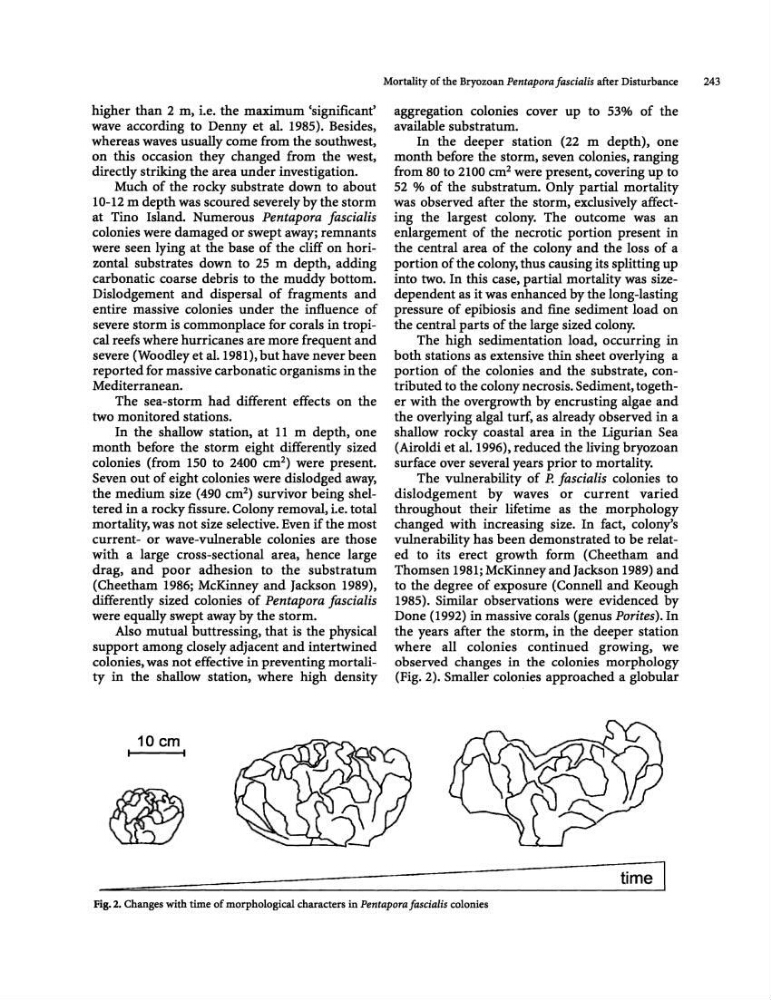
the years after the storm, in the deeper station
where all colonies continued growing. we
observed changes in the colonies morphology
(Fig. 2). Smaller colonies approached a globular
time
Fig. 2. Changes with time of morphological characters in Pentapora fascialis colonies
wave according to Dennyet al. 1985). Besides,
whereas waves usually come from the southwest,
on this occasion they changed from the west,
directly striking the area under investigation.
Much of the rocky substrate down to about
10-12 m depth was scoured severely by the storm
at Tino Island. Numerous Pentapora fascialis
colonies were damaged or swept away; remnants
were seen lying at the base of the cliff on horizontal substrates down to 25 m depth, adding
carbonatic coarse debris to the muddy bottom.
Dislodgement and dispersal of fragments and
entire massive colonies under the influence of
severe storm is commonplace for corals in tropical reefs where hurricanes are more frequent and
severe (Woodley et at 1981), but have never been
reported for massive carbonatic organisms in the
Mediterranean.
The sea-storm had different effects on the
two monitored stations.
In the shallow station, at 11 m depth, one
month before the storm eight differently sized
colonies (from 150 to 2400 cm 2 ) were present.
Seven out of eight colonies were dislodged away.
the medium size (490 cm 2 ) survivor being sheltered in a rocky fissure. Colony removal, i.e. total
mortality, was not size selective. Even if the most
current- or wave-vulnerable colonies are those
with a large cross-sectional area, hence large
drag, and poor adhesion to the substratum
(Cheetham 1986; McKinney and Jackson 1989),
differently sized colonies of Pentapora fascialis
were equally swept away by the storm.
Also mutual buttressing, that is the physical
support among closely adjacent and intertwined
colonies, was not effective in preventing mortality in the shallow station, where high density
10cm
Mortality of the Bryozoan Pentapora foscialis after Disturbance
243
aggregation colonies cover up to 53% of the
available substratum.
In the deeper station (22 m depth), one
month before the storm, seven colonies, ranging
from 80 to 2100 cm 2 were present, covering up to
52 % of the substratum. Only partial mortality
was observed after the storm, exclusively affecting the largest colony. The outcome was an
enlargement of the necrotic portion present in
the central area of the colony and the loss of a
portion of the colony, thus causing its splitting up
into two. In this case, partial mortality was sizedependent as it was enhanced by the long-lasting
pressure of epibiosis and fine sediment load on
the central parts of the large sized colony.
The high sedimentation load. occurring in
both stations as extensive thin sheet overlying a
portion of the colonies and the substrate, contributed to the colony necrosis. Sediment, together with the overgrowth by encrusting algae and
the overlying algal turf, as already observed in a
shallow rocky coastal area in the Ligurian Sea
(Airoldi et aI. 1996), reduced the living bryozoan
surface over several years prior to mortality.
The vulnerability of P. fascialis colonies to
dislodgement by waves or current varied
throughout their lifetime as the morphology
changed with increasing size. In fact. colony's
vulnerability has been demonstrated to be related to its erect growth form (Cheetham and
Thomsen 1981; McKinney and Jackson 1989) and
to the degree of exposure (Connell and Keough
1985). Similar observations were evidenced by
Done (1992) in massive corals (genus Porites). In
the years after the storm, in the deeper station
where all colonies continued growing. we
observed changes in the colonies morphology
(Fig. 2). Smaller colonies approached a globular
time
Fig. 2. Changes with time of morphological characters in Pentapora fascialis colonies