

242
S. Cocho and S. Sgorbini
Materials and Methods
The bryozoan Pentapora fascialis (Pallas) lives
on hard and stable subtidal bottoms, down to 50
m or more (Gautier 1962); it is common on rocks
exposed to strong currents (Hayward and Ryland
1979). It commonly develops massive erect
colonies, with an encrusting base and convoluted
bilamina sheets arising (Hayward and Ryland
1979; Jackson 1979), growing to a diameter of 2030 cm (Sala et al. 1996). The P. fascialis is a perennial species with a growth-vertical rate up to 3.5
cm·r l when epibiosis is reduced (Cocito and
Ferdeghini 1998). In the study sites, the population is formed by 7 ± 1.5 colonies·m 2 , growing
closely adjacent and intertwined, and showing
fusion among satellite colonies (Cocito et al.
1998b); at Medes Island the population has been
reported to be made by 3.3 ± 2.5 colonies·m 2
(Sala et al. 1996).
The study site, Tino Island (latitude 44°01'
north, longitude 9°50' east), was located at the
western border of the Gulf of La Spezia (eastern
Ligurian Sea, Italy).
Current measurements were taken in the
area for a two-year period (1993-1994) through
Aanderaa and electromagnetic currentmeters.
Currents had medium speed of 17 cm·s- I , ranging from 9 cm·s- 1 during summer months (S.
Sgorbini, unpublished data) to maximum speed
of 80 cm·s- 1 in autumn-winter (Cocito et al.
1997). In December 1993, during the sea-storm,
current measurements were not registered. Wave
measurements were registered for an eight-year
period (1989-1996) and the maximum 'signifi.12
10
D ma-.:imllm wave height (m)
D Illlmberofdays with wave height > 2m
8
-
6
2
0
0)
0
0
~
C\J
C\J
C":l
C"')
'<:t
'<:t
co
O'l
O'l
O'l
O'l
O'l
O'l
O'l
O'l
0>
0>
C3
c:: C3 c:: C3 c:: C3 c:: C3 c:: C3
0
CIS
0
CIS
0
m 0
CIS
0
m 0
,
J
J
,
J
cant' wave (> 2 m) (Denny et al. 1985) was taken
into account.
Two photographic stations were established
on the rocky bottom with 1m2 quadrats permanently marked with metal stakes at 11 and 22 m
depth. The shallow station lay on a vertical cliff
facing northwest; the deep station was located on
a sloping substrate facing west. Photographs with
Nikonos camera and 15 mm lens were taken
periodically at 3-7 month intervals from
November 1993 to November 1997. On images,
vectorial digitisation and storage of computerassisted drawings were produced with Autocad
lll
software. Polygon areas represented the total
projected area on the two-dimensional substrate.
The complete procedure is described by Sgorbini
et al. (1996).
Results and Discussion
The difference in relative frequency of factors
that caused total mortality in the course of the
whole investigation period at the 2 depth stations is a result of difference in exposure to a
high wave-energy event, and thus to storm
impact.
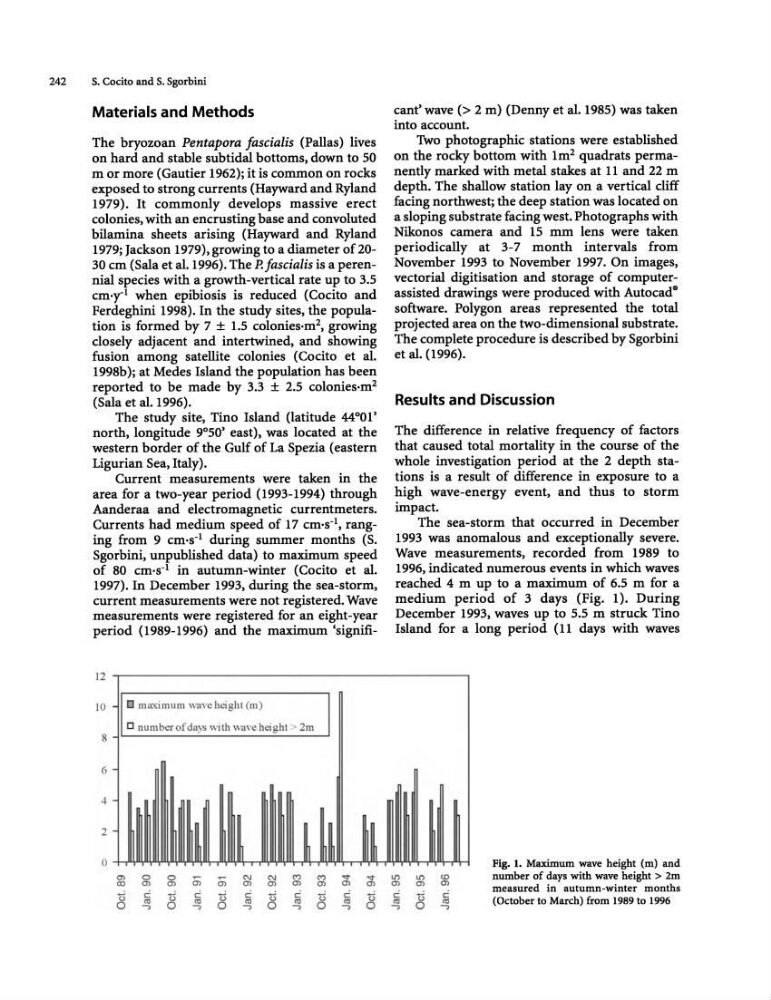
The sea-storm that occurred in December
1993 was anomalous and exceptionally severe.
Wave measurements, recorded from 1989 to
1996, indicated numerous events in which waves
reached 4 m up to a maximum of 6.5 m for a
medium period of 3 days (Fig. 1). During
December 1993, waves up to 5.5 m struck Tino
Island for a long period (11 days with waves
Fig. 1. Maximum wave height (m) and
10
10
CD
number of days with wave height> 2m
O'l
O'l
0>
c::
c::
measured in autumn-winter months
C3
CIS
0
CIS
(October to March) from 1989 to 1996
J
...,
S. Cocho and S. Sgorbini
Materials and Methods
The bryozoan Pentapora fascialis (Pallas) lives
on hard and stable subtidal bottoms, down to 50
m or more (Gautier 1962); it is common on rocks
exposed to strong currents (Hayward and Ryland
1979). It commonly develops massive erect
colonies, with an encrusting base and convoluted
bilamina sheets arising (Hayward and Ryland
1979; Jackson 1979), growing to a diameter of 2030 cm (Sala et al. 1996). The P. fascialis is a perennial species with a growth-vertical rate up to 3.5
cm·r l when epibiosis is reduced (Cocito and
Ferdeghini 1998). In the study sites, the population is formed by 7 ± 1.5 colonies·m 2 , growing
closely adjacent and intertwined, and showing
fusion among satellite colonies (Cocito et al.
1998b); at Medes Island the population has been
reported to be made by 3.3 ± 2.5 colonies·m 2
(Sala et al. 1996).
The study site, Tino Island (latitude 44°01'
north, longitude 9°50' east), was located at the
western border of the Gulf of La Spezia (eastern
Ligurian Sea, Italy).
Current measurements were taken in the
area for a two-year period (1993-1994) through
Aanderaa and electromagnetic currentmeters.
Currents had medium speed of 17 cm·s- I , ranging from 9 cm·s- 1 during summer months (S.
Sgorbini, unpublished data) to maximum speed
of 80 cm·s- 1 in autumn-winter (Cocito et al.
1997). In December 1993, during the sea-storm,
current measurements were not registered. Wave
measurements were registered for an eight-year
period (1989-1996) and the maximum 'signifi.12
10
D ma-.:imllm wave height (m)
D Illlmberofdays with wave height > 2m
8
-
6
2
0
0)
0
0
~
C\J
C\J
C":l
C"')
'<:t
'<:t
co
O'l
O'l
O'l
O'l
O'l
O'l
O'l
O'l
0>
0>
C3
c:: C3 c:: C3 c:: C3 c:: C3 c:: C3
0
CIS
0
CIS
0
m 0
CIS
0
m 0
,
J
J
,
J
cant' wave (> 2 m) (Denny et al. 1985) was taken
into account.
Two photographic stations were established
on the rocky bottom with 1m2 quadrats permanently marked with metal stakes at 11 and 22 m
depth. The shallow station lay on a vertical cliff
facing northwest; the deep station was located on
a sloping substrate facing west. Photographs with
Nikonos camera and 15 mm lens were taken
periodically at 3-7 month intervals from
November 1993 to November 1997. On images,
vectorial digitisation and storage of computerassisted drawings were produced with Autocad
lll
software. Polygon areas represented the total
projected area on the two-dimensional substrate.
The complete procedure is described by Sgorbini
et al. (1996).
Results and Discussion
The difference in relative frequency of factors
that caused total mortality in the course of the
whole investigation period at the 2 depth stations is a result of difference in exposure to a
high wave-energy event, and thus to storm
impact.
The sea-storm that occurred in December
1993 was anomalous and exceptionally severe.
Wave measurements, recorded from 1989 to
1996, indicated numerous events in which waves
reached 4 m up to a maximum of 6.5 m for a
medium period of 3 days (Fig. 1). During
December 1993, waves up to 5.5 m struck Tino
Island for a long period (11 days with waves
Fig. 1. Maximum wave height (m) and
10
10
CD
number of days with wave height> 2m
O'l
O'l
0>
c::
c::
measured in autumn-winter months
C3
CIS
0
CIS
(October to March) from 1989 to 1996
J
...,