

230
M. Bartoli et al.
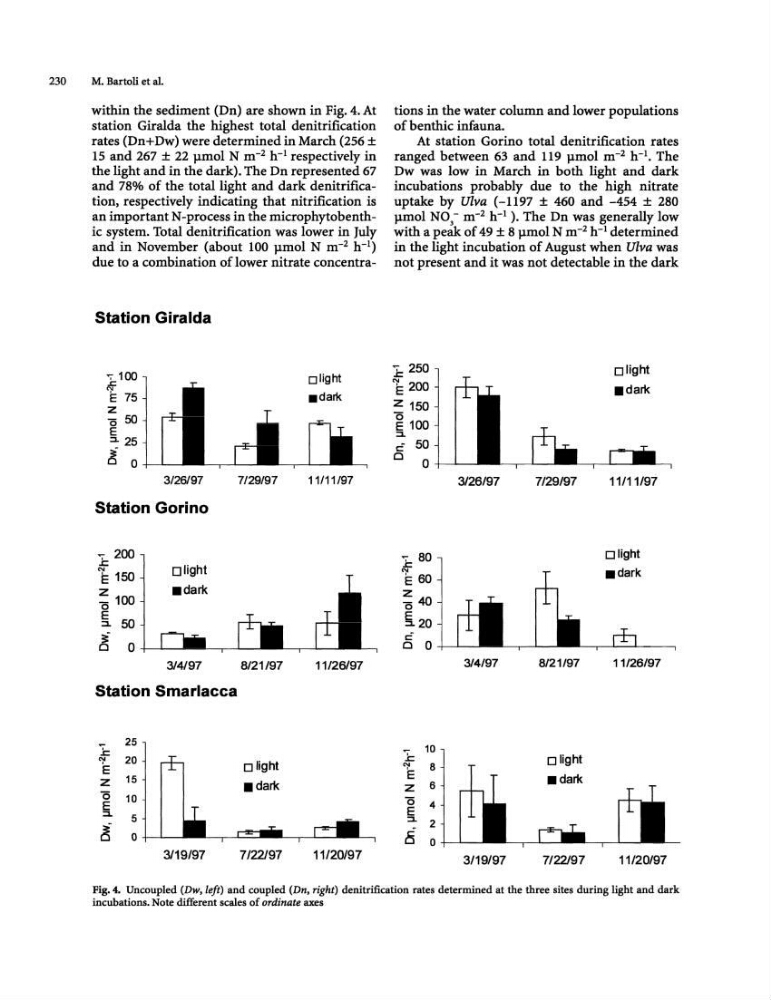
within the sediment (Dn) are shown in Fig. 4. At
station Giralda the highest total denitrification
rates (Dn+ Dw) were determined in March (256 ±
15 and 267 ± 22 Jlmol N m- 2 h- 1 respectively in
the light and in the dark). The Dn represented 67
and 78% of the total light and dark denitrification, respectively indicating that nitrification is
an important N-process in the microphytobenthic system. Total denitrification was lower in July
and in November (about 100 Jlmol N m- 2 h- 1 )
due to a combination of lower nitrate concentraStation Giralda
'7 100
o light
IiE 75
.dark
z
0 50
E
:::L 25
~ 0
3/26197
7129/97
11111/97
Station Gorino
... 200
.c:
o light
N
E 150
~ 100
• dark
0
§.50
~ 0
314/97
8121197
11/26197
Station Smarlacca
-
25
.l=
"!
20
o light
E
Z
15
• dark
(5
10
E
:::L
5
~ 0
3119/97
7/22197
11/20/97
tions in the water column and lower populations
of benthic infauna.
At station Gorino total denitrification rates
ranged between 63 and 119 Jlmol m- 2 h- 1 • The
Dw was low in March in both light and dark
incubations probably due to the high nitrate
uptake by Ulva (-1197 ± 460 and -454 ± 280
}lmo! N0 3 - m- 2 h- 1 ). The Dn was generally low
with a peak of 49 ± 8 Jlmol N m- 2 h- 1 determined
in the light incubation of August when Ulva was
not present and it was not detectable in the dark
1: 250
o light
1200
• dark
z 150
(5
E 100
:::L
c;:- 50
Q
a
3126/97
7129/97
11/11/97
'7 80
o light
.s::.
N
E 60
• dark
~40 0
§..20
c
Q
a
314197
8/21/97
11/26/97
10
1:
o light
1
8
• dark
z 6
(5
4
E ::L 2
8 0
3119/97
7/22197
11/20/97
Fig.4. Uncoupled (Dw, left) and coupled (Dn, right) denitrification rates determined at the three sites during light and dark
incubations. Note different scales of ordinate axes
M. Bartoli et al.
within the sediment (Dn) are shown in Fig. 4. At
station Giralda the highest total denitrification
rates (Dn+ Dw) were determined in March (256 ±
15 and 267 ± 22 Jlmol N m- 2 h- 1 respectively in
the light and in the dark). The Dn represented 67
and 78% of the total light and dark denitrification, respectively indicating that nitrification is
an important N-process in the microphytobenthic system. Total denitrification was lower in July
and in November (about 100 Jlmol N m- 2 h- 1 )
due to a combination of lower nitrate concentraStation Giralda
'7 100
o light
IiE 75
.dark
z
0 50
E
:::L 25
~ 0
3/26197
7129/97
11111/97
Station Gorino
... 200
.c:
o light
N
E 150
~ 100
• dark
0
§.50
~ 0
314/97
8121197
11/26197
Station Smarlacca
-
25
.l=
"!
20
o light
E
Z
15
• dark
(5
10
E
:::L
5
~ 0
3119/97
7/22197
11/20/97
tions in the water column and lower populations
of benthic infauna.
At station Gorino total denitrification rates
ranged between 63 and 119 Jlmol m- 2 h- 1 • The
Dw was low in March in both light and dark
incubations probably due to the high nitrate
uptake by Ulva (-1197 ± 460 and -454 ± 280
}lmo! N0 3 - m- 2 h- 1 ). The Dn was generally low
with a peak of 49 ± 8 Jlmol N m- 2 h- 1 determined
in the light incubation of August when Ulva was
not present and it was not detectable in the dark
1: 250
o light
1200
• dark
z 150
(5
E 100
:::L
c;:- 50
Q
a
3126/97
7129/97
11/11/97
'7 80
o light
.s::.
N
E 60
• dark
~40 0
§..20
c
Q
a
314197
8/21/97
11/26/97
10
1:
o light
1
8
• dark
z 6
(5
4
E ::L 2
8 0
3119/97
7/22197
11/20/97
Fig.4. Uncoupled (Dw, left) and coupled (Dn, right) denitrification rates determined at the three sites during light and dark
incubations. Note different scales of ordinate axes