

Fluxes and Denitrification within Communities of Different Primary Producers
229
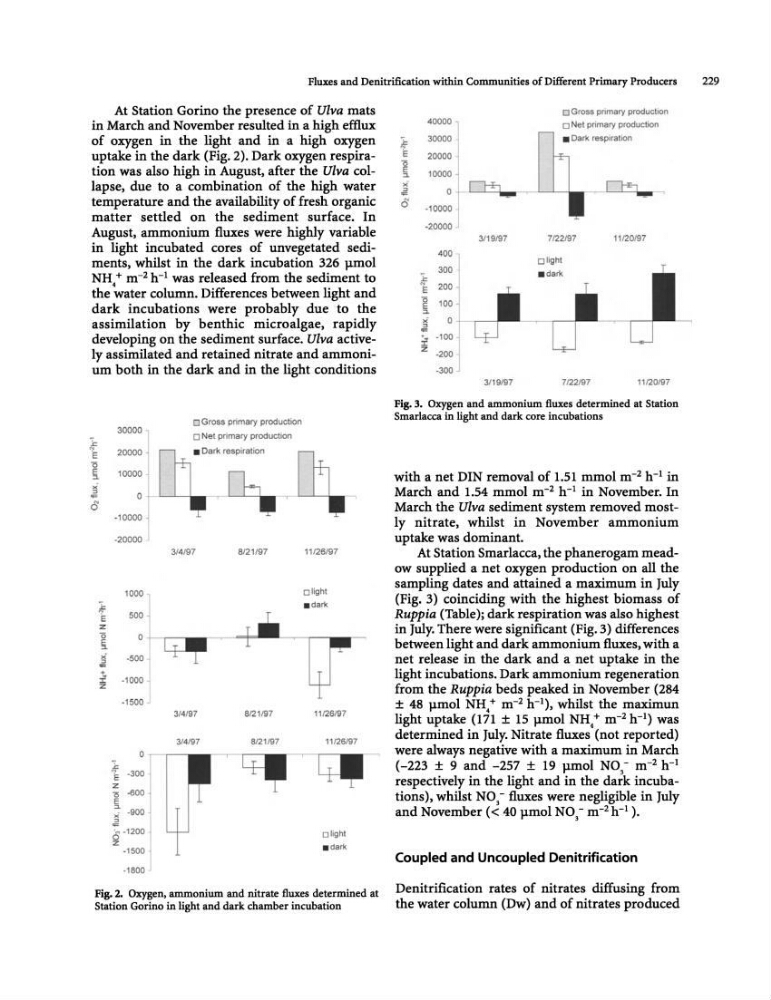
At Station Gorino the presence of Ulva mats
in March and November resulted in a high efflux
of oxygen in the light and in a high oxygen
uptake in the dark (Fig. 2). Dark oxygen respiration was also high in August, after the Ulva collapse, due to a combination of the high water
temperature and the availability of fresh organic
matter settled on the sediment surface. In
August, ammonium fluxes were highly variable
in light incubated cores of unvegetated sediments, whilst in the dark incubation 326 }lmol
NH/ m- 2 h- 1 was released from the sediment to
the water column. Differences between light and
dark incubations were probably due to the
assimilation by benthic microalgae, rapidly
developing on the sediment surface. Ulva actively assimilated and retained nitrate and ammonium both in the dark and in the light conditions
30000
J:::
':' E
20000
"0
E
10000
x~
0
'"
0
-10000
-20000
~
1000
1
E
500
z
"0
0
S.
x
-500
::>
'"'
~ -1000
z
-1500
0
.<:
1: -300
z
0 -600
E
:l.
~
-900
a -1200
z -1500
-1800
o Gross primary production
o Net primary production
• Dark respiration
3/4/9 7
8/21/97
314197
8121197
3/4197
8121 /97
11/26/97
Olight
• dark
11126/97
11126197
o light
. dark
Fig.2. Oxygen, ammonium and nitrate fluxes determined at
Station Gorino in light and dark chamber incubation
40000
1
30000
20000
-0
E
10000
:l.
x
::>
0
'"'
0 -10000
-20000
400
300
l= 200
E
"0
100
E
:l.
x
~
0
;: -100
Z
-200
-300
3/19/9 7
3119/97
o Gross primary production
o Net primary production
• DarK respiration
7/22/97
11/20/97
7122197
11/20197
Fig. 3. Oxygen and ammonium fluxes determined at Station
Smarlacca in light and dark core incubations
with a net DIN removal of 1.51 mmol m- 2 h- 1 in
March and 1.54 mmol m- 2 h- 1 in November. In
March the Ulva sediment system removed mostly nitrate, whilst in November ammonium
uptake was dominant.
At Station Smarlacca, the phanerogam meadow supplied a net oxygen production on all the
sampling dates and attained a maximum in July
(Fig. 3) coinciding with the highest biomass of
Ruppia (Table); dark respiration was also highest
in July. There were significant (Fig. 3) differences
between light and dark ammonium fluxes, with a
net release in the dark and a net uptake in the
light incubations. Dark ammonium regeneration
from the Ruppia beds peaked in November (284
± 48 }lmol NH/ m- 2 h- 1 ). whilst the maximun
light uptake (171 ± 15 }lmol NH/ m- 2 h- 1 ) was
determined in July. Nitrate fluxes (not reported)
were always negative with a maximum in March
(-223 ± 9 and -257 ± 19 }lIDol N0 3 - m- 2 h- 1
respectively in the light and in the dark incubations), whilst NO;- fluxes were negligible in July
and November « 40 }lmo! NO;- m- 2 h- 1 ).
Coupled and Uncoupled Denitrification
Denitrification rates of nitrates diffusing from
the water column (Dw) and of nitrates produced
229
At Station Gorino the presence of Ulva mats
in March and November resulted in a high efflux
of oxygen in the light and in a high oxygen
uptake in the dark (Fig. 2). Dark oxygen respiration was also high in August, after the Ulva collapse, due to a combination of the high water
temperature and the availability of fresh organic
matter settled on the sediment surface. In
August, ammonium fluxes were highly variable
in light incubated cores of unvegetated sediments, whilst in the dark incubation 326 }lmol
NH/ m- 2 h- 1 was released from the sediment to
the water column. Differences between light and
dark incubations were probably due to the
assimilation by benthic microalgae, rapidly
developing on the sediment surface. Ulva actively assimilated and retained nitrate and ammonium both in the dark and in the light conditions
30000
J:::
':' E
20000
"0
E
10000
x~
0
'"
0
-10000
-20000
~
1000
1
E
500
z
"0
0
S.
x
-500
::>
'"'
~ -1000
z
-1500
0
.<:
1: -300
z
0 -600
E
:l.
~
-900
a -1200
z -1500
-1800
o Gross primary production
o Net primary production
• Dark respiration
3/4/9 7
8/21/97
314197
8121197
3/4197
8121 /97
11/26/97
Olight
• dark
11126/97
11126197
o light
. dark
Fig.2. Oxygen, ammonium and nitrate fluxes determined at
Station Gorino in light and dark chamber incubation
40000
1
30000
20000
-0
E
10000
:l.
x
::>
0
'"'
0 -10000
-20000
400
300
l= 200
E
"0
100
E
:l.
x
~
0
;: -100
Z
-200
-300
3/19/9 7
3119/97
o Gross primary production
o Net primary production
• DarK respiration
7/22/97
11/20/97
7122197
11/20197
Fig. 3. Oxygen and ammonium fluxes determined at Station
Smarlacca in light and dark core incubations
with a net DIN removal of 1.51 mmol m- 2 h- 1 in
March and 1.54 mmol m- 2 h- 1 in November. In
March the Ulva sediment system removed mostly nitrate, whilst in November ammonium
uptake was dominant.
At Station Smarlacca, the phanerogam meadow supplied a net oxygen production on all the
sampling dates and attained a maximum in July
(Fig. 3) coinciding with the highest biomass of
Ruppia (Table); dark respiration was also highest
in July. There were significant (Fig. 3) differences
between light and dark ammonium fluxes, with a
net release in the dark and a net uptake in the
light incubations. Dark ammonium regeneration
from the Ruppia beds peaked in November (284
± 48 }lmol NH/ m- 2 h- 1 ). whilst the maximun
light uptake (171 ± 15 }lmol NH/ m- 2 h- 1 ) was
determined in July. Nitrate fluxes (not reported)
were always negative with a maximum in March
(-223 ± 9 and -257 ± 19 }lIDol N0 3 - m- 2 h- 1
respectively in the light and in the dark incubations), whilst NO;- fluxes were negligible in July
and November « 40 }lmo! NO;- m- 2 h- 1 ).
Coupled and Uncoupled Denitrification
Denitrification rates of nitrates diffusing from
the water column (Dw) and of nitrates produced