

200
A. Granata et aI.
pophagous, medium-sized fishes prey on
euphausiids and large ones on other fishes.
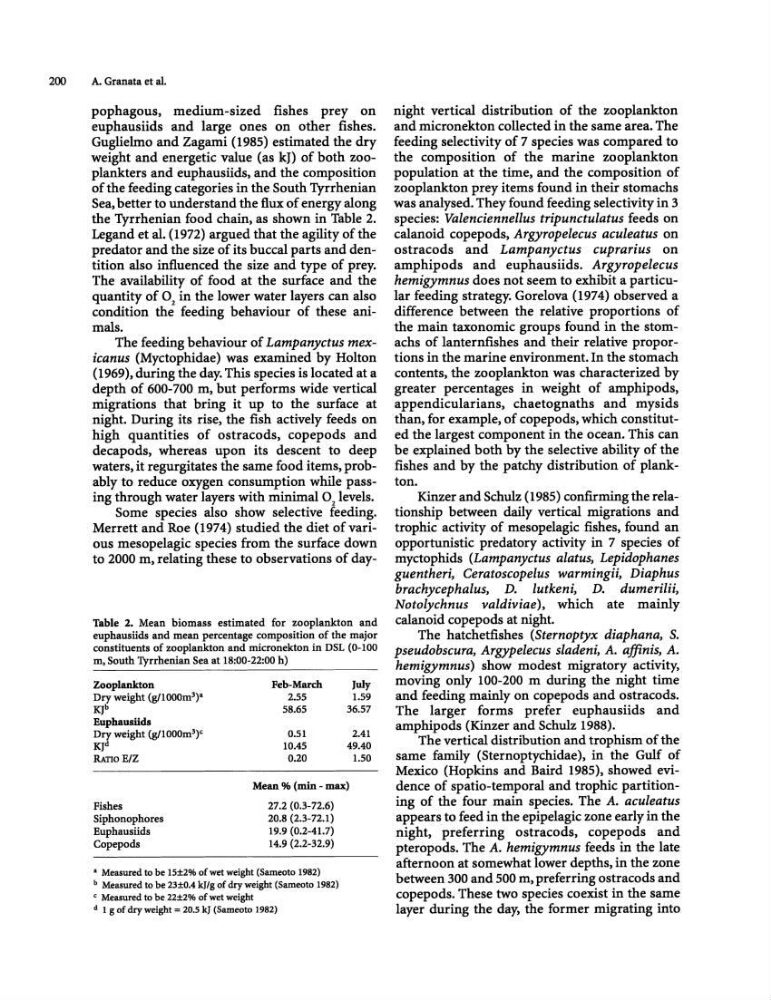
Guglielmo and Zagami (1985) estimated the dry
weight and energetic value (as kJ) of both zooplankters and euphausiids. and the composition
of the feeding categories in the South Tyrrhenian
Sea, better to understand the flux of energy along
the Tyrrhenian food chain, as shown in Table 2.
Legand et al. (1972) argued that the agility of the
predator and the size of its buccal parts and dentition also influenced the size and type of prey.
The availability of food at the surface and the
quantity of O 2 in the lower water layers can also
condition the feeding behaviour of these animals.
The feeding behaviour of Lampan),ctus mexicanus (Myctophidae) was examined by Holton
(1969), during the day. This species is located at a
depth of 600-700 m. but performs wide vertical
migrations that bring it up to the surface at
night. During its rise, the fish actively feeds on
high quantities of ostracods, copepods and
decapods, whereas upon its descent to deep
waters, it regurgitates the same food items, probably to reduce oxygen consumption while passing through water layers with minimal O 2 levels.
Some species also show selective feeding.
Merrett and Roe (1974) studied the diet ofvarious mesopelagic species from the surface down
to 2000 m, relating these to observations of dayTable 2. Mean biomass estimated for zooplankton and
euphausiids and mean percentage composition of the major
constituents of zooplankton and micronekton in DSL (0-100
m, South Tyrrhenian Sea at 18:00-22:00 h)
Zooplankton
Dry weight (gllOOOm 3 )X
KJb
Euphausiids
Dry weight (gll000m 3 )<
KJd
RATIOE/Z
Fishes
Siphonophores
Euphausiids
Copepoda
Feb-March
2.55
58.65
0.51
10.45
0.20
July
1.59
36.57
2.41
49.40
1.50
Mean % (min - max)
27.2 (0.3-72.6)
20.8 (2.3-72.1)
19.9 (0.2-41.7)
14.9 (2.2-32.9)
a Measured to be 15±2% of wet weight (Sameoto 1982)
b Measured to be 23±0.4 kJ/g of dry weight (Sameoto 1982)
C Measured to be 22±2% of wet weight
dIg of dry weight = 20.5 kJ (Sameoto 1982)
night vertical distribution of the zooplankton
and micronekton collected in the same area. The
feeding selectivity of 7 species was compared to
the composition of the marine zooplankton
population at the time, and the composition of
zooplankton prey items found in their stomachs
was analysed. They found feeding selectivity in 3
species: Valenciennellus tripunctulatus feeds on
calanoid copepods, Argyropelecus aculeatus on
ostracods and Lampan),ctus cuprarius on
amphipods and euphausiids. Arg)'ropelecus
hemigymnus does not seem to exhibit a particular feeding strategy. Gorelova (1974) observed a
difference between the relative proportions of
the main taxonomic groups found in the stomachs of lanternfishes and their relative proportions in the marine environment. In the stomach
contents, the zooplankton was characterized by
greater percentages in weight of amphipods,
appendicularians, chaetognaths and mysids
than, for example, of copepods, which constituted the largest component in the ocean. This can
be explained both by the selective ability of the
fishes and by the patchy distribution of plankton.
Kinzer and Schulz (1985) confirming the relationship between daily vertical migrations and
trophic activity of mesope1agic fishes, found an
opportunistic predatory activity in 7 species of
myctophids (Lampan),ctus alatus, Lepidophanes
guentheri, Ceratoscopelus warmingii, Diaphus
brach),cephalus, D. lutkeni, D. dumerilii,
Notol),chnus valdiviae), which ate mainly
calanoid copepods at night.
The hatchetfishes (Sternopt)'x diaphana. S.
pseudobscura, Arg)'pelecus sladeni, A. affinis, A.
hemig)'mnus) show modest migratory activity.
moving only 100-200 m during the night time
and feeding mainly on copepods and ostracods.
The larger forms prefer euphausiids and
amphipods (Kinzer and Schulz 1988).
The vertical distribution and trophism of the
same family (Sternoptychidae), in the Gulf of
Mexico (Hopkins and Baird 1985), showed evidence of spatio-temporal and trophic partitioning of the four main species. The A. aculeatus
appears to feed in the epipelagic zone early in the
night. preferring ostracods, copepods and
pteropods. The A. hemig)'mnus feeds in the late
afternoon at somewhat lower depths, in the zone
between 300 and 500 m, preferring ostracods and
copepods. These two species coexist in the same
layer during the day, the former migrating into
A. Granata et aI.
pophagous, medium-sized fishes prey on
euphausiids and large ones on other fishes.
Guglielmo and Zagami (1985) estimated the dry
weight and energetic value (as kJ) of both zooplankters and euphausiids. and the composition
of the feeding categories in the South Tyrrhenian
Sea, better to understand the flux of energy along
the Tyrrhenian food chain, as shown in Table 2.
Legand et al. (1972) argued that the agility of the
predator and the size of its buccal parts and dentition also influenced the size and type of prey.
The availability of food at the surface and the
quantity of O 2 in the lower water layers can also
condition the feeding behaviour of these animals.
The feeding behaviour of Lampan),ctus mexicanus (Myctophidae) was examined by Holton
(1969), during the day. This species is located at a
depth of 600-700 m. but performs wide vertical
migrations that bring it up to the surface at
night. During its rise, the fish actively feeds on
high quantities of ostracods, copepods and
decapods, whereas upon its descent to deep
waters, it regurgitates the same food items, probably to reduce oxygen consumption while passing through water layers with minimal O 2 levels.
Some species also show selective feeding.
Merrett and Roe (1974) studied the diet ofvarious mesopelagic species from the surface down
to 2000 m, relating these to observations of dayTable 2. Mean biomass estimated for zooplankton and
euphausiids and mean percentage composition of the major
constituents of zooplankton and micronekton in DSL (0-100
m, South Tyrrhenian Sea at 18:00-22:00 h)
Zooplankton
Dry weight (gllOOOm 3 )X
KJb
Euphausiids
Dry weight (gll000m 3 )<
KJd
RATIOE/Z
Fishes
Siphonophores
Euphausiids
Copepoda
Feb-March
2.55
58.65
0.51
10.45
0.20
July
1.59
36.57
2.41
49.40
1.50
Mean % (min - max)
27.2 (0.3-72.6)
20.8 (2.3-72.1)
19.9 (0.2-41.7)
14.9 (2.2-32.9)
a Measured to be 15±2% of wet weight (Sameoto 1982)
b Measured to be 23±0.4 kJ/g of dry weight (Sameoto 1982)
C Measured to be 22±2% of wet weight
dIg of dry weight = 20.5 kJ (Sameoto 1982)
night vertical distribution of the zooplankton
and micronekton collected in the same area. The
feeding selectivity of 7 species was compared to
the composition of the marine zooplankton
population at the time, and the composition of
zooplankton prey items found in their stomachs
was analysed. They found feeding selectivity in 3
species: Valenciennellus tripunctulatus feeds on
calanoid copepods, Argyropelecus aculeatus on
ostracods and Lampan),ctus cuprarius on
amphipods and euphausiids. Arg)'ropelecus
hemigymnus does not seem to exhibit a particular feeding strategy. Gorelova (1974) observed a
difference between the relative proportions of
the main taxonomic groups found in the stomachs of lanternfishes and their relative proportions in the marine environment. In the stomach
contents, the zooplankton was characterized by
greater percentages in weight of amphipods,
appendicularians, chaetognaths and mysids
than, for example, of copepods, which constituted the largest component in the ocean. This can
be explained both by the selective ability of the
fishes and by the patchy distribution of plankton.
Kinzer and Schulz (1985) confirming the relationship between daily vertical migrations and
trophic activity of mesope1agic fishes, found an
opportunistic predatory activity in 7 species of
myctophids (Lampan),ctus alatus, Lepidophanes
guentheri, Ceratoscopelus warmingii, Diaphus
brach),cephalus, D. lutkeni, D. dumerilii,
Notol),chnus valdiviae), which ate mainly
calanoid copepods at night.
The hatchetfishes (Sternopt)'x diaphana. S.
pseudobscura, Arg)'pelecus sladeni, A. affinis, A.
hemig)'mnus) show modest migratory activity.
moving only 100-200 m during the night time
and feeding mainly on copepods and ostracods.
The larger forms prefer euphausiids and
amphipods (Kinzer and Schulz 1988).
The vertical distribution and trophism of the
same family (Sternoptychidae), in the Gulf of
Mexico (Hopkins and Baird 1985), showed evidence of spatio-temporal and trophic partitioning of the four main species. The A. aculeatus
appears to feed in the epipelagic zone early in the
night. preferring ostracods, copepods and
pteropods. The A. hemig)'mnus feeds in the late
afternoon at somewhat lower depths, in the zone
between 300 and 500 m, preferring ostracods and
copepods. These two species coexist in the same
layer during the day, the former migrating into