

tory animals, and the standing stocks of surface
and deeper waters. The data examined in this
paper derive from different literature sources
and collections of samples from the Straits of
Messina ecosystem in the Mediterranean Sea.
These include: (1) trawling samples collected
with classical fine-mesh nets such as the JudayBogorov, WP2, and Ori-Net 1.6 at fixed stations
and along different sampling grids (Guglielmo et
al. 1995, 1996); (2) collections of stranded organism (Berdar et al. 1979; Genovese et al. 1971); (3)
observations with the deep-diving vehicle "FA
Forel" (Genovese et al. 1985).
Relationship Between Mesopelagic
Fishes and Zooplankton: Vertical
Distribution and Feeding Ecology
Mesopelagic fishes dominate the mesopelagic
zone of all oceanic regions (Dalpadado and
Gj0sreter 1988). In recent years, several studies
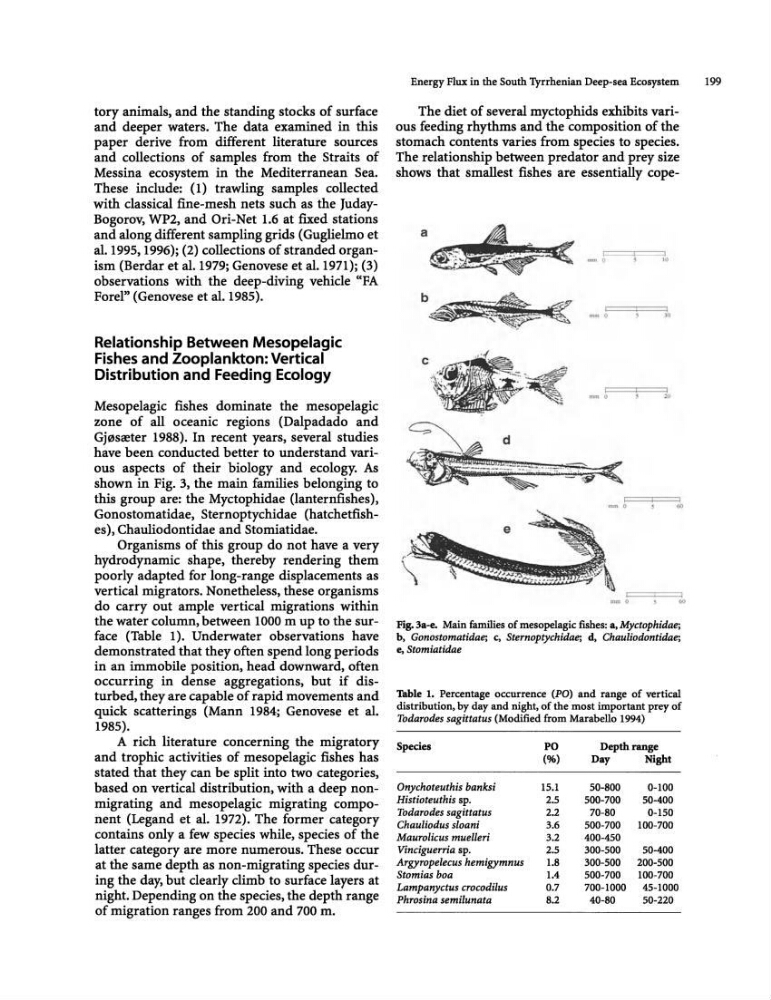
have been conducted better to understand various aspects of their biology and ecology. As
shown in Fig. 3, the main families belonging to
this group are: the Myctophidae (lanternfishes),
Gonostomatidae, Sternoptychidae (hatchetfishes), Chauliodontidae and Stomiatidae.
Organisms of this group do not have a very
hydrodynamic shape, thereby rendering them
poorly adapted for long-range displacements as
vertical migrators. Nonetheless, these organisms
do carry out ample vertical migrations within
the water column, between 1000 m up to the surface (Table 1). Underwater observations have
demonstrated that they often spend long periods
in an immobile position, head downward, often
occurring in dense aggregations, but if disturbed, they are capable of rapid movements and
quick scatterings (Mann 1984; Genovese et al.
1985).
A rich literature concerning the migratory
and trophic activities of mesopelagic fishes has
stated that they can be split into two categories,
based on vertical distribution, with a deep nonmigrating and mesopelagic migrating component (Legand et al. 1972). The former category
contains only a few species while, species of the
latter category are more numerous. These occur
at the same depth as non-migrating species during the day, but clearly climb to surface layers at
night. Depending on the species. the depth range
of migration ranges from 200 and 700 m.
Energy Flux in the South Tyrrhenian Deep-sea Ecosystem
199
The diet of several myctophids exhibits various feeding rhythms and the composition of the
stomach contents varies from species to species.
The relationship between predator and prey size
shows that smallest fishes are essentially copea
,..
=t=~
mm 0
...
10
~J
. 6 9
I
I
b
~:.,..
_ , ? i >. % mm 0
]0
.. . . . -
>".'
I
I
mm 0
60
•
I
mm 0
W
Fig. 3a-e. Main families of mesopelagic fishes: a, Myctophidae;
b. Gonostomatidae; c. Sternoptychidae; d. Chauliodontidae;
e, Stomiatidae
Table 1. Percentage occurrence (PO) and range of vertical
distribution. by day and night, of the most important prey of
Thdarodes sagittatus (Modified from Marabello 1994)
Species
PO
Depth range
(%)
Day
Night
Onychoteuthis banksi
15.1
SO-SOO
0-100
Histioteuthis sp.
2.5
500-700
50-400
Todarodes sagittatus
2.2
70-S0
0-150
Chauliodus sloani
3.6
500-700
100-700
Maurolicus muelleri
3.2
400-450
Vinciguerria sp.
2.5
300-500
50-400
Argyropelecus hemigymnus
1.8
300-500
200-500
Stomias boa
1.4
500-700
100-700
Lampanyctus crocodilus
0.7
700-1000
45-1000
Phrosina semilunata
S.2
40-80
50-220
and deeper waters. The data examined in this
paper derive from different literature sources
and collections of samples from the Straits of
Messina ecosystem in the Mediterranean Sea.
These include: (1) trawling samples collected
with classical fine-mesh nets such as the JudayBogorov, WP2, and Ori-Net 1.6 at fixed stations
and along different sampling grids (Guglielmo et
al. 1995, 1996); (2) collections of stranded organism (Berdar et al. 1979; Genovese et al. 1971); (3)
observations with the deep-diving vehicle "FA
Forel" (Genovese et al. 1985).
Relationship Between Mesopelagic
Fishes and Zooplankton: Vertical
Distribution and Feeding Ecology
Mesopelagic fishes dominate the mesopelagic
zone of all oceanic regions (Dalpadado and
Gj0sreter 1988). In recent years, several studies
have been conducted better to understand various aspects of their biology and ecology. As
shown in Fig. 3, the main families belonging to
this group are: the Myctophidae (lanternfishes),
Gonostomatidae, Sternoptychidae (hatchetfishes), Chauliodontidae and Stomiatidae.
Organisms of this group do not have a very
hydrodynamic shape, thereby rendering them
poorly adapted for long-range displacements as
vertical migrators. Nonetheless, these organisms
do carry out ample vertical migrations within
the water column, between 1000 m up to the surface (Table 1). Underwater observations have
demonstrated that they often spend long periods
in an immobile position, head downward, often
occurring in dense aggregations, but if disturbed, they are capable of rapid movements and
quick scatterings (Mann 1984; Genovese et al.
1985).
A rich literature concerning the migratory
and trophic activities of mesopelagic fishes has
stated that they can be split into two categories,
based on vertical distribution, with a deep nonmigrating and mesopelagic migrating component (Legand et al. 1972). The former category
contains only a few species while, species of the
latter category are more numerous. These occur
at the same depth as non-migrating species during the day, but clearly climb to surface layers at
night. Depending on the species. the depth range
of migration ranges from 200 and 700 m.
Energy Flux in the South Tyrrhenian Deep-sea Ecosystem
199
The diet of several myctophids exhibits various feeding rhythms and the composition of the
stomach contents varies from species to species.
The relationship between predator and prey size
shows that smallest fishes are essentially copea
,..
=t=~
mm 0
...
10
~J
. 6 9
I
I
b
~:.,..
_ , ? i >. % mm 0
]0
.. . . . -
>".'
I
I
mm 0
60
•
I
mm 0
W
Fig. 3a-e. Main families of mesopelagic fishes: a, Myctophidae;
b. Gonostomatidae; c. Sternoptychidae; d. Chauliodontidae;
e, Stomiatidae
Table 1. Percentage occurrence (PO) and range of vertical
distribution. by day and night, of the most important prey of
Thdarodes sagittatus (Modified from Marabello 1994)
Species
PO
Depth range
(%)
Day
Night
Onychoteuthis banksi
15.1
SO-SOO
0-100
Histioteuthis sp.
2.5
500-700
50-400
Todarodes sagittatus
2.2
70-S0
0-150
Chauliodus sloani
3.6
500-700
100-700
Maurolicus muelleri
3.2
400-450
Vinciguerria sp.
2.5
300-500
50-400
Argyropelecus hemigymnus
1.8
300-500
200-500
Stomias boa
1.4
500-700
100-700
Lampanyctus crocodilus
0.7
700-1000
45-1000
Phrosina semilunata
S.2
40-80
50-220