

186
O. Sidoti et al.
35
30
25
20
0/ 0
15
10 '
S
0
Pa Ac
Ts
t
h
Pe
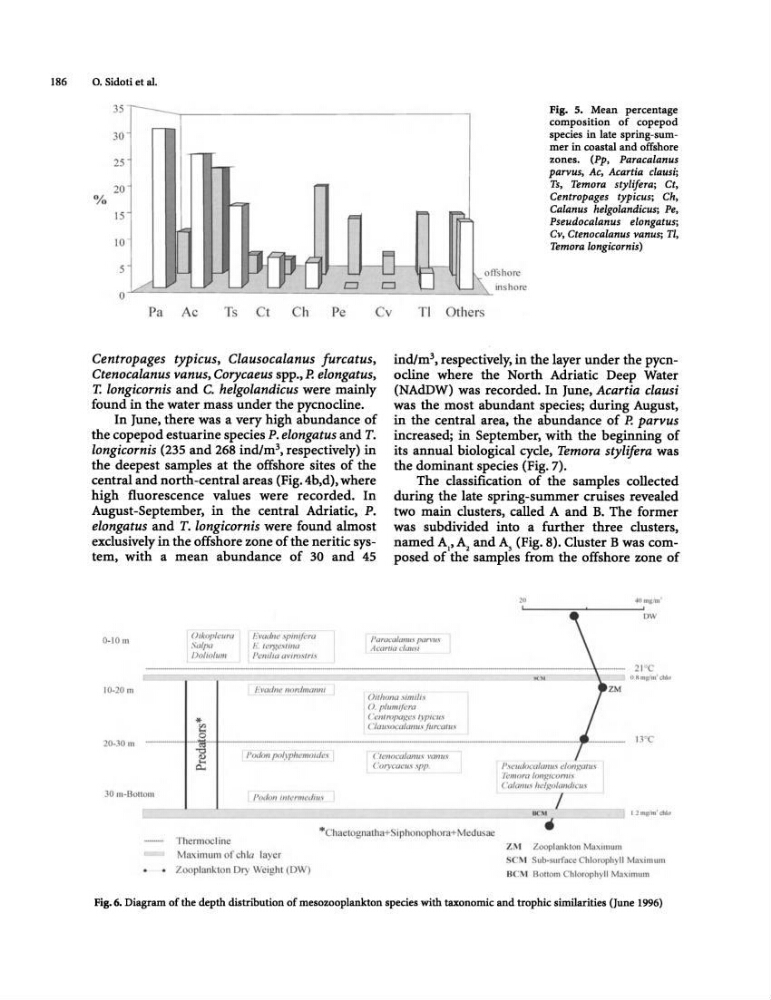
Centropages typicus, Clausocalanus furcatus,
Ctenocalanus vanus, Corycaeus spp., P. elongatus,
T. longicornis and C. helgolandicus were mainly
found in the water mass under the pycnocline.
In June, there was a very high abundance of
the copepod estuarine species P. elongatus and T.
longicornis (235 and 268 indlm\ respectively) in
the deepest samples at the offshore sites of the
central and north-central areas (Fig. 4b,d), where
high fluorescence values were recorded. In
August-September, in the central Adriatic, P.
elongatus and T. longicornis were found almost
exclusively in the offshore zone of the neritic system, with a mean abundance of 30 and 45
v
TI Others
Fig. 5. Mean percentage
composition of copepod
species in late spring·sum·
mer in coastal and offshore
zones. (Pp, PaTacalanus
pan/us, Ac, AcaTtia clausi;
Ts, TemOTa stylifeTa; Ct,
Centropages typicus; Ch,
Calanus helgolandicus; Pe,
Pseudocalanus elongatus;
Cv, Ctenocalanus vanus; Tl,
TemoTa longicoTnis)
indlm 3 , respectively, in the layer under the pycnocline where the North Adriatic Deep Water
(NAdDW) was recorded. In June, Acartia clausi
was the most abundant species; during August,
in the central area, the abundance of P. parvus
increased; in September, with the beginning of
its annual biological cycle, Temora stylifera was
the dominant species (Fig. 7).
The classification of the samples collected
during the late spring-summer cruises revealed
two main clusters, called A and B. The former
was subdivided into a further three clusters,
named AI' A2 and A3 (Fig. 8). Cluster B was composed of the samples from the offshore zone of
2U
"Umghn '
DW
0- 10 III
O,kof1/ellra
.\'0/1'''
/)0/10/11111
8vadlle spilujera
H. Ierge.~lIna
Pt:Ill/J(J (JWff),\/rM
1.J{lraCCI/anIlS p(lrnM'
A('onw dansl
10·20 III
20· 30 III
...........•..........•.................................................................... , ..... , ........ , ..... , ..... , ...................... - .. --.. - .............•........... , .. , ..... , .......................................................... ,.......... 21 °C
* ""
... o
i.:.' \radmt l10rdnlmJnI
011/10110 .\'/IIIIIi, \
O. f1/lIlIIljera
( 'elll "'f1OKe" 'Yf1;O'lIs
('/au,W),'(I/(mll .... jureoIN.,
0(.1
..................... ~..... . .................................. , ....... , ............................................... _ ................ , .. , ............................................... .
"0
£
l'odOIl fX,{yphellloll/e.\
('teI10(:a/tmus VOJHI , I(
( ' (1),(;0(:14.'- "1'1'.
1'.'ielidocalcll'Il.~ elollROlil, \
Temora long/corms
('0/01111< /1 o 8111s/m'ddCl
ZM
13°C
30 Ill·Botlom
Poeloll IIIIr.:rmt.fdw. \
/
T hermocl ine
* haelOgnalha+ i phonoph ora+ M edusae
M a;"imum of chla l
aye r
• Zooplankton Dry Weighl (DW)
nc ..
I :2 mglmt chlo
•
ZM Zooplall kt n Maximum
M ub-surface Ch lorophyl l Maxim um
B M BOil m Chl oroph 'II Max imum
Fig. 6. Diagram of the depth distribution of mesozooplankton species with taxonomic and trophic similarities (June 1996)
O. Sidoti et al.
35
30
25
20
0/ 0
15
10 '
S
0
Pa Ac
Ts
t
h
Pe
Centropages typicus, Clausocalanus furcatus,
Ctenocalanus vanus, Corycaeus spp., P. elongatus,
T. longicornis and C. helgolandicus were mainly
found in the water mass under the pycnocline.
In June, there was a very high abundance of
the copepod estuarine species P. elongatus and T.
longicornis (235 and 268 indlm\ respectively) in
the deepest samples at the offshore sites of the
central and north-central areas (Fig. 4b,d), where
high fluorescence values were recorded. In
August-September, in the central Adriatic, P.
elongatus and T. longicornis were found almost
exclusively in the offshore zone of the neritic system, with a mean abundance of 30 and 45
v
TI Others
Fig. 5. Mean percentage
composition of copepod
species in late spring·sum·
mer in coastal and offshore
zones. (Pp, PaTacalanus
pan/us, Ac, AcaTtia clausi;
Ts, TemOTa stylifeTa; Ct,
Centropages typicus; Ch,
Calanus helgolandicus; Pe,
Pseudocalanus elongatus;
Cv, Ctenocalanus vanus; Tl,
TemoTa longicoTnis)
indlm 3 , respectively, in the layer under the pycnocline where the North Adriatic Deep Water
(NAdDW) was recorded. In June, Acartia clausi
was the most abundant species; during August,
in the central area, the abundance of P. parvus
increased; in September, with the beginning of
its annual biological cycle, Temora stylifera was
the dominant species (Fig. 7).
The classification of the samples collected
during the late spring-summer cruises revealed
two main clusters, called A and B. The former
was subdivided into a further three clusters,
named AI' A2 and A3 (Fig. 8). Cluster B was composed of the samples from the offshore zone of
2U
"Umghn '
DW
0- 10 III
O,kof1/ellra
.\'0/1'''
/)0/10/11111
8vadlle spilujera
H. Ierge.~lIna
Pt:Ill/J(J (JWff),\/rM
1.J{lraCCI/anIlS p(lrnM'
A('onw dansl
10·20 III
20· 30 III
...........•..........•.................................................................... , ..... , ........ , ..... , ..... , ...................... - .. --.. - .............•........... , .. , ..... , .......................................................... ,.......... 21 °C
* ""
... o
i.:.' \radmt l10rdnlmJnI
011/10110 .\'/IIIIIi, \
O. f1/lIlIIljera
( 'elll "'f1OKe" 'Yf1;O'lIs
('/au,W),'(I/(mll .... jureoIN.,
0(.1
..................... ~..... . .................................. , ....... , ............................................... _ ................ , .. , ............................................... .
"0
£
l'odOIl fX,{yphellloll/e.\
('teI10(:a/tmus VOJHI , I(
( ' (1),(;0(:14.'- "1'1'.
1'.'ielidocalcll'Il.~ elollROlil, \
Temora long/corms
('0/01111< /1 o 8111s/m'ddCl
ZM
13°C
30 Ill·Botlom
Poeloll IIIIr.:rmt.fdw. \
/
T hermocl ine
* haelOgnalha+ i phonoph ora+ M edusae
M a;"imum of chla l
aye r
• Zooplankton Dry Weighl (DW)
nc ..
I :2 mglmt chlo
•
ZM Zooplall kt n Maximum
M ub-surface Ch lorophyl l Maxim um
B M BOil m Chl oroph 'II Max imum
Fig. 6. Diagram of the depth distribution of mesozooplankton species with taxonomic and trophic similarities (June 1996)