

Distribution and Ecology of Mesozooplankton (Northern and Central Adriatic Sea)
185
a
~ 10-20 ~
i7>C:::l
r1
Zoop l.Hlklon ( orlhtrn A~iI)
200
400
600
800
1000
1:200
1400
I bOO
C CI"~fQf11
. ('()Sh:J)Od8
C Daholum
2(1.30 ~
C .... f'1'~*'Wh
C
b
o-w
!
~ 10-20 ..
i7>
Cope,)()ds (i\orlhern rea)
Ah undancc (ind J nl)
100
200
'00
"*00
Ij{W)
60()
700
C A ".II'~'
.,' "'NI~'
C C' h£/ltIlllln&h~TI,I
1Q..30
~
~_~ O{.~~ g l/l"'K"~'"''''
D I'l'lfNlJ,. ... illJJo
7AOIJhmkIOn (CeOlr:II· Norlhl.'rn Art.ll)
bunchmcc (i nd J m J)
1000
2000
)000
·1000
50000
6000
7000
C Dohotwli
O APflCliodlClllani1l11
10-1>
~ ________________________ ~ c o_
o
0-10 ~
_ 10-20 ~
!. .
] :0·30 , .• :, .~ , .' : .
... . ,
( 'OpellOdS (Central .. Norlhern rea)
i\bumlu"",,' (intlJ I1I ' )
50
100
150
200
2$0
c
d
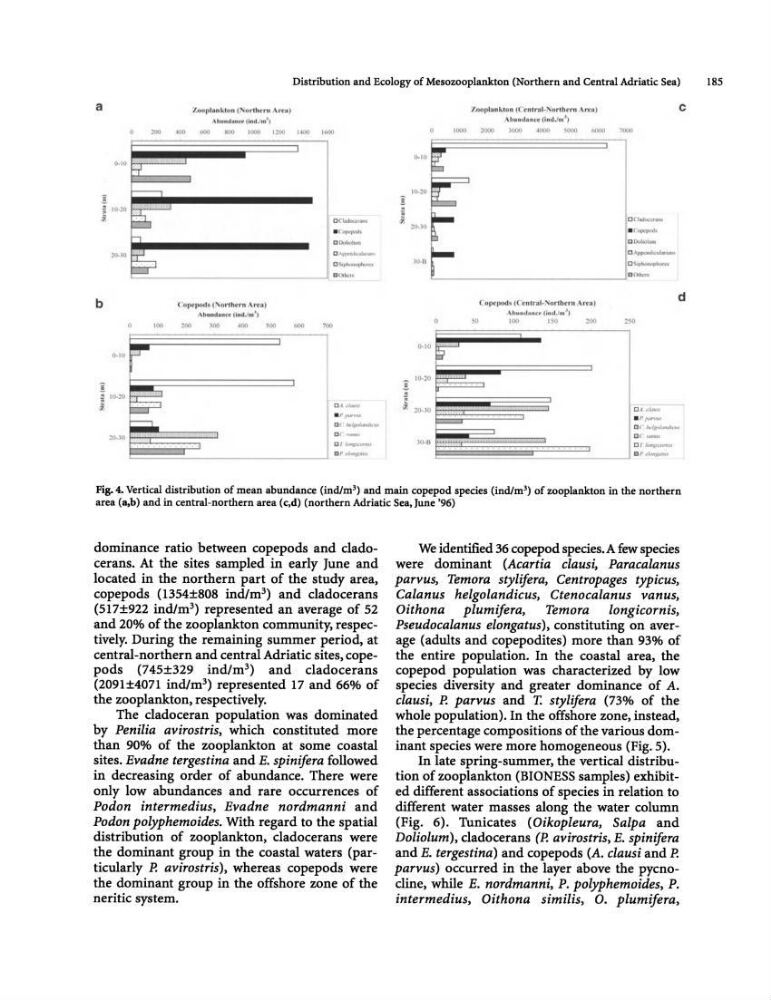
Fig. 4. Vertical distribution of mean abundance (indlm 3 ) and main copepod species (indlm 3 ) of zooplankton in the northern
area (a,b) and in central-northern area (c,d) (northern Adriatic Sea, June '96)
dominance ratio between copepods and cladocerans. At the sites sampled in early June and
located in the northern part of the study area,
copepods (1354±808 ind/m") and cladocerans
(517±922 ind/m") represented an average of 52
and 20% of the zooplankton community, respectively. During the remaining summer period, at
central-northern and central Adriatic sites, copepods (745±329 ind/m") and c1adocerans
(2091±4071 ind/m") represented 17 and 66% of
the zooplankton, respectively.
The cladoceran population was dominated
by Penilia avirostris, which constituted more
than 90% of the zooplankton at some coastal
sites. Evadne tergestina and E. spinifera followed
in decreasing order of abundance. There were
only low abundances and rare occurrences of
Podon intermedius, Evadne nordmanni and
Podon polyphemoides. With regard to the spatial
distribution of zooplankton, c1adocerans were
the dominant group in the coastal waters (particularly P. avirostris), whereas copepods were
the dominant group in the offshore zone of the
neritic system.
We identified 36 copepod species. A few species
were dominant (Acartia clausi, Paracalanus
parvus, Temora stylifera, Centropages typicus,
Calanus helgolandicus, Ctenocalanus vanus,
Oithona plumifera, Temora longicornis,
Pseudocalanus elongatus), constituting on average (adults and copepodites) more than 93% of
the entire population. In the coastal area, the
copepod population was characterized by low
species diversity and greater dominance of A.
clausi, P. parvus and T. stylifera (73% of the
whole population). In the offshore zone, instead,
the percentage compositions of the various dominant species were more homogeneous (Fig. 5).
In late spring-summer, the vertical distribution of zooplankton (BIONESS samples) exhibited different associations of species in relation to
different water masses along the water column
(Fig. 6). Tunicates (Oikopleura, Salpa and
Doliolum), c1adocerans (P. avirostris, E. spinifera
and E. tergestina) and copepods (A. clausi and P.
parvus) occurred in the layer above the pycnocline, while E. nordmanni, P. polyphemoides, P.
intermedius, Oithona similis, o. plumifera,
185
a
~ 10-20 ~
i7>C:::l
r1
Zoop l.Hlklon ( orlhtrn A~iI)
200
400
600
800
1000
1:200
1400
I bOO
C CI"~fQf11
. ('()Sh:J)Od8
C Daholum
2(1.30 ~
C .... f'1'~*'Wh
C
b
o-w
!
~ 10-20 ..
i7>
Cope,)()ds (i\orlhern rea)
Ah undancc (ind J nl)
100
200
'00
"*00
Ij{W)
60()
700
C A ".II'~'
.,' "'NI~'
C C' h£/ltIlllln&h~TI,I
1Q..30
~
~_~ O{.~~ g l/l"'K"~'"''''
D I'l'lfNlJ,. ... illJJo
7AOIJhmkIOn (CeOlr:II· Norlhl.'rn Art.ll)
bunchmcc (i nd J m J)
1000
2000
)000
·1000
50000
6000
7000
C Dohotwli
O APflCliodlClllani1l11
10-1>
~ ________________________ ~ c o_
o
0-10 ~
_ 10-20 ~
!. .
] :0·30 , .• :, .~ , .' : .
... . ,
( 'OpellOdS (Central .. Norlhern rea)
i\bumlu"",,' (intlJ I1I ' )
50
100
150
200
2$0
c
d
Fig. 4. Vertical distribution of mean abundance (indlm 3 ) and main copepod species (indlm 3 ) of zooplankton in the northern
area (a,b) and in central-northern area (c,d) (northern Adriatic Sea, June '96)
dominance ratio between copepods and cladocerans. At the sites sampled in early June and
located in the northern part of the study area,
copepods (1354±808 ind/m") and cladocerans
(517±922 ind/m") represented an average of 52
and 20% of the zooplankton community, respectively. During the remaining summer period, at
central-northern and central Adriatic sites, copepods (745±329 ind/m") and c1adocerans
(2091±4071 ind/m") represented 17 and 66% of
the zooplankton, respectively.
The cladoceran population was dominated
by Penilia avirostris, which constituted more
than 90% of the zooplankton at some coastal
sites. Evadne tergestina and E. spinifera followed
in decreasing order of abundance. There were
only low abundances and rare occurrences of
Podon intermedius, Evadne nordmanni and
Podon polyphemoides. With regard to the spatial
distribution of zooplankton, c1adocerans were
the dominant group in the coastal waters (particularly P. avirostris), whereas copepods were
the dominant group in the offshore zone of the
neritic system.
We identified 36 copepod species. A few species
were dominant (Acartia clausi, Paracalanus
parvus, Temora stylifera, Centropages typicus,
Calanus helgolandicus, Ctenocalanus vanus,
Oithona plumifera, Temora longicornis,
Pseudocalanus elongatus), constituting on average (adults and copepodites) more than 93% of
the entire population. In the coastal area, the
copepod population was characterized by low
species diversity and greater dominance of A.
clausi, P. parvus and T. stylifera (73% of the
whole population). In the offshore zone, instead,
the percentage compositions of the various dominant species were more homogeneous (Fig. 5).
In late spring-summer, the vertical distribution of zooplankton (BIONESS samples) exhibited different associations of species in relation to
different water masses along the water column
(Fig. 6). Tunicates (Oikopleura, Salpa and
Doliolum), c1adocerans (P. avirostris, E. spinifera
and E. tergestina) and copepods (A. clausi and P.
parvus) occurred in the layer above the pycnocline, while E. nordmanni, P. polyphemoides, P.
intermedius, Oithona similis, o. plumifera,