

174
R. Casotti et aL
O+-------~~------~--------~--------~-------+
-.:t
-
-20
00
~~DDYj
3e.1C~
38.10
~~
38.06
-----38. ~ 38.10
-40-60
G
I---~
7-fj1~ 38.06
~ ~AW "---.J 0 ~38.C2
8.0.2 _ _ _ _ _ _ _ 38.02 - - - - - - - -
-80
~~!36 ------- 38.06
- l OO~--~--~--~--~~------~--------~--~--~
9
10
It
.
12
StatIOns
13
14
coast
offshore
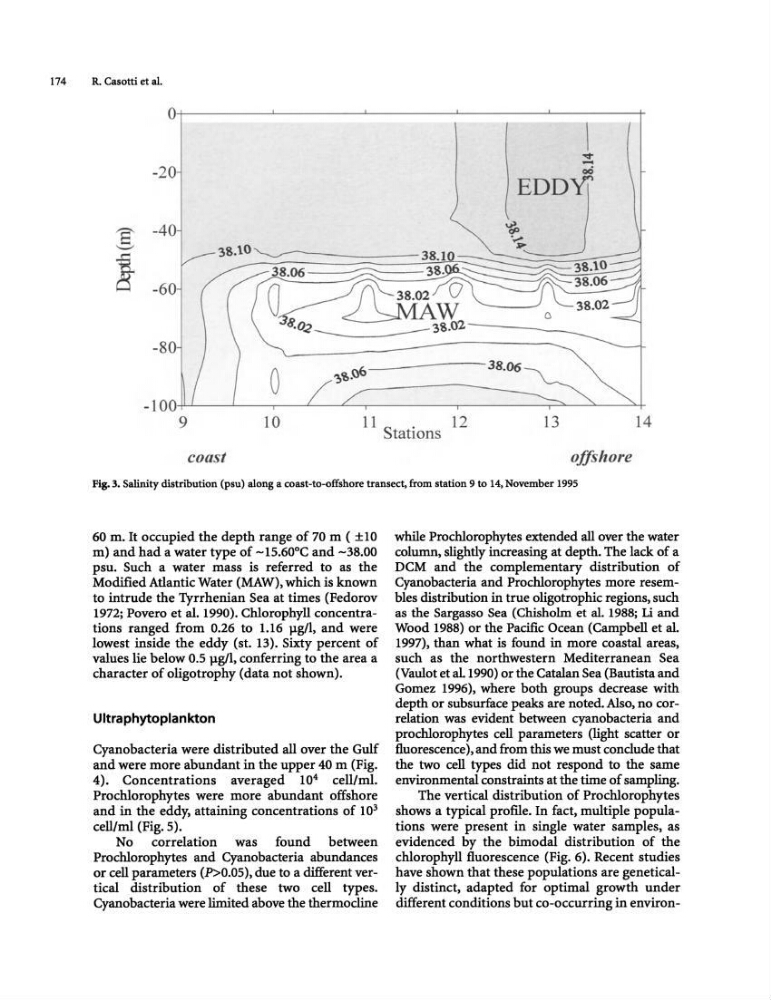
Fig. 3. Salinity distribution (psu) along a coast-to-offshore transect, from station 9 to 14, November 1995
60 m. It occupied the depth range of 70 m ( ±10
m) and had a water type of -IS.60°C and -38.00
psu. Such a water mass is referred to as the
Modified Atlantic Water (MAW), which is known
to intrude the Tyrrhenian Sea at times (Fedorov
1972; Povero et at. 1990). Chlorophyll concentrations ranged from 0.26 to 1.16 }lgll, and were
lowest inside the eddy (st. 13). Sixty percent of
values lie below 0.5 }lgll, conferring to the area a
character of oligotrophy (data not shown).
Ultra phytoplankton
Cyanobacteria were distributed all over the Gulf
and were more abundant in the upper 40 m (Fig.
4). Concentrations averaged 10 4 cell/mL
Prochlorophytes were more abundant offshore
and in the eddy. attaining concentrations of 10 3
cell/ml (Fig. 5).
No correlation was found between
Prochlorophytes and Cyanobacteria abundances
or cell parameters (P>O.OS), due to a different vertical distribution of these two cell types.
Cyanobacteria were limited above the thermocline
while Prochlorophytes extended all over the water
column, slightly increasing at depth. The lack of a
DCM and the complementary distribution of
Cyanobacteria and Prochlorophytes more resembles distribution in true oligotrophic regions, such
as the Sargasso Sea (Chisholm et aI. 1988; Li and
Wood 1988) or the Pacific Ocean (Campbell et al.
1997), than what is found in more coastal areas,
such as the northwestern Mediterranean Sea
(Vaulot et al. 1990) or the Catalan Sea (Bautista and
Gomez 1996), where both groups decrease with
depth or subsurface peaks are noted. Also, no correlation was evident between cyanobacteria and
prochlorophytes cell parameters (light scatter or
fluorescence), and from this we must conclude that
the two cell types did not respond to the same
environmental constraints at the time of sampling.
The vertical distribution of Prochlorophytes
shows a typical profile. In fact, multiple populations were present in single water samples, as
evidenced by the bimodal distribution of the
chlorophyll fluorescence (Fig. 6), Recent studies
have shown that these populations are genetically distinct, adapted for optimal growth under
different conditions but co-occurring in environ-
R. Casotti et aL
O+-------~~------~--------~--------~-------+
-.:t
-
-20
00
~~DDYj
3e.1C~
38.10
~~
38.06
-----38. ~ 38.10
-40-60
G
I---~
7-fj1~ 38.06
~ ~AW "---.J 0 ~38.C2
8.0.2 _ _ _ _ _ _ _ 38.02 - - - - - - - -
-80
~~!36 ------- 38.06
- l OO~--~--~--~--~~------~--------~--~--~
9
10
It
.
12
StatIOns
13
14
coast
offshore
Fig. 3. Salinity distribution (psu) along a coast-to-offshore transect, from station 9 to 14, November 1995
60 m. It occupied the depth range of 70 m ( ±10
m) and had a water type of -IS.60°C and -38.00
psu. Such a water mass is referred to as the
Modified Atlantic Water (MAW), which is known
to intrude the Tyrrhenian Sea at times (Fedorov
1972; Povero et at. 1990). Chlorophyll concentrations ranged from 0.26 to 1.16 }lgll, and were
lowest inside the eddy (st. 13). Sixty percent of
values lie below 0.5 }lgll, conferring to the area a
character of oligotrophy (data not shown).
Ultra phytoplankton
Cyanobacteria were distributed all over the Gulf
and were more abundant in the upper 40 m (Fig.
4). Concentrations averaged 10 4 cell/mL
Prochlorophytes were more abundant offshore
and in the eddy. attaining concentrations of 10 3
cell/ml (Fig. 5).
No correlation was found between
Prochlorophytes and Cyanobacteria abundances
or cell parameters (P>O.OS), due to a different vertical distribution of these two cell types.
Cyanobacteria were limited above the thermocline
while Prochlorophytes extended all over the water
column, slightly increasing at depth. The lack of a
DCM and the complementary distribution of
Cyanobacteria and Prochlorophytes more resembles distribution in true oligotrophic regions, such
as the Sargasso Sea (Chisholm et aI. 1988; Li and
Wood 1988) or the Pacific Ocean (Campbell et al.
1997), than what is found in more coastal areas,
such as the northwestern Mediterranean Sea
(Vaulot et al. 1990) or the Catalan Sea (Bautista and
Gomez 1996), where both groups decrease with
depth or subsurface peaks are noted. Also, no correlation was evident between cyanobacteria and
prochlorophytes cell parameters (light scatter or
fluorescence), and from this we must conclude that
the two cell types did not respond to the same
environmental constraints at the time of sampling.
The vertical distribution of Prochlorophytes
shows a typical profile. In fact, multiple populations were present in single water samples, as
evidenced by the bimodal distribution of the
chlorophyll fluorescence (Fig. 6), Recent studies
have shown that these populations are genetically distinct, adapted for optimal growth under
different conditions but co-occurring in environ-