

Mesozooplankton in a Mediterranean Coastal Sound (Stagnone di Marsala, Western Sicily)
157
shallower (less than 0.5 m deep), being partially
obstructed by sedimentary material, and allows
occasional turbulent inputs of marine water
(Pusceddu et al. 1999).
The "Stagnone" is characterised by large fluctuations in the values of physical-chemical parameters, especially temperature and salinity; in
the inner part of the sound. they range respectively from 11.2 to 29.1°C and from 32.8 to 47.1
psu (Campolmi 1998). The bottom is sandymuddy and covered mainly by Cymodocea
nodosa (Ucria) Ascherson, and Caulerpa proUtera (ForsskiU) Lamouroux. Meadows of
Posidonia oceanica (Linneus) Delile are restricted to the central and southern basins where they
are particularly luxuriant and greatly affect currents and silting (Pusceddu et al. 1999).
Sampling
Zooplankton samples were collected at a station
(1.5-2 m deep) located near the southern sea
mouth during four 24-hour periods on 9-10 May,
29-30 July and 22-23 October 1996. and on 14-15
March 1997. Samples were taken about every six
(May and July) or three (October and March)
hours with a plankton net (mouth opening diameter 40 em; mesh size 125 lLm) equipped with a
fluximeter (Hydrobios). The net was towed horizontally in the layer between the surface and a
depth of 1 m. About 50 m 3 of water were filtered
each time and three replicates of each sample
were taken. Samples were fixed immediately in
4% neutralised formalin/sea water solution.
Zooplankton organisms were counted in subsamples ranging from 1/40 to 1110 of the entire
sample, depending on abundance. Whole samples were analysed for rare species. Adult copepods were identified at the species level (except
Harpacticoida, Monstrilloida and Cyclopidae),
while copepodid stages were identified at the
genus level. Specimens belonging to other zooplankton groups were classified at higher taxonomic levels. Abundance values were expressed
as individuals per cubic metre (ind. m- 3 ).
Contemporaneously with the zooplankton
sampling, physical-chemical parameters were
recorded from the surface layer by means of a
multiparameter probe. Data of hydrometric
height and profiles of current speed and direction were recorded at 5 min. intervals with a
SENSOR DATA 6000 current meter.
Data Processing
The correlation between tide and chemical-physical parameters was calculated with the
Spearman p coefficient. Statistical differences in
zooplankton abundance between day and night
were assessed with the Mann-Whitney U-test
(Siegel 1956). The samples were classified by
cluster analysis of copepod abundance using the
UPGMA method on a Euclidean distance matrix
of quantitative data (Pielou 1984). Factor correspondence analysis (FCA) (Benzecri 1982) was
used as an ordination technique and performed
exclusively on the correlation matrix obtained
from the abundances of copepods, the most
important taxon (>95%). The significance of the
axes was evaluated using Lebart tables (1975).
"Statistica" software (Statsofi Inc.; reI. 5.1) was
used for the statistical analysis.
Results
Environmental Parameters
The average value of the die1 tidal range was 25
cm. The values of physical-chemical parameters
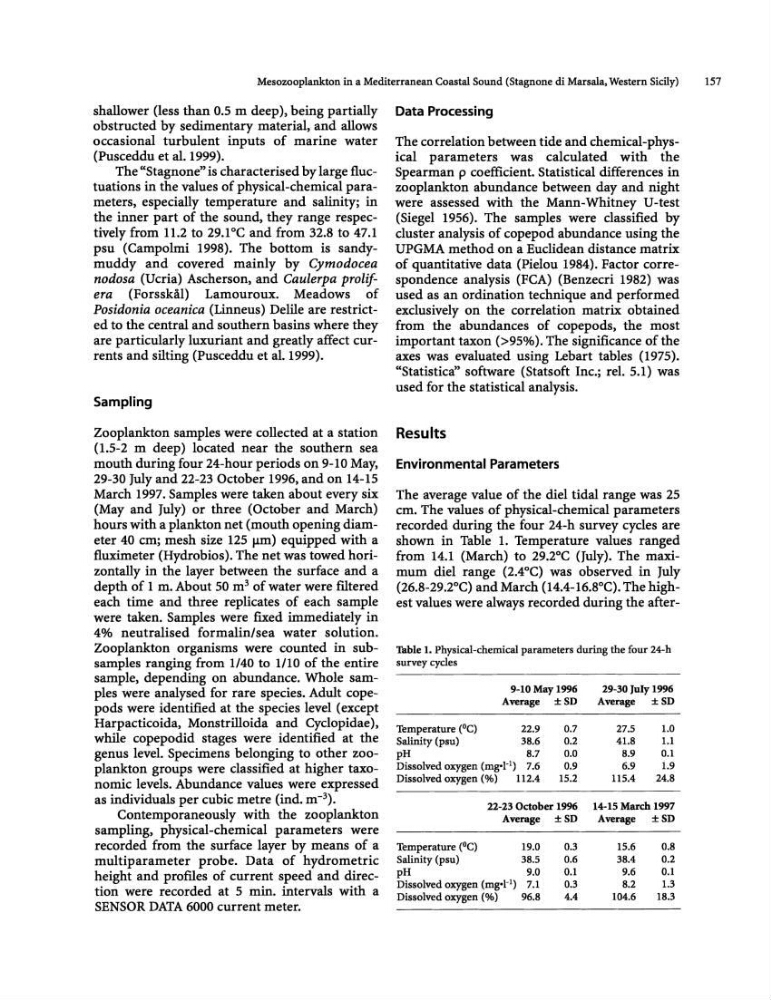
recorded during the four 24-h survey cycles are
shown in Table 1. Temperature values ranged
from 14.1 (March) to 29.2"C (July). The maximum diel range (2.4°C) was observed in July
(26.8-29.2°C) and March (14.4-16.8°C). The highest values were always recorded during the afterTable 1. Physical-chemical parameters during the four 24-h
survey cycles
9-10 May 1996
29-30 July 1996
Average ± SD
Average ± SD
Temperature (oG)
22.9
0.7
27.5
1.0
Salinity (psu)
38.6
0.2
41.8
1.1
pH
8.7
0.0
8.9
0.1
Dissolved oxygen (mg"P) 7.6
0.9
6.9
1.9
Dissolved oxygen (%)
112.4
15.2
115.4
24.8
22-23 October 1996 14-15 March 1997
Average ± SD
Average ± SD
Temperature (vC)
19.0
0.3
15.6
0.8
Salinity (psu)
38.5
0.6
38.4
0.2
pH
9.0
0.1
9.6
0.1
Dissolved oxygen (mg·P) 7.1
0.3
8.2
1.3
Dissolved oxygen (%)
96.8
4.4
104.6
18.3
157
shallower (less than 0.5 m deep), being partially
obstructed by sedimentary material, and allows
occasional turbulent inputs of marine water
(Pusceddu et al. 1999).
The "Stagnone" is characterised by large fluctuations in the values of physical-chemical parameters, especially temperature and salinity; in
the inner part of the sound. they range respectively from 11.2 to 29.1°C and from 32.8 to 47.1
psu (Campolmi 1998). The bottom is sandymuddy and covered mainly by Cymodocea
nodosa (Ucria) Ascherson, and Caulerpa proUtera (ForsskiU) Lamouroux. Meadows of
Posidonia oceanica (Linneus) Delile are restricted to the central and southern basins where they
are particularly luxuriant and greatly affect currents and silting (Pusceddu et al. 1999).
Sampling
Zooplankton samples were collected at a station
(1.5-2 m deep) located near the southern sea
mouth during four 24-hour periods on 9-10 May,
29-30 July and 22-23 October 1996. and on 14-15
March 1997. Samples were taken about every six
(May and July) or three (October and March)
hours with a plankton net (mouth opening diameter 40 em; mesh size 125 lLm) equipped with a
fluximeter (Hydrobios). The net was towed horizontally in the layer between the surface and a
depth of 1 m. About 50 m 3 of water were filtered
each time and three replicates of each sample
were taken. Samples were fixed immediately in
4% neutralised formalin/sea water solution.
Zooplankton organisms were counted in subsamples ranging from 1/40 to 1110 of the entire
sample, depending on abundance. Whole samples were analysed for rare species. Adult copepods were identified at the species level (except
Harpacticoida, Monstrilloida and Cyclopidae),
while copepodid stages were identified at the
genus level. Specimens belonging to other zooplankton groups were classified at higher taxonomic levels. Abundance values were expressed
as individuals per cubic metre (ind. m- 3 ).
Contemporaneously with the zooplankton
sampling, physical-chemical parameters were
recorded from the surface layer by means of a
multiparameter probe. Data of hydrometric
height and profiles of current speed and direction were recorded at 5 min. intervals with a
SENSOR DATA 6000 current meter.
Data Processing
The correlation between tide and chemical-physical parameters was calculated with the
Spearman p coefficient. Statistical differences in
zooplankton abundance between day and night
were assessed with the Mann-Whitney U-test
(Siegel 1956). The samples were classified by
cluster analysis of copepod abundance using the
UPGMA method on a Euclidean distance matrix
of quantitative data (Pielou 1984). Factor correspondence analysis (FCA) (Benzecri 1982) was
used as an ordination technique and performed
exclusively on the correlation matrix obtained
from the abundances of copepods, the most
important taxon (>95%). The significance of the
axes was evaluated using Lebart tables (1975).
"Statistica" software (Statsofi Inc.; reI. 5.1) was
used for the statistical analysis.
Results
Environmental Parameters
The average value of the die1 tidal range was 25
cm. The values of physical-chemical parameters
recorded during the four 24-h survey cycles are
shown in Table 1. Temperature values ranged
from 14.1 (March) to 29.2"C (July). The maximum diel range (2.4°C) was observed in July
(26.8-29.2°C) and March (14.4-16.8°C). The highest values were always recorded during the afterTable 1. Physical-chemical parameters during the four 24-h
survey cycles
9-10 May 1996
29-30 July 1996
Average ± SD
Average ± SD
Temperature (oG)
22.9
0.7
27.5
1.0
Salinity (psu)
38.6
0.2
41.8
1.1
pH
8.7
0.0
8.9
0.1
Dissolved oxygen (mg"P) 7.6
0.9
6.9
1.9
Dissolved oxygen (%)
112.4
15.2
115.4
24.8
22-23 October 1996 14-15 March 1997
Average ± SD
Average ± SD
Temperature (vC)
19.0
0.3
15.6
0.8
Salinity (psu)
38.5
0.6
38.4
0.2
pH
9.0
0.1
9.6
0.1
Dissolved oxygen (mg·P) 7.1
0.3
8.2
1.3
Dissolved oxygen (%)
96.8
4.4
104.6
18.3