

156
M. Campolmi et al.
been available on the structure and dynamics of
the zooplankton community in this ecosystem.
Indeed research on the zooplankton was carried
out only recently (Campolmi 1998); that study
revealed that rare hyperbenthic calanoid copepods belonging to plesiomorphic families
(including Pseudocyclopidae. Arietellidae and
Ridgewayiidae) or poorly known families (such
as the Stephidae) occur in the "Stagnone". These
findings are important from a biogeographical
point of view because some of the species have
never been recorded for the Mediterranean
(Campolmi et al. 1999), while others (currently
under study) are completely new to science.
The aims of the present research were: (1) to
analyse the diel and seasonal changes in zooplankton abundance and composition in this
shallow-water environment over 24-hour cycles
N
-+
in four seasons; (2) to evaluate the effects ofvariability in physical-chemical and hydrodynamic
conditions on the temporal distribution and
structure of the zooplankton.
Materials and Methods
Study Area
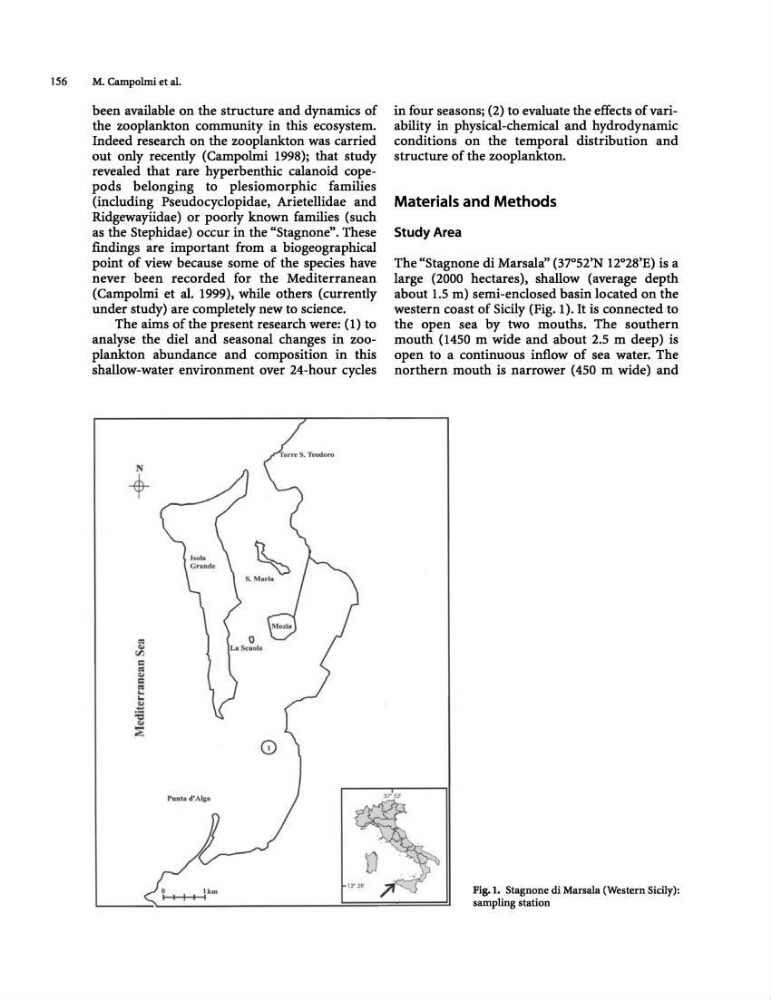
The "Stagnone di Marsala" (37°52'N 12°28'E) is a
large (2000 hectares), shallow (average depth
about 1.5 m) semi-enclosed basin located on the
western coast of Sicily (Fig. 1). It is connected to
the open sea by two mouths. The southern
mouth (1450 m wide and about 2.5 m deep) is
open to a continuous inflow of sea water. The
northern mouth is narrower (450 m wide) and
Fig. 1. Stagnone di Marsala (Western Sicily):
sampling station
M. Campolmi et al.
been available on the structure and dynamics of
the zooplankton community in this ecosystem.
Indeed research on the zooplankton was carried
out only recently (Campolmi 1998); that study
revealed that rare hyperbenthic calanoid copepods belonging to plesiomorphic families
(including Pseudocyclopidae. Arietellidae and
Ridgewayiidae) or poorly known families (such
as the Stephidae) occur in the "Stagnone". These
findings are important from a biogeographical
point of view because some of the species have
never been recorded for the Mediterranean
(Campolmi et al. 1999), while others (currently
under study) are completely new to science.
The aims of the present research were: (1) to
analyse the diel and seasonal changes in zooplankton abundance and composition in this
shallow-water environment over 24-hour cycles
N
-+
in four seasons; (2) to evaluate the effects ofvariability in physical-chemical and hydrodynamic
conditions on the temporal distribution and
structure of the zooplankton.
Materials and Methods
Study Area
The "Stagnone di Marsala" (37°52'N 12°28'E) is a
large (2000 hectares), shallow (average depth
about 1.5 m) semi-enclosed basin located on the
western coast of Sicily (Fig. 1). It is connected to
the open sea by two mouths. The southern
mouth (1450 m wide and about 2.5 m deep) is
open to a continuous inflow of sea water. The
northern mouth is narrower (450 m wide) and
Fig. 1. Stagnone di Marsala (Western Sicily):
sampling station