

124
P. Rossini et aI.
personal communication) preliminary comparisons between located wet and dry and bulk samplers have been reported. It emerged that for Cd,
Ni. Pb and Cu, wet+dry fluxes were =1.5 times
higher than bulk. Therefore, as reported, in general there is a good correlation between all median fluxes. Moreover, bulk samplers are easier to
operate than wet and dry, and may also be located at sites with no electrical power supply, where
it is difficult to manage sampling, e.g. on a gas
extraction base in the open sea.
Thus, in order to assess the importance of
atmospheric loads and compare them with riverine inputs, in this paper results obtained from
trace metal analysis on bulk samples collected
during the period 1993-97 at two coastal urban
sites (Cesenatico and Venice) in the north
Adriatic Sea, and on an offshore rig (AGIP), are
shown.
Materials and Methods
In order to obtain data on atmospheric transport
and deposition of metals, useful for management
policy, three atmospheric deposition sampling
stations were chosen, located at two coastal
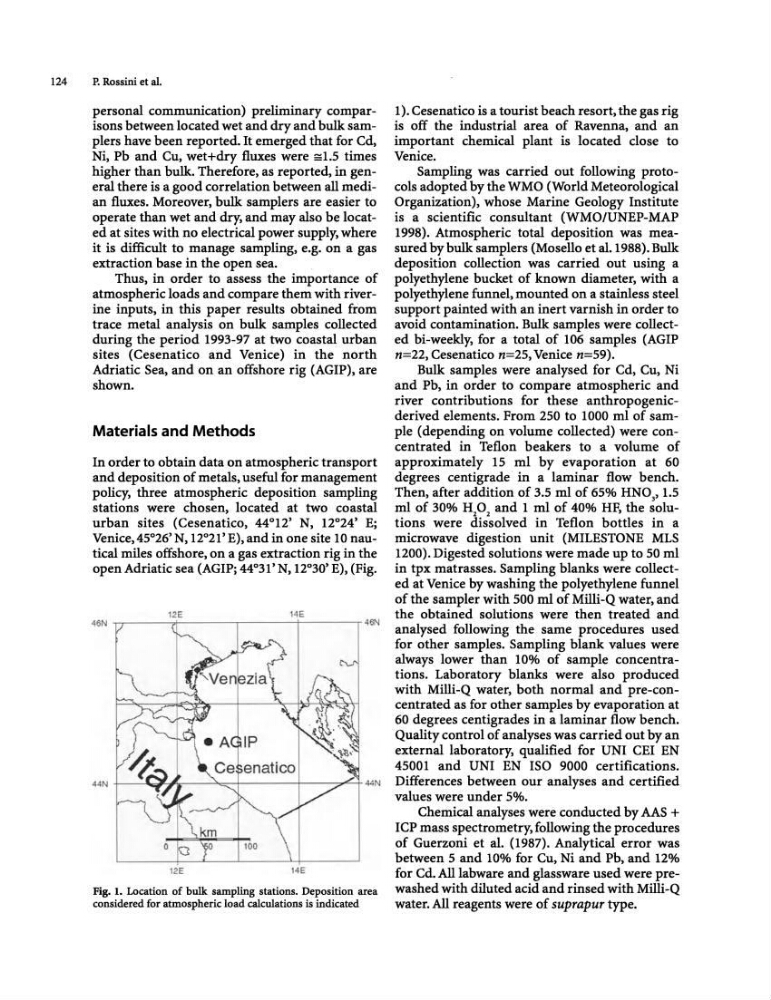
urban sites (Cesenatico, 44°12' N, 12°24' Ej
Venice,45°26'N,12°21' E), and in one site 10 nautical miles offshore, on a gas extraction rig in the
open Adriatic sea (AGIP; 44°31'N, 12°30' E), (Fig.
12E
14E
46N TT"---;of-----,-------t---~ 46N
44N +--"""'"~rIr--""""'=_+----+--___:::~ 44N
12E
14E
Fig. 1. Location of bulk sampling stations. Deposition area
considered for atmospheric load calculations is indicated
1). Cesenatico is a tourist beach resort, the gas rig
is off the industrial area of Ravenna, and an
important chemical plant is located close to
Venice.
Sampling was carried out following protocols adopted by the WMO (World Meteorological
Organization), whose Marine Geology Institute
is a scientific consultant (WMO/UNEP-MAP
1998). Atmospheric total deposition was measured by bulk samplers (Mosello et al. 1988). Bulk
deposition collection was carried out using a
polyethylene bucket of known diameter, with a
polyethylene funnel, mounted on a stainless steel
support painted with an inert varnish in order to
avoid contamination. Bulk samples were collected bi-weekly, for a total of 106 samples (AGIP
n=22, Cesenatico n=25, Venice n=59).
Bulk samples were analysed for Cd, Cu, Ni
and Pb, in order to compare atmospheric and
river contributions for these anthropogenicderived elements. From 250 to 1000 ml of sample (depending on volume collected) were concentrated in Teflon beakers to a volume of
approximately 15 ml by evaporation at 60
degrees centigrade in a laminar flow bench.
Then, after addition of 3.5 ml of 65% HN0 3 , 1.5
ml of 30% HP2 and 1 ml of 40% HF, the solutions were dissolved in Teflon bottles in a
microwave digestion unit (MILESTONE MLS
1200). Digested solutions were made up to 50 ml
in tpx matrasses. Sampling blanks were collected at Venice by washing the polyethylene funnel
of the sampler with 500 ml of Milli-Q water, and
the obtained solutions were then treated and
analysed following the same procedures used
for other samples. Sampling blank values were
always lower than 10% of sample concentrations. Laboratory blanks were also produced
with Milli-Q water, both normal and pre-concentrated as for other samples by evaporation at
60 degrees centigrades in a laminar flow bench.
Quality control of analyses was carried out by an
external laboratory, qualified for UNI CEl EN
45001 and UNI EN ISO 9000 certifications.
Differences between our analyses and certified
values were under 5%.
Chemical analyses were conducted by AAS +
ICP mass spectrometry, following the procedures
of Guerzoni et al. (1987). Analytical error was
between 5 and 10% for Cu, Ni and Pb, and 12%
for Cd. Al1labware and glassware used were prewashed with diluted acid and rinsed with Milli-Q
water. All reagents were of suprapur type.
P. Rossini et aI.
personal communication) preliminary comparisons between located wet and dry and bulk samplers have been reported. It emerged that for Cd,
Ni. Pb and Cu, wet+dry fluxes were =1.5 times
higher than bulk. Therefore, as reported, in general there is a good correlation between all median fluxes. Moreover, bulk samplers are easier to
operate than wet and dry, and may also be located at sites with no electrical power supply, where
it is difficult to manage sampling, e.g. on a gas
extraction base in the open sea.
Thus, in order to assess the importance of
atmospheric loads and compare them with riverine inputs, in this paper results obtained from
trace metal analysis on bulk samples collected
during the period 1993-97 at two coastal urban
sites (Cesenatico and Venice) in the north
Adriatic Sea, and on an offshore rig (AGIP), are
shown.
Materials and Methods
In order to obtain data on atmospheric transport
and deposition of metals, useful for management
policy, three atmospheric deposition sampling
stations were chosen, located at two coastal
urban sites (Cesenatico, 44°12' N, 12°24' Ej
Venice,45°26'N,12°21' E), and in one site 10 nautical miles offshore, on a gas extraction rig in the
open Adriatic sea (AGIP; 44°31'N, 12°30' E), (Fig.
12E
14E
46N TT"---;of-----,-------t---~ 46N
44N +--"""'"~rIr--""""'=_+----+--___:::~ 44N
12E
14E
Fig. 1. Location of bulk sampling stations. Deposition area
considered for atmospheric load calculations is indicated
1). Cesenatico is a tourist beach resort, the gas rig
is off the industrial area of Ravenna, and an
important chemical plant is located close to
Venice.
Sampling was carried out following protocols adopted by the WMO (World Meteorological
Organization), whose Marine Geology Institute
is a scientific consultant (WMO/UNEP-MAP
1998). Atmospheric total deposition was measured by bulk samplers (Mosello et al. 1988). Bulk
deposition collection was carried out using a
polyethylene bucket of known diameter, with a
polyethylene funnel, mounted on a stainless steel
support painted with an inert varnish in order to
avoid contamination. Bulk samples were collected bi-weekly, for a total of 106 samples (AGIP
n=22, Cesenatico n=25, Venice n=59).
Bulk samples were analysed for Cd, Cu, Ni
and Pb, in order to compare atmospheric and
river contributions for these anthropogenicderived elements. From 250 to 1000 ml of sample (depending on volume collected) were concentrated in Teflon beakers to a volume of
approximately 15 ml by evaporation at 60
degrees centigrade in a laminar flow bench.
Then, after addition of 3.5 ml of 65% HN0 3 , 1.5
ml of 30% HP2 and 1 ml of 40% HF, the solutions were dissolved in Teflon bottles in a
microwave digestion unit (MILESTONE MLS
1200). Digested solutions were made up to 50 ml
in tpx matrasses. Sampling blanks were collected at Venice by washing the polyethylene funnel
of the sampler with 500 ml of Milli-Q water, and
the obtained solutions were then treated and
analysed following the same procedures used
for other samples. Sampling blank values were
always lower than 10% of sample concentrations. Laboratory blanks were also produced
with Milli-Q water, both normal and pre-concentrated as for other samples by evaporation at
60 degrees centigrades in a laminar flow bench.
Quality control of analyses was carried out by an
external laboratory, qualified for UNI CEl EN
45001 and UNI EN ISO 9000 certifications.
Differences between our analyses and certified
values were under 5%.
Chemical analyses were conducted by AAS +
ICP mass spectrometry, following the procedures
of Guerzoni et al. (1987). Analytical error was
between 5 and 10% for Cu, Ni and Pb, and 12%
for Cd. Al1labware and glassware used were prewashed with diluted acid and rinsed with Milli-Q
water. All reagents were of suprapur type.