

98
M. Baroli et al.
Table 2. Comparison of metal concentrations (median and standard deviation, below
range) in dated sheaths of Posidonia oceanica in Western Mediterranean sites
Cd
Cu
(p.g. g-l)
(p.g. g-l)
Sheaths
Sheaths
Usda bay
0.6±O.1
6.0±2.5
(Sardinia)
(0.3-0.8)
(3.2-13.1)
Lavezzi a
1.2±0.2
8.1±2.1
(Corsica)
(0.7-1.S)
(6.2-14.6)
La Darse"
O.S±O.2
33.6±6.5
(Cote d'Azur)
(0.3-0.9)
(27.1-46.3)
Rochambeau a
O.9±OA
17.2±10.8
(Cote d'Azur)
(0.3-1.4)
(7.4-40.1)
Cap-Martina
O.7±O.3
12.5±8.7
(Cote d'Azur)
(0.6-1.4)
(11.1-35.8)
• Romeo et aI. 1995
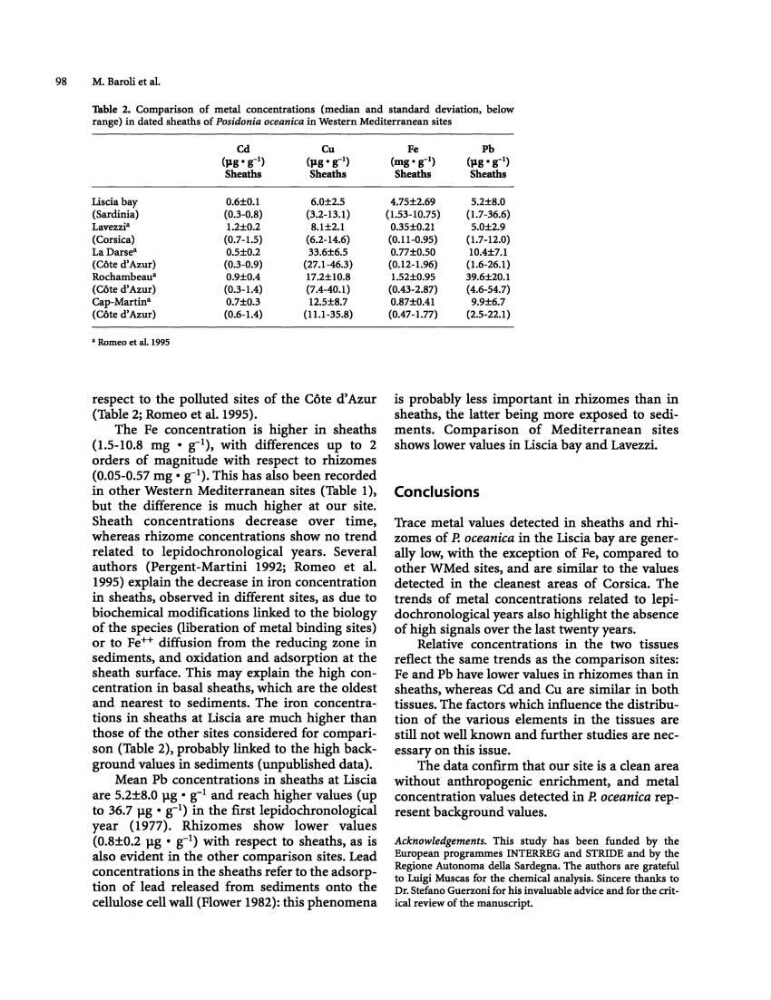
respect to the polluted sites of the Cl>te d' Azur
(Table 2; Romeo et al. 1995).
The Fe concentration is higher in sheaths
(1.5-10.8 mg • g-l), with differences up to 2
orders of magnitude with respect to rhizomes
(0.05-0.57 mg • g-l). This has also been recorded
in other Western Mediterranean sites (Table 1),
but the difference is much higher at our site.
Sheath concentrations decrease over time,
whereas rhizome concentrations show no trend
related to lepidochronological years. Several
authors (Pergent-Martini 1992; Romeo et al.
1995) explain the decrease in iron concentration
in sheaths, observed in different sites, as due to
biochemical modifications linked to the biology
of the species (liberation of metal binding sites)
or to Fe++ diffusion from the reducing zone in
sediments, and oxidation and adsorption at the
sheath surface. This may explain the high concentration in basal sheaths, which are the oldest
and nearest to sediments. The iron concentrations in sheaths at Lisda are much higher than
those of the other sites considered for comparison (Table 2), probably linked to the high background values in sediments (unpublished data).
Mean Pb concentrations in sheaths at Lisda
are S.2±8.0 llg • g-l and reach higher values (up
to 36.7 )lg • g-l) in the first lepidochronological
year (1977). Rhizomes show lower values
(0.8±0.2 llg • g-l) with respect to sheaths, as is
also evident in the other comparison sites. Lead
concentrations in the sheaths refer to the adsorption of lead released from sediments onto the
cellulose cell wall (Flower 1982): this phenomena
Fe
Pb
(mg- g-l)
(p.g. g-l)
Sheaths
Sheaths
4.75±2.69
5.2±8.0
(1.53-10.75)
(1.7-36.6)
0.35±0.21
S.O±2.9
(0.11-0.95)
(1.7-12.0)
0.77±0.50
lOA±7.1
(0.12-1.96)
(1.6-26.1)
1.52±O.95
39.6±20.1
(0.43-2.87)
(4.6-54.7)
O.87±OAl
9.9±6.7
(OA7-1.77)
(2.5-22.1)
is probably less important in rhizomes than in
sheaths, the latter being more exposed to sediments. Comparison of Mediterranean sites
shows lower values in Lisda bay and Lavezzi.
Conclusions
Trace metal values detected in sheaths and rhizomes of P. oceanica in the Lisda bay are generally low, with the exception of Fe, compared to
other WMed sites, and are similar to the values
detected in the cleanest areas of Corsica. The
trends of metal concentrations related to lepido chronological years also highlight the absence
of high signals over the last twenty years.
Relative concentrations in the two tissues
reflect the same trends as the comparison sites:
Fe and Pb have lower values in rhizomes than in
sheaths. whereas Cd and Cu are similar in both
tissues. The factors which influence the distribution of the various elements in the tissues are
still not well known and further studies are necessary on this issue.
The data confirm that our site is a clean area
without anthropogenic enrichment, and metal
concentration values detected in P. oceanica represent background values.
Acknowledgements. This study has been funded by the
European programmes INTERREG and STRIDE and by the
Regione Autonoma della Sardegna. The authors are grateful
to Luigi Muscas for the chemical analysis. Sincere thanks to
Dr. Stefano Guerzoni for his invaluable advice and for the critical review of the manuscript.
M. Baroli et al.
Table 2. Comparison of metal concentrations (median and standard deviation, below
range) in dated sheaths of Posidonia oceanica in Western Mediterranean sites
Cd
Cu
(p.g. g-l)
(p.g. g-l)
Sheaths
Sheaths
Usda bay
0.6±O.1
6.0±2.5
(Sardinia)
(0.3-0.8)
(3.2-13.1)
Lavezzi a
1.2±0.2
8.1±2.1
(Corsica)
(0.7-1.S)
(6.2-14.6)
La Darse"
O.S±O.2
33.6±6.5
(Cote d'Azur)
(0.3-0.9)
(27.1-46.3)
Rochambeau a
O.9±OA
17.2±10.8
(Cote d'Azur)
(0.3-1.4)
(7.4-40.1)
Cap-Martina
O.7±O.3
12.5±8.7
(Cote d'Azur)
(0.6-1.4)
(11.1-35.8)
• Romeo et aI. 1995
respect to the polluted sites of the Cl>te d' Azur
(Table 2; Romeo et al. 1995).
The Fe concentration is higher in sheaths
(1.5-10.8 mg • g-l), with differences up to 2
orders of magnitude with respect to rhizomes
(0.05-0.57 mg • g-l). This has also been recorded
in other Western Mediterranean sites (Table 1),
but the difference is much higher at our site.
Sheath concentrations decrease over time,
whereas rhizome concentrations show no trend
related to lepidochronological years. Several
authors (Pergent-Martini 1992; Romeo et al.
1995) explain the decrease in iron concentration
in sheaths, observed in different sites, as due to
biochemical modifications linked to the biology
of the species (liberation of metal binding sites)
or to Fe++ diffusion from the reducing zone in
sediments, and oxidation and adsorption at the
sheath surface. This may explain the high concentration in basal sheaths, which are the oldest
and nearest to sediments. The iron concentrations in sheaths at Lisda are much higher than
those of the other sites considered for comparison (Table 2), probably linked to the high background values in sediments (unpublished data).
Mean Pb concentrations in sheaths at Lisda
are S.2±8.0 llg • g-l and reach higher values (up
to 36.7 )lg • g-l) in the first lepidochronological
year (1977). Rhizomes show lower values
(0.8±0.2 llg • g-l) with respect to sheaths, as is
also evident in the other comparison sites. Lead
concentrations in the sheaths refer to the adsorption of lead released from sediments onto the
cellulose cell wall (Flower 1982): this phenomena
Fe
Pb
(mg- g-l)
(p.g. g-l)
Sheaths
Sheaths
4.75±2.69
5.2±8.0
(1.53-10.75)
(1.7-36.6)
0.35±0.21
S.O±2.9
(0.11-0.95)
(1.7-12.0)
0.77±0.50
lOA±7.1
(0.12-1.96)
(1.6-26.1)
1.52±O.95
39.6±20.1
(0.43-2.87)
(4.6-54.7)
O.87±OAl
9.9±6.7
(OA7-1.77)
(2.5-22.1)
is probably less important in rhizomes than in
sheaths, the latter being more exposed to sediments. Comparison of Mediterranean sites
shows lower values in Lisda bay and Lavezzi.
Conclusions
Trace metal values detected in sheaths and rhizomes of P. oceanica in the Lisda bay are generally low, with the exception of Fe, compared to
other WMed sites, and are similar to the values
detected in the cleanest areas of Corsica. The
trends of metal concentrations related to lepido chronological years also highlight the absence
of high signals over the last twenty years.
Relative concentrations in the two tissues
reflect the same trends as the comparison sites:
Fe and Pb have lower values in rhizomes than in
sheaths. whereas Cd and Cu are similar in both
tissues. The factors which influence the distribution of the various elements in the tissues are
still not well known and further studies are necessary on this issue.
The data confirm that our site is a clean area
without anthropogenic enrichment, and metal
concentration values detected in P. oceanica represent background values.
Acknowledgements. This study has been funded by the
European programmes INTERREG and STRIDE and by the
Regione Autonoma della Sardegna. The authors are grateful
to Luigi Muscas for the chemical analysis. Sincere thanks to
Dr. Stefano Guerzoni for his invaluable advice and for the critical review of the manuscript.