

92
M.G. Marin et al.
temperature, salinity and suspended particulate
organic matter values were recorded.
The physiological responses (clearance rate
and oxygen uptake) were measured in static systems on sixteen individual clams of standard
body size (4 cm length) from each site, according
to the methodology described by Smaal and
Widdows (1994). Each physiological rate was
then converted to energy equivalent Ug- I h- 1 ) in
order to obtain the scope for growth, which represents the difference between the energy gained
from the food and the energy lost via metabolic
energy expenditure (Widdows 1993). Moreover,
the scope for growth was calculated by using a
standardized ration level of 0.4 mg POM-l and
an absorption efficiency of 0.45 in order to show
underlying pollution-induced stress, when all
other natural and potential environmental stressors were held constant (Widdows et al. 1997).
"Survival in air" was tested on thirty clams
from each monitoring site: the animals were subjected to anoxia by air exposure at 18°C in
humidified chambers (Eertman et al. 1993).
Survival was assessed daily until a 100% mortality rate was reached.
Lysosomal membrane stability based on the
latency of N-acetyl-~-hexosaminidase was estimated on digestive gland tissue of ten clams,
frozen immediately after dissection. preserved in
supercooled hexane (-70°C) and then processed
as described by Moore (1976).
Analysis of survival was performed according to the method of Kaplan and Meier (l958);
the significance of differences between groups
was tested using the Gehan and Wilcoxon test
(Gehan 1965). The ANOVA test was used for all
other statistical comparisons.
Results and Discussion
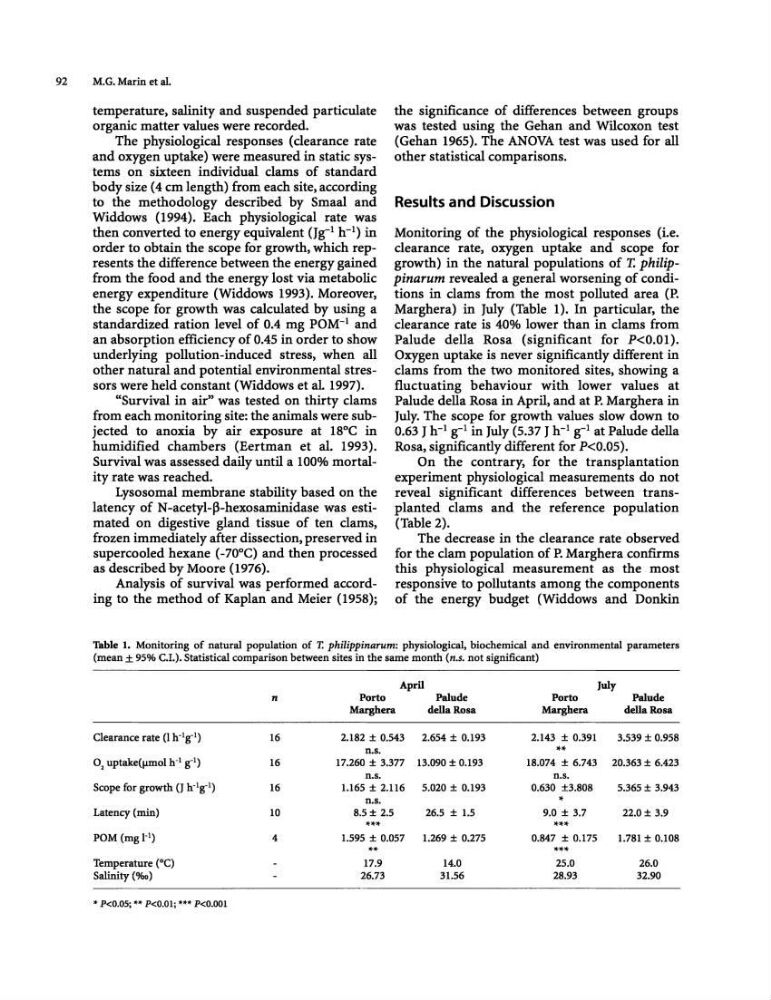
Monitoring of the physiological responses (Le.
clearance rate. oxygen uptake and scope for
growth) in the natural populations of T. philippinarum revealed a general worsening of conditions in clams from the most polluted area (P.
Marghera) in July (Table 1). In particular. the
clearance rate is 40% lower than in clams from
Palude della Rosa (significant for P<0.01).
Oxygen uptake is never significantly different in
clams from the two monitored sites, showing a
fluctuating behaviour with lower values at
Palude della Rosa in April, and at P. Marghera in
July. The scope for growth values slow down to
0.63 J h- 1 g-l in July (5.37 J h- 1 g-l at Palude della
Rosa, significantly different for P<0.05).
On the contrary, for the transplantation
experiment physiological measurements do not
reveal significant differences between transplanted clams and the reference population
(Table 2).
The decrease in the clearance rate observed
for the clam population of P. Marghera confirms
this physiological measurement as the most
responsive to pollutants among the components
of the energy budget (Widdows and Donldn
Table I. Monitoring of Datural population of T. philippiTUlrum: physiological, biochemical and environmental parameters
(mean ± 95% C.L). Statistical comparison between sites in the same month (n.s. not significant)
April
July
n
Porto
Palude
Porto
Palude
Marghera
della Rosa
Marghera
della Rosa
Clearance rate (1 h-lg- 1 )
16
2.182 ± 0.543
2.654 ± 0.193
2.143 ± 0.391
3.539 ± 0.958
n.s.
**
O 2 nptake(lJ.mol h- 1 g-I)
16
17.260 ± 3.377 13.090 ± 0.193
18.074 ± 6.743 20.363 ± 6.423
n.s.
n.s.
Scope for growth (J h'Ig-I)
16
1.165 ± 2.116
5.020 ± 0.193
0.630 ±3.808
5.365 ± 3.943
n.s.
..
Latency (min)
10
B5 ± 25
265 ± 1.5
9.0 ± 3.7
22.0± 3.9
......
*'llt
POM (mgtI)
4
1.595 ± 0.057
1.269 ± 0.275
0.B47 ± 0.175
1.781 ± O.lOB
....
.... *
Temperature (VC)
17.9
14.0
25.0
26.0
Salinity (%0)
26.73
31.56
28.93
32.90
* P.::O.05; "* P'::O.Ol; *** P
M.G. Marin et al.
temperature, salinity and suspended particulate
organic matter values were recorded.
The physiological responses (clearance rate
and oxygen uptake) were measured in static systems on sixteen individual clams of standard
body size (4 cm length) from each site, according
to the methodology described by Smaal and
Widdows (1994). Each physiological rate was
then converted to energy equivalent Ug- I h- 1 ) in
order to obtain the scope for growth, which represents the difference between the energy gained
from the food and the energy lost via metabolic
energy expenditure (Widdows 1993). Moreover,
the scope for growth was calculated by using a
standardized ration level of 0.4 mg POM-l and
an absorption efficiency of 0.45 in order to show
underlying pollution-induced stress, when all
other natural and potential environmental stressors were held constant (Widdows et al. 1997).
"Survival in air" was tested on thirty clams
from each monitoring site: the animals were subjected to anoxia by air exposure at 18°C in
humidified chambers (Eertman et al. 1993).
Survival was assessed daily until a 100% mortality rate was reached.
Lysosomal membrane stability based on the
latency of N-acetyl-~-hexosaminidase was estimated on digestive gland tissue of ten clams,
frozen immediately after dissection. preserved in
supercooled hexane (-70°C) and then processed
as described by Moore (1976).
Analysis of survival was performed according to the method of Kaplan and Meier (l958);
the significance of differences between groups
was tested using the Gehan and Wilcoxon test
(Gehan 1965). The ANOVA test was used for all
other statistical comparisons.
Results and Discussion
Monitoring of the physiological responses (Le.
clearance rate. oxygen uptake and scope for
growth) in the natural populations of T. philippinarum revealed a general worsening of conditions in clams from the most polluted area (P.
Marghera) in July (Table 1). In particular. the
clearance rate is 40% lower than in clams from
Palude della Rosa (significant for P<0.01).
Oxygen uptake is never significantly different in
clams from the two monitored sites, showing a
fluctuating behaviour with lower values at
Palude della Rosa in April, and at P. Marghera in
July. The scope for growth values slow down to
0.63 J h- 1 g-l in July (5.37 J h- 1 g-l at Palude della
Rosa, significantly different for P<0.05).
On the contrary, for the transplantation
experiment physiological measurements do not
reveal significant differences between transplanted clams and the reference population
(Table 2).
The decrease in the clearance rate observed
for the clam population of P. Marghera confirms
this physiological measurement as the most
responsive to pollutants among the components
of the energy budget (Widdows and Donldn
Table I. Monitoring of Datural population of T. philippiTUlrum: physiological, biochemical and environmental parameters
(mean ± 95% C.L). Statistical comparison between sites in the same month (n.s. not significant)
April
July
n
Porto
Palude
Porto
Palude
Marghera
della Rosa
Marghera
della Rosa
Clearance rate (1 h-lg- 1 )
16
2.182 ± 0.543
2.654 ± 0.193
2.143 ± 0.391
3.539 ± 0.958
n.s.
**
O 2 nptake(lJ.mol h- 1 g-I)
16
17.260 ± 3.377 13.090 ± 0.193
18.074 ± 6.743 20.363 ± 6.423
n.s.
n.s.
Scope for growth (J h'Ig-I)
16
1.165 ± 2.116
5.020 ± 0.193
0.630 ±3.808
5.365 ± 3.943
n.s.
..
Latency (min)
10
B5 ± 25
265 ± 1.5
9.0 ± 3.7
22.0± 3.9
......
*'llt
POM (mgtI)
4
1.595 ± 0.057
1.269 ± 0.275
0.B47 ± 0.175
1.781 ± O.lOB
....
.... *
Temperature (VC)
17.9
14.0
25.0
26.0
Salinity (%0)
26.73
31.56
28.93
32.90
* P.::O.05; "* P'::O.Ol; *** P