

b .. ' RecolonizatIon After Experimental Disturbances
179
20 a) 1994
200 b) 1994 c::::::J experiment
15
150
t::::.:l
~'m' ~
10
a
_lli
100
Jlk
'"
'"
E 5
E 50
0
0
~
~
M
0
D
0
E
2
3
4
9 15 33
'"
2
3
4
9 15 33
:>
c: 20 c) 1995
~ 200 d) 1995
' "
.~ 15
.:;; 150
'6
c.!;;
111
'" 10
11
100
5
50
r I r
. . m
0
0
2 3 4 7 14 29 49
2 3 4 7 14 29 49
days
days
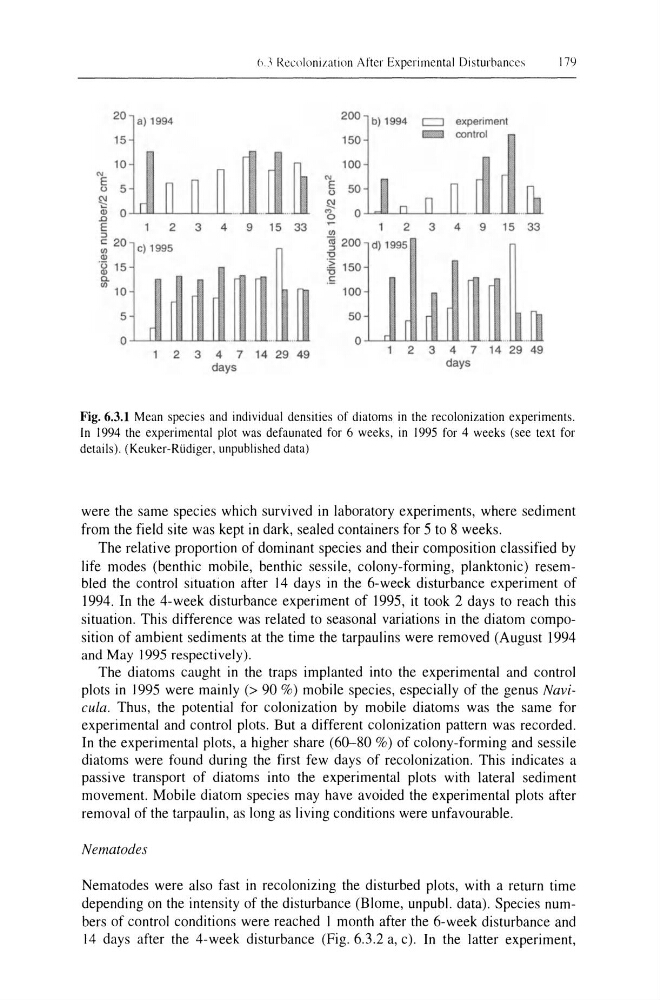
Fig. 6.3.1 Mean species and individual densities of diatoms in the recolonization experiments.
In 1994 the experimental plot was defaunated for 6 weeks, in 1995 for 4 weeks (see text for
details). (Keuker-Rudiger, unpublished data)
were the same species which survived in laboratory experiments, where sediment
from the field site was kept in dark, sealed containers for 5 to 8 weeks.
The relative proportion of dominant species and their composition classified by
life modes (benthic mobile, benthic sessile, colony-forming, planktonic) resembled the control situation after 14 days in the 6-week disturbance experiment of
1994. In the 4-week disturbance experiment of 1995, it took 2 days to reach this
situation. This difference was related to seasonal variations in the diatom composition of ambient sediments at the time the tarpaulins were removed (August 1994
and May 1995 respectively).
The diatoms caught in the traps implanted into the experimental and control
plots in 1995 were mainly (> 90 %) mobile species, especially of the genus Navicula. Thus, the potential for colonization by mobile diatoms was the same for
experimental and control plots. But a different colonization pattern was recorded.
In the experimental plots, a higher share (60-80 %) of colony-forming and sessile
diatoms were found during the first few days of recolonization. This indicates a
passive transport of diatoms into the experimental plots with lateral sediment
movement. Mobile diatom species may have avoided the experimental plots after
removal of the tarpaulin, as long as living conditions were unfavourable.
Nematodes
Nematodes were also fast in recolonizing the disturbed plots, with a return time
depending on the intensity of the disturbance (Blome, unpubl. data). Species numbers of control conditions were reached I month after the 6-week disturbance and
14 days after the 4-week disturbance (Fig. 6.3.2 a, c). In the latter experiment,
179
20 a) 1994
200 b) 1994 c::::::J experiment
15
150
t::::.:l
~'m' ~
10
a
_lli
100
Jlk
'"
'"
E 5
E 50
0
0
~
~
M
0
D
0
E
2
3
4
9 15 33
'"
2
3
4
9 15 33
:>
c: 20 c) 1995
~ 200 d) 1995
' "
.~ 15
.:;; 150
'6
c.!;;
111
'" 10
11
100
5
50
r I r
. . m
0
0
2 3 4 7 14 29 49
2 3 4 7 14 29 49
days
days
Fig. 6.3.1 Mean species and individual densities of diatoms in the recolonization experiments.
In 1994 the experimental plot was defaunated for 6 weeks, in 1995 for 4 weeks (see text for
details). (Keuker-Rudiger, unpublished data)
were the same species which survived in laboratory experiments, where sediment
from the field site was kept in dark, sealed containers for 5 to 8 weeks.
The relative proportion of dominant species and their composition classified by
life modes (benthic mobile, benthic sessile, colony-forming, planktonic) resembled the control situation after 14 days in the 6-week disturbance experiment of
1994. In the 4-week disturbance experiment of 1995, it took 2 days to reach this
situation. This difference was related to seasonal variations in the diatom composition of ambient sediments at the time the tarpaulins were removed (August 1994
and May 1995 respectively).
The diatoms caught in the traps implanted into the experimental and control
plots in 1995 were mainly (> 90 %) mobile species, especially of the genus Navicula. Thus, the potential for colonization by mobile diatoms was the same for
experimental and control plots. But a different colonization pattern was recorded.
In the experimental plots, a higher share (60-80 %) of colony-forming and sessile
diatoms were found during the first few days of recolonization. This indicates a
passive transport of diatoms into the experimental plots with lateral sediment
movement. Mobile diatom species may have avoided the experimental plots after
removal of the tarpaulin, as long as living conditions were unfavourable.
Nematodes
Nematodes were also fast in recolonizing the disturbed plots, with a return time
depending on the intensity of the disturbance (Blome, unpubl. data). Species numbers of control conditions were reached I month after the 6-week disturbance and
14 days after the 4-week disturbance (Fig. 6.3.2 a, c). In the latter experiment,