

160
5 Spatial and Temporal Distnhulion Patterns
300
N
250
'E
"200
8
U) 150
(ij
::J
~IOO
'6
.S 50
artifICial lubes
conlrOi sites
DAugust
IllSeplember
untleated slles
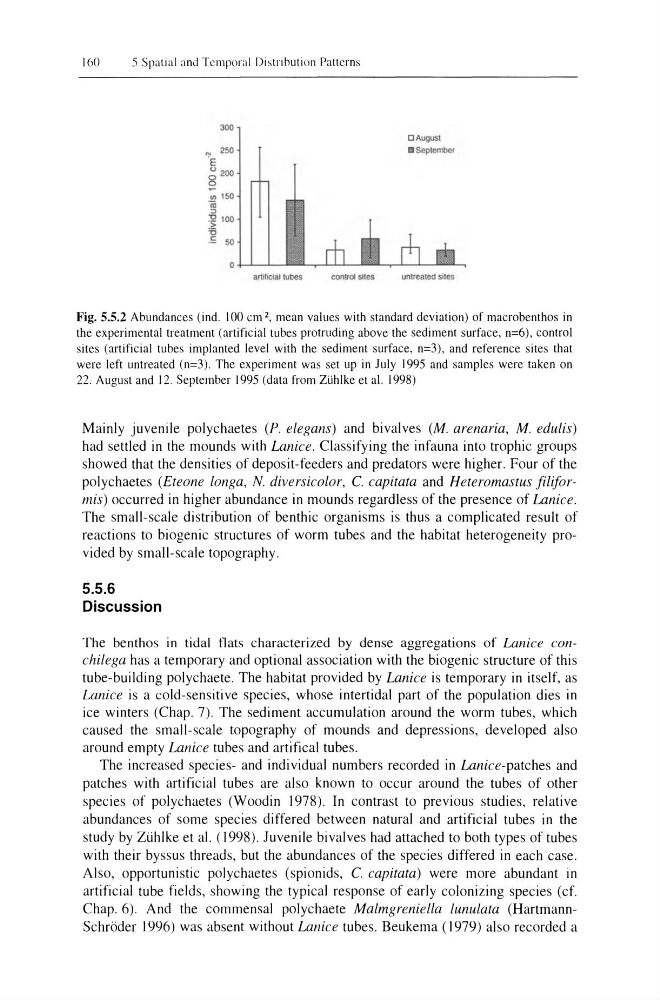
Fig. 5.5.2 Abundances (ind. 100 em 2, mean values with standard deviation) of macrobenthos in
the experimental treatment (artificial tubes protruding above the sediment surface, n=6), control
sites (artificial tubes implanted level with the sediment surface, n=3), and reference sites that
were left untreated (n=3). The experiment was set up in July 1995 and samples were taken on
22. August and 12. Septemher 1995 (data from Zuhlke et al. 1998)
Mainly juvenile polychaetes (P. elegans) and bivalves (M. arenaria, M. edulis)
had settled in the mounds with Lanice. Classifying the infauna into trophic groups
showed that the densities of deposit-feeders and predators were higher. Four of the
polychaetes (Eteone longa, N. diversicolor, C. capitata and Heteromastus filiformis) occurred in higher abundance in mounds regardless of the presence of Lanice.
The small-scale distribution of benthic organisms is thus a complicated result of
reactions to biogenic structures of worm tubes and the habitat heterogeneity provided by small-scale topography.
5.5.6
Discussion
The benthos in tidal tlats characterized by dense aggregations of Lanice conchilega has a temporary and optional association with the biogenic structure of this
tube-building polychaete. The habitat provided by Lanice is temporary in itself, as
Lanice is a cold-sensitive species, whose intertidal part of the population dies in
ice winters (Chap. 7). The sediment accumulation around the worm tubes, which
caused the small-scale topography of mounds and depressions, developed also
around empty Lanice tubes and artifical tubes.
The increased species- and individual numbers recorded in Lanice-patches and
patches with artificial tubes are also known to occur around the tubes of other
species of polychaetes (Woodin 1978). In contrast to previous studies, relative
abundances of some species differed between natural and artificial tubes in the
study by Zi.ihlke et al. (1998). Juvenile bivalves had attached to both types of tubes
with their byssus threads, but the abundances of the species differed in each case.
Also, opportunistic polychaetes (spionids, C. capitata) were more abundant in
artificial tube fields, showing the typical response of early colonizing species (cf.
Chap. 6). And the commensal polychaete Malmgreniella lunulata (HartmannSchroder 1996) was absent without Lanice tubes. Beukema (1979) also recorded a
5 Spatial and Temporal Distnhulion Patterns
300
N
250
'E
"200
8
U) 150
(ij
::J
~IOO
'6
.S 50
artifICial lubes
conlrOi sites
DAugust
IllSeplember
untleated slles
Fig. 5.5.2 Abundances (ind. 100 em 2, mean values with standard deviation) of macrobenthos in
the experimental treatment (artificial tubes protruding above the sediment surface, n=6), control
sites (artificial tubes implanted level with the sediment surface, n=3), and reference sites that
were left untreated (n=3). The experiment was set up in July 1995 and samples were taken on
22. August and 12. Septemher 1995 (data from Zuhlke et al. 1998)
Mainly juvenile polychaetes (P. elegans) and bivalves (M. arenaria, M. edulis)
had settled in the mounds with Lanice. Classifying the infauna into trophic groups
showed that the densities of deposit-feeders and predators were higher. Four of the
polychaetes (Eteone longa, N. diversicolor, C. capitata and Heteromastus filiformis) occurred in higher abundance in mounds regardless of the presence of Lanice.
The small-scale distribution of benthic organisms is thus a complicated result of
reactions to biogenic structures of worm tubes and the habitat heterogeneity provided by small-scale topography.
5.5.6
Discussion
The benthos in tidal tlats characterized by dense aggregations of Lanice conchilega has a temporary and optional association with the biogenic structure of this
tube-building polychaete. The habitat provided by Lanice is temporary in itself, as
Lanice is a cold-sensitive species, whose intertidal part of the population dies in
ice winters (Chap. 7). The sediment accumulation around the worm tubes, which
caused the small-scale topography of mounds and depressions, developed also
around empty Lanice tubes and artifical tubes.
The increased species- and individual numbers recorded in Lanice-patches and
patches with artificial tubes are also known to occur around the tubes of other
species of polychaetes (Woodin 1978). In contrast to previous studies, relative
abundances of some species differed between natural and artificial tubes in the
study by Zi.ihlke et al. (1998). Juvenile bivalves had attached to both types of tubes
with their byssus threads, but the abundances of the species differed in each case.
Also, opportunistic polychaetes (spionids, C. capitata) were more abundant in
artificial tube fields, showing the typical response of early colonizing species (cf.
Chap. 6). And the commensal polychaete Malmgreniella lunulata (HartmannSchroder 1996) was absent without Lanice tubes. Beukema (1979) also recorded a