

5.5 BlOtlC Interactions in a Lanice-Tidal Flat
159
70 .j
D L.".,.
60
0 ~'WlttwIiLNWI:'.-pllltch
'550
"
~ ouIsm tNJIC. -patch
0
~ 40
'"
~30
'2
~ 20
~
10
FoooJ ary
Mo",h
May
J~y
Oc10b0r
300
' "
250
E
8
200
.sa ISO
' "
"
~100
'0
£ '"
bl
August
() LiIIf1oIC.
I:I b«ItI'\osW'l'lhr"t~.~~
EI bton\hM! ctUCu:J. ... .aM'. -pa1ch
Septemoor
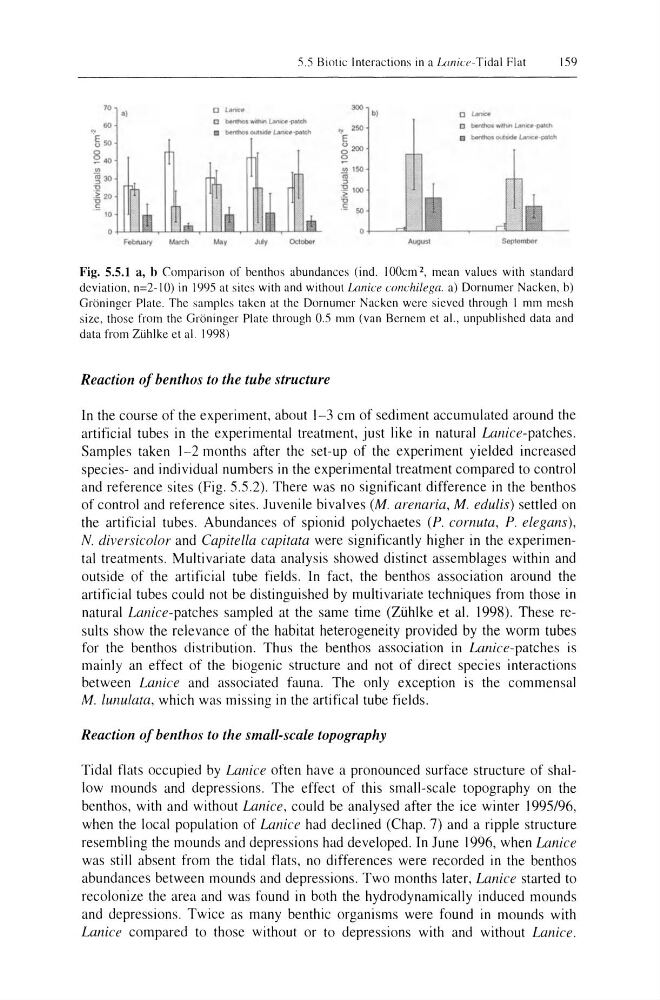
Fig. 5.5.1 a, b Comparison of benthos abundances (ind. IOOcm 2 , mean values with standard
deviation, n=2-IO) in 1995 at sites with and without Lanice conchiiega. a) Dornumer Nacken, b)
Groninger Plate. The samples taken at the Dornumer Nacken were sieved through I mm mesh
size, those from the Groninger Plate through 0.5 mm (van Bernem et aI., unpublished data and
data from Zuhlke ct a1. 1998)
Reaction of benthos to the tube structure
In the course of the experiment, about 1-3 cm of sediment accumulated around the
artificial tubes in the experimental treatment, just like in natural Lanice-patches.
Samples taken 1-2 months after the set-up of the experiment yielded increased
species- and individual numbers in the experimental treatment compared to control
and reference sites (Fig. 5.5.2). There was no significant difference in the benthos
of control and reference sites. Juvenile bivalves (M. arenaria, M. edulis) settled on
the artificial tubes. Abundances of spionid polychaetes (P. comuta, P. elegans),
N. diversicolor and Capitella capitata were significantly higher in the experimental treatments. Multivariate data analysis showed distinct assemblages within and
outside of the artificial tube fields. In fact, the benthos association around the
artificial tubes could not be distinguished by multivariate techniques from those in
natural Lanice-patches sampled at the same time (Zuhlke et a1. 1998). These results show the relevance of the habitat heterogeneity provided by the worm tubes
for the benthos distribution. Thus the benthos association in Lanice-patches is
mainly an effect of the biogenic structure and not of direct species interactions
between Lanice and associated fauna. The only exception is the commensal
M. lunulata, which was missing in the artifical tube fields.
Reaction of benthos to the small-scale topography
Tidal tlats occupied by Lanice often have a pronounced surface structure of shallow mounds and depressions. The effect of this small-scale topography on the
benthos, with and without Lanice, could be analysed after the ice winter 1995/96,
when the local population of Lanice had declined (Chap. 7) and a ripple structure
resembling the mounds and depressions had developed. In June 1996, when Lanice
was still absent from the tidal tlats, no differences were recorded in the benthos
abundances between mounds and depressions. Two months later, Lanice started to
recolonize the area and was found in both the hydrodynamically induced mounds
and depressions. Twice as many benthic organisms were found in mounds with
Lanice compared to those without or to depressions with and without Lanice.
159
70 .j
D L.".,.
60
0 ~'WlttwIiLNWI:'.-pllltch
'550
"
~ ouIsm tNJIC. -patch
0
~ 40
'"
~30
'2
~ 20
~
10
FoooJ ary
Mo",h
May
J~y
Oc10b0r
300
' "
250
E
8
200
.sa ISO
' "
"
~100
'0
£ '"
bl
August
() LiIIf1oIC.
I:I b«ItI'\osW'l'lhr"t~.~~
EI bton\hM! ctUCu:J. ... .aM'. -pa1ch
Septemoor
Fig. 5.5.1 a, b Comparison of benthos abundances (ind. IOOcm 2 , mean values with standard
deviation, n=2-IO) in 1995 at sites with and without Lanice conchiiega. a) Dornumer Nacken, b)
Groninger Plate. The samples taken at the Dornumer Nacken were sieved through I mm mesh
size, those from the Groninger Plate through 0.5 mm (van Bernem et aI., unpublished data and
data from Zuhlke ct a1. 1998)
Reaction of benthos to the tube structure
In the course of the experiment, about 1-3 cm of sediment accumulated around the
artificial tubes in the experimental treatment, just like in natural Lanice-patches.
Samples taken 1-2 months after the set-up of the experiment yielded increased
species- and individual numbers in the experimental treatment compared to control
and reference sites (Fig. 5.5.2). There was no significant difference in the benthos
of control and reference sites. Juvenile bivalves (M. arenaria, M. edulis) settled on
the artificial tubes. Abundances of spionid polychaetes (P. comuta, P. elegans),
N. diversicolor and Capitella capitata were significantly higher in the experimental treatments. Multivariate data analysis showed distinct assemblages within and
outside of the artificial tube fields. In fact, the benthos association around the
artificial tubes could not be distinguished by multivariate techniques from those in
natural Lanice-patches sampled at the same time (Zuhlke et a1. 1998). These results show the relevance of the habitat heterogeneity provided by the worm tubes
for the benthos distribution. Thus the benthos association in Lanice-patches is
mainly an effect of the biogenic structure and not of direct species interactions
between Lanice and associated fauna. The only exception is the commensal
M. lunulata, which was missing in the artifical tube fields.
Reaction of benthos to the small-scale topography
Tidal tlats occupied by Lanice often have a pronounced surface structure of shallow mounds and depressions. The effect of this small-scale topography on the
benthos, with and without Lanice, could be analysed after the ice winter 1995/96,
when the local population of Lanice had declined (Chap. 7) and a ripple structure
resembling the mounds and depressions had developed. In June 1996, when Lanice
was still absent from the tidal tlats, no differences were recorded in the benthos
abundances between mounds and depressions. Two months later, Lanice started to
recolonize the area and was found in both the hydrodynamically induced mounds
and depressions. Twice as many benthic organisms were found in mounds with
Lanice compared to those without or to depressions with and without Lanice.