

11 2
5 Spatial and Temporal Distribution Patterns
0 ~----~----~ 2------~----~
80 ,--------------------------,
1
60
(8) PHAEOPHOR8 'DE
g
S •
'60 40
0;
©
;g
"0 20
-_
.
.
~
o ~------------------------~
3
STAT'ONS
40 r( = C)~ ru ~C =O ~ X~ AN ~ T= H'= N ~ E --~-----'------'
,
~ 30
.,
E
'"
C. 20
! g
'0 10
of.
0 ~----~----~ 2------J-----~
2.S r (- O)-: F- UC - O-XA -:N -T- H'- OL - 1--"- .1 --I-----"==-"' : -: -: , - n.l : -: -:
,,. -, '
c:J 25% ·75%
to 2.0
• M.dr. n
;::
Go
g, 1.5
Q.
I
! 1.0
.g
; 0.5
0.0 ~----~----~-----:: 3~---'
STATIONS
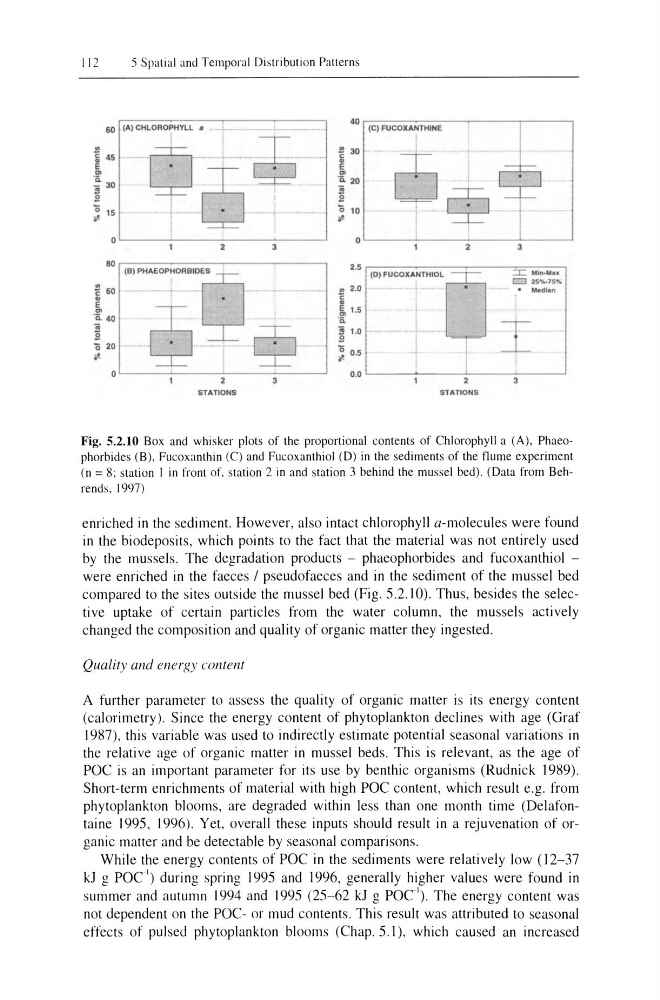
Fig. 5.2.10 Box and whisker plots of the proportional contents of Chlorophyll a (A), Phaeophorbides (B), Fucoxanthin (C) and Fucoxanthiol (D) in the sediments of the flume experiment
(n = 8; station I in front of, station 2 in and station 3 behind the mussel bed). (Data from Behrends. 1997)
enriched in the sediment. However, also intact chlorophyll a-molecules were found
in the biodeposits, which points to the fact that the material was not entirely used
by the mussels. The degradation products - phaeophorbides and fucoxanthiol -
were enriched in the faeces / pseudofaeces and in the sediment of the mussel bed
compared to the sites outside the mussel bed (Fig. 5.2.10). Thus, besides the selective uptake of certain particles from the water column, the mussels actively
changed the composition and quality of organic matter they ingested .
Quality and energy content
A further parameter to assess the quality of organic matter is its energy content
(calorimetry). Since the energy content of phytoplankton declines with age (Graf
1987), this variable was used to indirectly estimate potential seasonal variations in
the relative age of organic matter in mussel beds. This is relevant, as the age of
POC is an important parameter for its use by benthic organisms (Rudnick 1989).
Short-term enrichments of material with high POC content, which result e.g. from
phytoplankton blooms, are degraded within less than one month time (Delafontaine 1995, 1996). Yet , overall these inputs should result in a rejuvenation of organic matter and be detectable by seasonal comparisons.
While the energy contents of POC in the sediments were relatively low (12-37
kJ g POC') during spring 1995 and 1996, generally higher values were found in
summer and autumn 1994 and 1995 (25- 62 kJ g POC'). The energy content was
not dependent on the POC- or mud contents. This result was attributed to seasonal
effects of pulsed phytoplankton blooms (Chap. 5.1), which caused an increased
5 Spatial and Temporal Distribution Patterns
0 ~----~----~ 2------~----~
80 ,--------------------------,
1
60
(8) PHAEOPHOR8 'DE
g
S •
'60 40
0;
©
;g
"0 20
-_
.
.
~
o ~------------------------~
3
STAT'ONS
40 r( = C)~ ru ~C =O ~ X~ AN ~ T= H'= N ~ E --~-----'------'
,
~ 30
.,
E
'"
C. 20
! g
'0 10
of.
0 ~----~----~ 2------J-----~
2.S r (- O)-: F- UC - O-XA -:N -T- H'- OL - 1--"- .1 --I-----"==-"' : -: -: , - n.l : -: -:
,,. -, '
c:J 25% ·75%
to 2.0
• M.dr. n
;::
Go
g, 1.5
Q.
I
! 1.0
.g
; 0.5
0.0 ~----~----~-----:: 3~---'
STATIONS
Fig. 5.2.10 Box and whisker plots of the proportional contents of Chlorophyll a (A), Phaeophorbides (B), Fucoxanthin (C) and Fucoxanthiol (D) in the sediments of the flume experiment
(n = 8; station I in front of, station 2 in and station 3 behind the mussel bed). (Data from Behrends. 1997)
enriched in the sediment. However, also intact chlorophyll a-molecules were found
in the biodeposits, which points to the fact that the material was not entirely used
by the mussels. The degradation products - phaeophorbides and fucoxanthiol -
were enriched in the faeces / pseudofaeces and in the sediment of the mussel bed
compared to the sites outside the mussel bed (Fig. 5.2.10). Thus, besides the selective uptake of certain particles from the water column, the mussels actively
changed the composition and quality of organic matter they ingested .
Quality and energy content
A further parameter to assess the quality of organic matter is its energy content
(calorimetry). Since the energy content of phytoplankton declines with age (Graf
1987), this variable was used to indirectly estimate potential seasonal variations in
the relative age of organic matter in mussel beds. This is relevant, as the age of
POC is an important parameter for its use by benthic organisms (Rudnick 1989).
Short-term enrichments of material with high POC content, which result e.g. from
phytoplankton blooms, are degraded within less than one month time (Delafontaine 1995, 1996). Yet , overall these inputs should result in a rejuvenation of organic matter and be detectable by seasonal comparisons.
While the energy contents of POC in the sediments were relatively low (12-37
kJ g POC') during spring 1995 and 1996, generally higher values were found in
summer and autumn 1994 and 1995 (25- 62 kJ g POC'). The energy content was
not dependent on the POC- or mud contents. This result was attributed to seasonal
effects of pulsed phytoplankton blooms (Chap. 5.1), which caused an increased