

......
c
Q)
30
.§ 20
()
''::
C
Q)
..... o
'- 10
o
......
()
eel
.....
5.2 BIOgeochemical Processes and InteractIOns
III
'- '- >-c- 0lQ.. ...... > ()
eel Q.. eel
::J::J Q) () 0
Q)
~«~~J«(f)OZO
1995
-+- THAA
_____ Toe
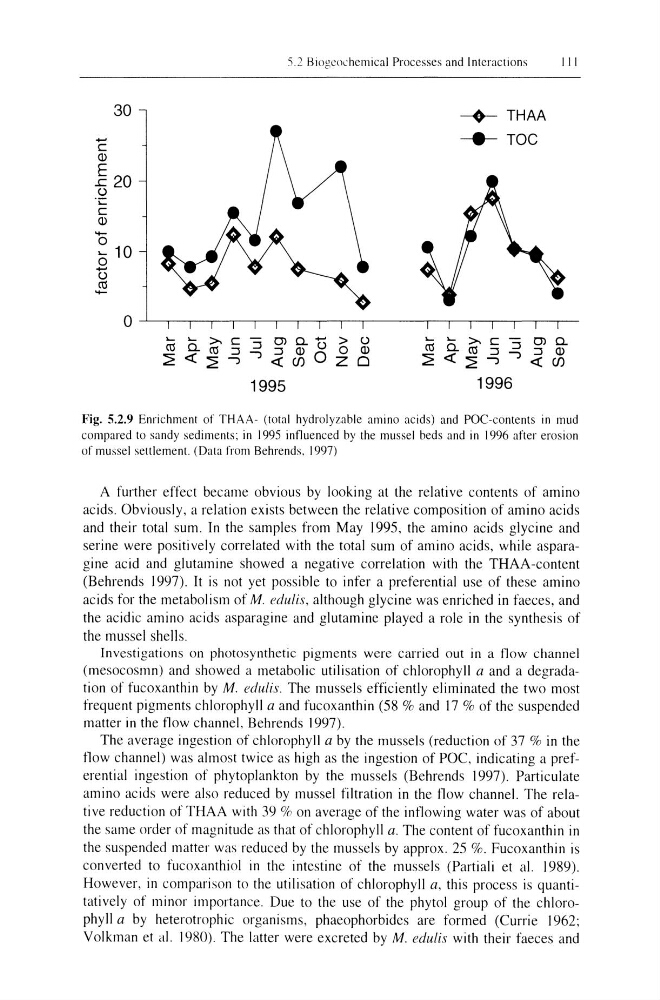
Fig. 5.2.9 Enrichment of THAA- (total hydrolyzable amino acids) and POC-contents in mud
compared to sandy sediments; in 1995 influenced by the mussel beds and in 1996 after erosion
of mussel settlement. (Data from Behrends. 1997)
A further effect became obvious by looking at the relative contents of amino
acids. Obviously, a relation exists between the relative composition of amino acids
and their total sum. In the samples from May 1995, the amino acids glycine and
serine were positively correlated with the total sum of amino acids, while asparagine acid and glutamine showed a negative correlation with the THAA-content
(Behrends 1997). It is not yet possible to infer a preferential use of these amino
acids for the metabolism of M. edulis, although glycine was enriched in faeces, and
the acidic amino acids asparagine and glutamine played a role in the synthesis of
the mussel shells.
Investigations on photosynthetic pigments were carried out in a flow channel
(mesocosmn) and showed a metabolic utilisation of chlorophyll a and a degradation of fucoxanthin by M. edulis. The mussels efficiently eliminated the two most
frequent pigments chlorophyll a and fucoxanthin (58 % and 17 % of the suspended
matter in the tlow channel, Behrends 1997).
The average ingestion of chlorophyll a by the mussels (reduction of 37 % in the
flow channel) was almost twice as high as the ingestion of POCo indicating a preferential ingestion of phytoplankton by the mussels (Behrends 1997). Particulate
amino acids were also reduced by mussel filtration in the flow channel. The relative reduction of THAA with 39 % on average of the intlowing water was of about
the same order of magnitude as that of chlorophyll a. The content of fucoxanthin in
the suspended matter was reduced by the mussels by approx. 25 %. Fucoxanthin is
converted to fucoxanthiol in the intestine of the mussels (Partiali et al. 1989).
However, in comparison to the utilisation of chlorophyll a, this process is quantitatively of minor importance. Due to the use of the phytol group of the chlorophyll a by heterotrophic organisms, phaeophorbides are formed (Currie 1962;
Volkman et al. 1980). The latter were excreted by M. edulis with their faeces and
c
Q)
30
.§ 20
()
''::
C
Q)
..... o
'- 10
o
......
()
eel
.....
5.2 BIOgeochemical Processes and InteractIOns
III
'- '- >-c- 0lQ.. ...... > ()
eel Q.. eel
::J::J Q) () 0
Q)
~«~~J«(f)OZO
1995
-+- THAA
_____ Toe
Fig. 5.2.9 Enrichment of THAA- (total hydrolyzable amino acids) and POC-contents in mud
compared to sandy sediments; in 1995 influenced by the mussel beds and in 1996 after erosion
of mussel settlement. (Data from Behrends. 1997)
A further effect became obvious by looking at the relative contents of amino
acids. Obviously, a relation exists between the relative composition of amino acids
and their total sum. In the samples from May 1995, the amino acids glycine and
serine were positively correlated with the total sum of amino acids, while asparagine acid and glutamine showed a negative correlation with the THAA-content
(Behrends 1997). It is not yet possible to infer a preferential use of these amino
acids for the metabolism of M. edulis, although glycine was enriched in faeces, and
the acidic amino acids asparagine and glutamine played a role in the synthesis of
the mussel shells.
Investigations on photosynthetic pigments were carried out in a flow channel
(mesocosmn) and showed a metabolic utilisation of chlorophyll a and a degradation of fucoxanthin by M. edulis. The mussels efficiently eliminated the two most
frequent pigments chlorophyll a and fucoxanthin (58 % and 17 % of the suspended
matter in the tlow channel, Behrends 1997).
The average ingestion of chlorophyll a by the mussels (reduction of 37 % in the
flow channel) was almost twice as high as the ingestion of POCo indicating a preferential ingestion of phytoplankton by the mussels (Behrends 1997). Particulate
amino acids were also reduced by mussel filtration in the flow channel. The relative reduction of THAA with 39 % on average of the intlowing water was of about
the same order of magnitude as that of chlorophyll a. The content of fucoxanthin in
the suspended matter was reduced by the mussels by approx. 25 %. Fucoxanthin is
converted to fucoxanthiol in the intestine of the mussels (Partiali et al. 1989).
However, in comparison to the utilisation of chlorophyll a, this process is quantitatively of minor importance. Due to the use of the phytol group of the chlorophyll a by heterotrophic organisms, phaeophorbides are formed (Currie 1962;
Volkman et al. 1980). The latter were excreted by M. edulis with their faeces and