

92
5 Spatial and Temporal Di stnhution Patterns
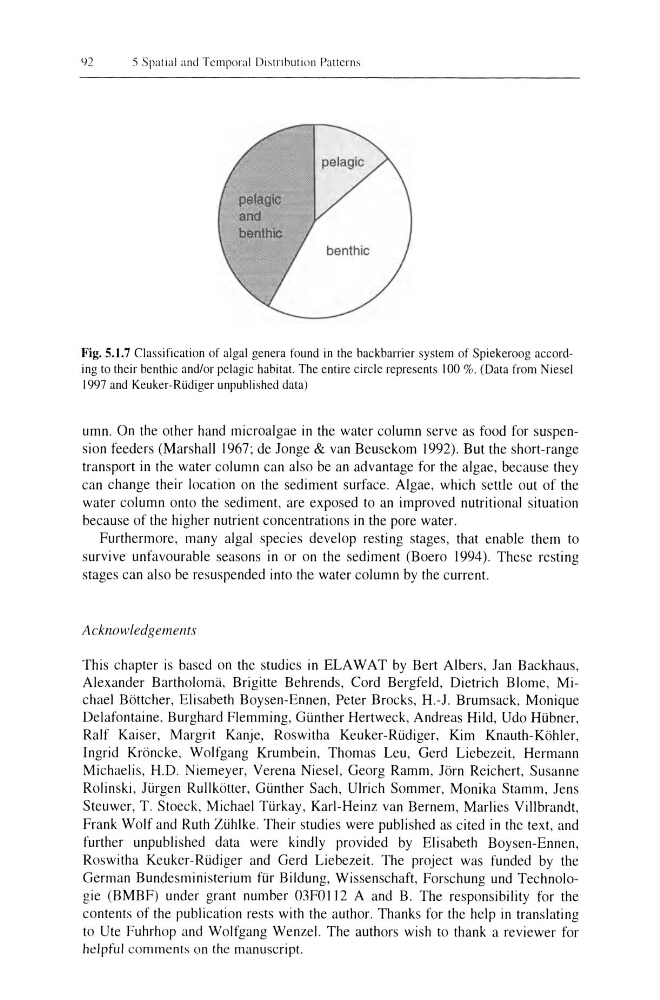
Fig. 5.l.7 Classification of algal genera found in the backbarrier system of Spiekeroog according to their benthic and/or pelagic habitat. The entire circle represents 100 %. (Data from Niesel
1997 and Keukcr-Riidiger unpuhlished data)
umn. On the other hand microalgae in the water column serve as food for suspension feeders (Marshall 1967; de Jonge & van Beusekom 1992). But the short-range
transport in the water column can also be an advantage for the algae, because they
can change their location on the sediment surface. Algae, which settle out of the
water column onto the sediment, are exposed to an improved nutritional situation
because of the higher nutrient concentrations in the pore water.
Furthermore, many algal species develop resting stages, that enable them to
survive unfavourable seasons in or on the sediment (Boero 1994). These resting
stages can also be resuspended into the water column by the current.
Acknowledgements
This chapter is based on the studies in ELA W AT by Bert Albers, Jan Backhaus,
Alexander Bartholoma, Brigitte Behrends, Cord Bergfeld, Dietrich Blome, Michael Bottcher, Elisabeth Boysen-Ennen, Peter Brocks, H.-J. Brumsack, Monique
Delafontaine, Burghard Flemming, Gunther Hertweck, Andreas Hild, Udo Hubner,
Ralf Kaiser, Margrit Kanje, Roswitha Keuker-Rudiger, Kim Knauth-Kohler,
Ingrid Kroncke, Wolfgang Krumbein , Thomas Leu, Gerd Liebezeit, Hermann
Michaelis, H.D. Niemeyer, Verena Niesel , Georg Ramm, Jorn Reichert, Susanne
Rolinski , Jurgen Rullkotter, Gunther Sach, Ulrich Sommer, Monika Stamm, Jens
Steuwer, T. Stoeck, Michael Turkay, Karl-Heinz van Bernem, Marlies Villbrandt,
Frank Wolf and Ruth Zuhlke. Their studies were published as cited in the text, and
further unpublished data were kindly provided by Elisabeth Boysen-Ennen,
Roswitha Keuker-Rudiger and Gerd Liebezeit. The project was funded by the
German Bundesministerium fUr Bildung, Wissenschaft, Forschung und Technologie (BMBF) under grant number 03FOl12 A and B. The responsibility for the
contents of the publication rests with the author. Thanks for the help in translating
to Ute Fuhrhop and Wolfgang Wenzel. The authors wish to thank a reviewer for
helpful comments on the manuscript.
5 Spatial and Temporal Di stnhution Patterns
Fig. 5.l.7 Classification of algal genera found in the backbarrier system of Spiekeroog according to their benthic and/or pelagic habitat. The entire circle represents 100 %. (Data from Niesel
1997 and Keukcr-Riidiger unpuhlished data)
umn. On the other hand microalgae in the water column serve as food for suspension feeders (Marshall 1967; de Jonge & van Beusekom 1992). But the short-range
transport in the water column can also be an advantage for the algae, because they
can change their location on the sediment surface. Algae, which settle out of the
water column onto the sediment, are exposed to an improved nutritional situation
because of the higher nutrient concentrations in the pore water.
Furthermore, many algal species develop resting stages, that enable them to
survive unfavourable seasons in or on the sediment (Boero 1994). These resting
stages can also be resuspended into the water column by the current.
Acknowledgements
This chapter is based on the studies in ELA W AT by Bert Albers, Jan Backhaus,
Alexander Bartholoma, Brigitte Behrends, Cord Bergfeld, Dietrich Blome, Michael Bottcher, Elisabeth Boysen-Ennen, Peter Brocks, H.-J. Brumsack, Monique
Delafontaine, Burghard Flemming, Gunther Hertweck, Andreas Hild, Udo Hubner,
Ralf Kaiser, Margrit Kanje, Roswitha Keuker-Rudiger, Kim Knauth-Kohler,
Ingrid Kroncke, Wolfgang Krumbein , Thomas Leu, Gerd Liebezeit, Hermann
Michaelis, H.D. Niemeyer, Verena Niesel , Georg Ramm, Jorn Reichert, Susanne
Rolinski , Jurgen Rullkotter, Gunther Sach, Ulrich Sommer, Monika Stamm, Jens
Steuwer, T. Stoeck, Michael Turkay, Karl-Heinz van Bernem, Marlies Villbrandt,
Frank Wolf and Ruth Zuhlke. Their studies were published as cited in the text, and
further unpublished data were kindly provided by Elisabeth Boysen-Ennen,
Roswitha Keuker-Rudiger and Gerd Liebezeit. The project was funded by the
German Bundesministerium fUr Bildung, Wissenschaft, Forschung und Technologie (BMBF) under grant number 03FOl12 A and B. The responsibility for the
contents of the publication rests with the author. Thanks for the help in translating
to Ute Fuhrhop and Wolfgang Wenzel. The authors wish to thank a reviewer for
helpful comments on the manuscript.