

59
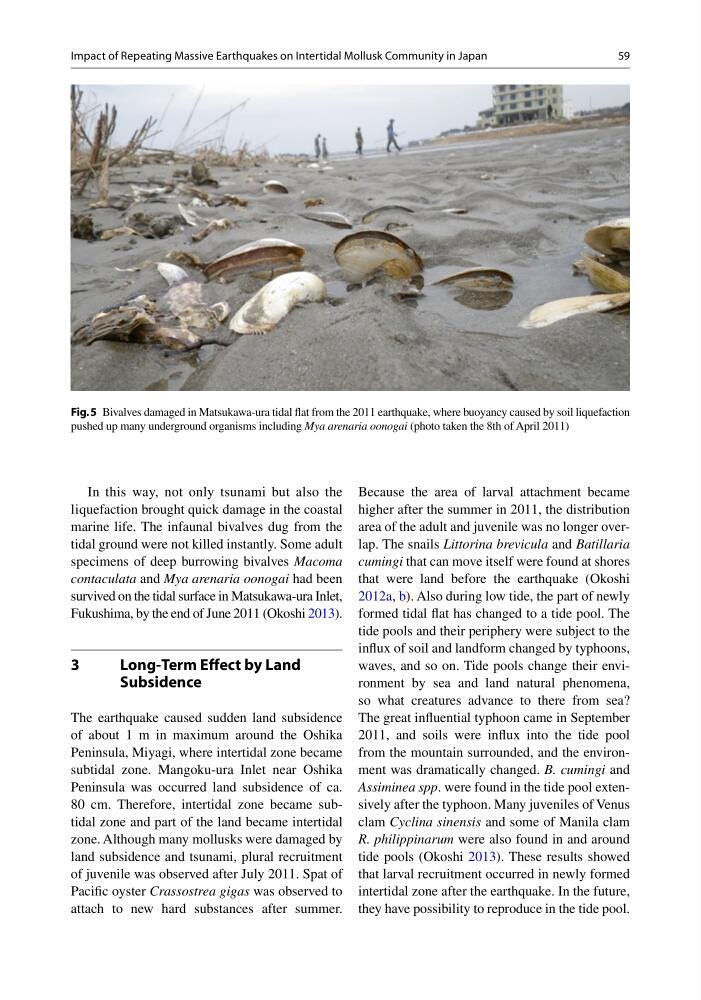
In this way, not only tsunami but also the
liquefaction brought quick damage in the coastal
marine life. The infaunal bivalves dug from the
tidal ground were not killed instantly. Some adult
specimens of deep burrowing bivalves Macoma
contaculata and Mya arenaria oonogai had been
survived on the tidal surface in Matsukawa-ura Inlet,
Fukushima, by the end of June 2011 (Okoshi 2013 ).
3
Long-Term Effect by Land
Subsidence
The earthquake caused sudden land subsidence
of about 1 m in maximum around the Oshika
Peninsula, Miyagi, where intertidal zone became
subtidal zone. Mangoku-ura Inlet near Oshika
Peninsula was occurred land subsidence of ca.
80 cm. Therefore, intertidal zone became subtidal zone and part of the land became intertidal
zone. Although many mollusks were damaged by
land subsidence and tsunami, plural recruitment
of juvenile was observed after July 2011. Spat of
Pacifi c oyster Crassostrea gigas was observed to
attach to new hard substances after summer.
Because the area of larval attachment became
higher after the summer in 2011, the distribution
area of the adult and juvenile was no longer overlap. The snails Littorina brevicula and Batillaria
cumingi that can move itself were found at shores
that were land before the earthquake (Okoshi
2012a , b ). Also during low tide, the part of newly
formed tidal fl at has changed to a tide pool. The
tide pools and their periphery were subject to the
infl ux of soil and landform changed by typhoons,
waves, and so on. Tide pools change their environment by sea and land natural phenomena,
so what creatures advance to there from sea?
The great infl uential typhoon came in September
2011, and soils were infl ux into the tide pool
from the mountain surrounded, and the environment was dramatically changed. B. cumingi and
Assiminea spp . were found in the tide pool extensively after the typhoon. Many juveniles of Venus
clam Cyclina sinensis and some of Manila clam
R. philippinarum were also found in and around
tide pools (Okoshi 2013 ). These results showed
that larval recruitment occurred in newly formed
intertidal zone after the earthquake. In the future,
they have possibility to reproduce in the tide pool.
Fig. 5 Bivalves damaged in Matsukawa-ura tidal fl at from the 2011 earthquake, where buoyancy caused by soil liquefaction
pushed up many underground organisms including Mya arenaria oonogai (photo taken the 8th of April 2011)
Impact of Repeating Massive Earthquakes on Intertidal Mollusk Community in Japan
In this way, not only tsunami but also the
liquefaction brought quick damage in the coastal
marine life. The infaunal bivalves dug from the
tidal ground were not killed instantly. Some adult
specimens of deep burrowing bivalves Macoma
contaculata and Mya arenaria oonogai had been
survived on the tidal surface in Matsukawa-ura Inlet,
Fukushima, by the end of June 2011 (Okoshi 2013 ).
3
Long-Term Effect by Land
Subsidence
The earthquake caused sudden land subsidence
of about 1 m in maximum around the Oshika
Peninsula, Miyagi, where intertidal zone became
subtidal zone. Mangoku-ura Inlet near Oshika
Peninsula was occurred land subsidence of ca.
80 cm. Therefore, intertidal zone became subtidal zone and part of the land became intertidal
zone. Although many mollusks were damaged by
land subsidence and tsunami, plural recruitment
of juvenile was observed after July 2011. Spat of
Pacifi c oyster Crassostrea gigas was observed to
attach to new hard substances after summer.
Because the area of larval attachment became
higher after the summer in 2011, the distribution
area of the adult and juvenile was no longer overlap. The snails Littorina brevicula and Batillaria
cumingi that can move itself were found at shores
that were land before the earthquake (Okoshi
2012a , b ). Also during low tide, the part of newly
formed tidal fl at has changed to a tide pool. The
tide pools and their periphery were subject to the
infl ux of soil and landform changed by typhoons,
waves, and so on. Tide pools change their environment by sea and land natural phenomena,
so what creatures advance to there from sea?
The great infl uential typhoon came in September
2011, and soils were infl ux into the tide pool
from the mountain surrounded, and the environment was dramatically changed. B. cumingi and
Assiminea spp . were found in the tide pool extensively after the typhoon. Many juveniles of Venus
clam Cyclina sinensis and some of Manila clam
R. philippinarum were also found in and around
tide pools (Okoshi 2013 ). These results showed
that larval recruitment occurred in newly formed
intertidal zone after the earthquake. In the future,
they have possibility to reproduce in the tide pool.
Fig. 5 Bivalves damaged in Matsukawa-ura tidal fl at from the 2011 earthquake, where buoyancy caused by soil liquefaction
pushed up many underground organisms including Mya arenaria oonogai (photo taken the 8th of April 2011)
Impact of Repeating Massive Earthquakes on Intertidal Mollusk Community in Japan