

58
The muddy water was fl owing to the Sanbanze
tidal fl ats through the sewage outlet and two
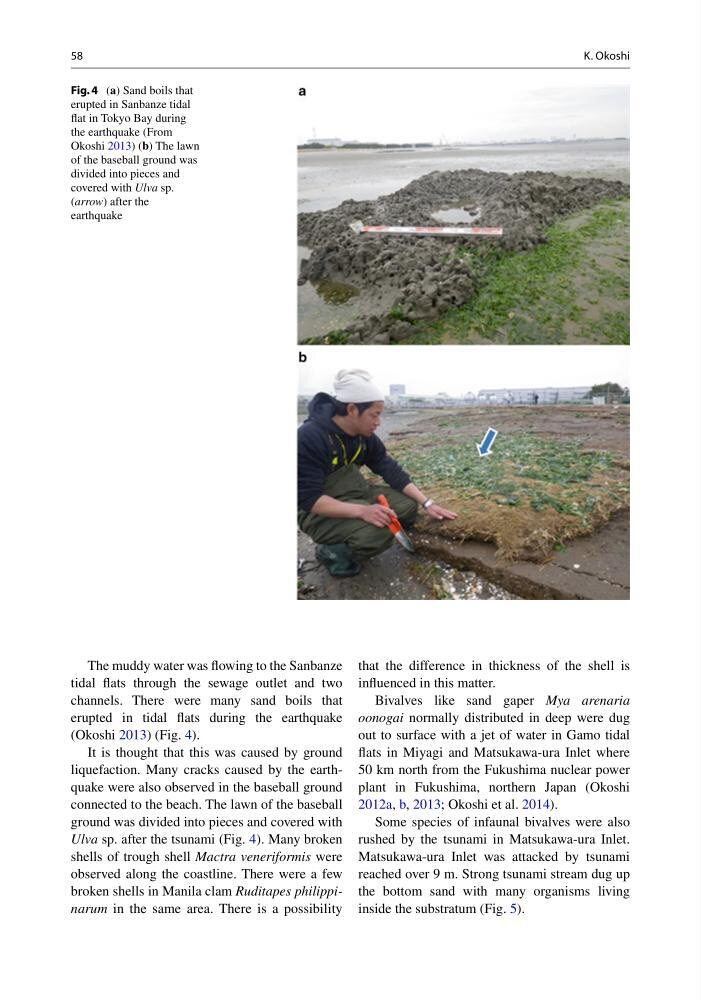
channels. There were many sand boils that
erupted in tidal fl ats during the earthquake
(Okoshi 2013 ) (Fig. 4 ).
It is thought that this was caused by ground
liquefaction. Many cracks caused by the earthquake were also observed in the baseball ground
connected to the beach. The lawn of the baseball
ground was divided into pieces and covered with
Ulva sp. after the tsunami (Fig. 4 ). Many broken
shells of trough shell Mactra veneriformis were
observed along the coastline. There were a few
broken shells in Manila clam Ruditapes philippinarum in the same area. There is a possibility
that the difference in thickness of the shell is
infl uenced in this matter.
Bivalves like sand gaper Mya arenaria
oonogai normally distributed in deep were dug
out to surface with a jet of water in Gamo tidal
fl ats in Miyagi and Matsukawa-ura Inlet where
50 km north from the Fukushima nuclear power
plant in Fukushima, northern Japan (Okoshi
2012a , b , 2013 ; Okoshi et al. 2014 ).
Some species of infaunal bivalves were also
rushed by the tsunami in Matsukawa-ura Inlet.
Matsukawa-ura Inlet was attacked by tsunami
reached over 9 m. Strong tsunami stream dug up
the bottom sand with many organisms living
inside the substratum (Fig. 5 ).
Fig. 4 ( a ) Sand boils that
erupted in Sanbanze tidal
fl at in Tokyo Bay during
the earthquake (From
Okoshi 2013 ) ( b ) The lawn
of the baseball ground was
divided into pieces and
covered with Ulva sp.
( arrow ) after the
earthquake
K. Okoshi
The muddy water was fl owing to the Sanbanze
tidal fl ats through the sewage outlet and two
channels. There were many sand boils that
erupted in tidal fl ats during the earthquake
(Okoshi 2013 ) (Fig. 4 ).
It is thought that this was caused by ground
liquefaction. Many cracks caused by the earthquake were also observed in the baseball ground
connected to the beach. The lawn of the baseball
ground was divided into pieces and covered with
Ulva sp. after the tsunami (Fig. 4 ). Many broken
shells of trough shell Mactra veneriformis were
observed along the coastline. There were a few
broken shells in Manila clam Ruditapes philippinarum in the same area. There is a possibility
that the difference in thickness of the shell is
infl uenced in this matter.
Bivalves like sand gaper Mya arenaria
oonogai normally distributed in deep were dug
out to surface with a jet of water in Gamo tidal
fl ats in Miyagi and Matsukawa-ura Inlet where
50 km north from the Fukushima nuclear power
plant in Fukushima, northern Japan (Okoshi
2012a , b , 2013 ; Okoshi et al. 2014 ).
Some species of infaunal bivalves were also
rushed by the tsunami in Matsukawa-ura Inlet.
Matsukawa-ura Inlet was attacked by tsunami
reached over 9 m. Strong tsunami stream dug up
the bottom sand with many organisms living
inside the substratum (Fig. 5 ).
Fig. 4 ( a ) Sand boils that
erupted in Sanbanze tidal
fl at in Tokyo Bay during
the earthquake (From
Okoshi 2013 ) ( b ) The lawn
of the baseball ground was
divided into pieces and
covered with Ulva sp.
( arrow ) after the
earthquake
K. Okoshi