

5
Twelfth edition in Japan at Tokyo in 2005 on the
“Mutual new understanding for research in
oceanography and fi sheries, in France and in
Japan.” Scientifi c meetings at Tokyo University
of Marine Science and Technology (TUMSAT)
and then visits to university laboratories,
research vessels, offi cial offi ces, and private
fi rms in Onjuku, Abiko, and Shimizu.
Thirteenth edition in France at Marseille in 2008
on the “Global Change: interactions mankind/
marine environments.” Scientifi c meetings held
at the Faculty of Pharmacy of Marseille from
the 8 to 10 September and then at the Paris
Nihon Bunka Kaikan (Maison de la Culture
du Japon à Paris) on 12 September with special thema : Oceanography, Microbiology,
Bio-geo-chemistry, Coral reefs, Biodiversity,
Management of littoral zones and artifi cial
reefs, Aquaculture, and New techniques of
observation in the marine environment.
Fourteenth edition in Japan at Kobe then at Tokyo in
2010 with the special topic “Toward sustainable
use and management of the oceans.” Meetings
held at Kobe in the international exhibition hall, in
the framework of the forum “Techno-Ocean.” In
Tokyo, other meetings on education and on fi sh
behavior, in TUMSAT (Kaiyodai) then a
conference in “Maison Franco-Japonaise”
(Nichi- Futsu Kaikan). Commemoration of the
50th anniversary of the “Société franco-japonaise
d’Océanographie” of Japan.
2
Transportation of Seed
Oysters from Japan to France
in the 1960s
The mass production of oyster seeds (spat) in Japan
started in the 1920s at Mangoku-Ura bay, Ishinomaki
City, near Sendai. These seed oysters were transported
to all regions around the Japanese coast, and in the
1940s, they were exported to the United States by ship.
For oyster culture, in European countries,
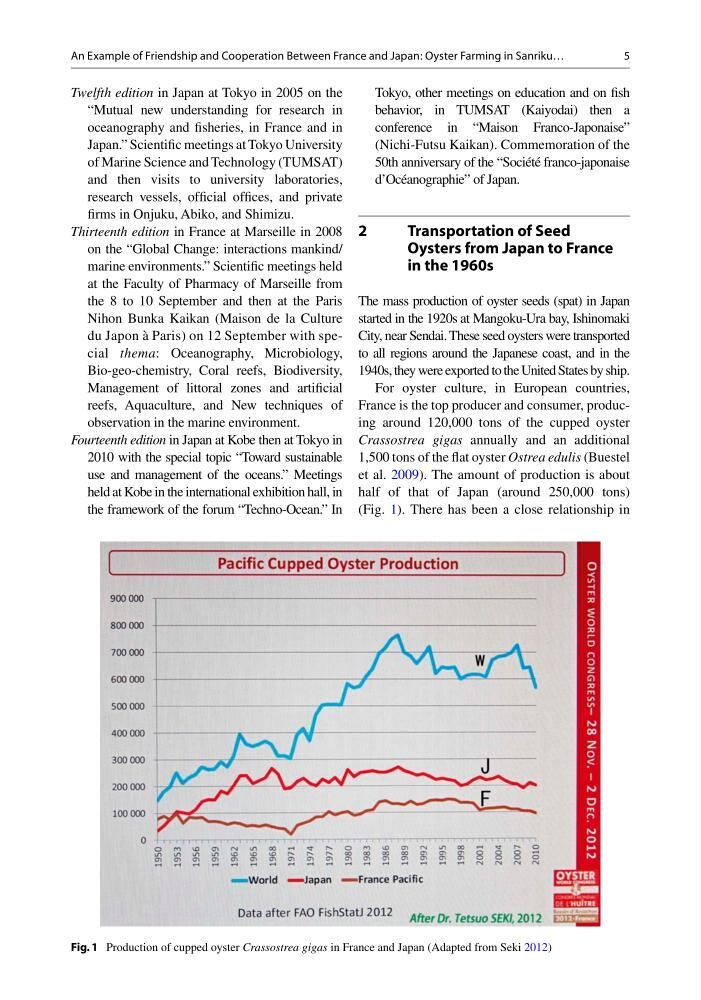
France is the top producer and consumer, producing around 120,000 tons of the cupped oyster
Crassostrea gigas annually and an additional
1,500 tons of the fl at oyster Ostrea edulis (Buestel
et al. 2009 ). The amount of production is about
half of that of Japan (around 250,000 tons)
(Fig. 1 ). There has been a close relationship in
Fig. 1 Production of cupped oyster Crassostrea gigas in France and Japan (Adapted from Seki 2012 )
An Example of Friendship and Cooperation Between France and Japan: Oyster Farming in Sanriku…
Twelfth edition in Japan at Tokyo in 2005 on the
“Mutual new understanding for research in
oceanography and fi sheries, in France and in
Japan.” Scientifi c meetings at Tokyo University
of Marine Science and Technology (TUMSAT)
and then visits to university laboratories,
research vessels, offi cial offi ces, and private
fi rms in Onjuku, Abiko, and Shimizu.
Thirteenth edition in France at Marseille in 2008
on the “Global Change: interactions mankind/
marine environments.” Scientifi c meetings held
at the Faculty of Pharmacy of Marseille from
the 8 to 10 September and then at the Paris
Nihon Bunka Kaikan (Maison de la Culture
du Japon à Paris) on 12 September with special thema : Oceanography, Microbiology,
Bio-geo-chemistry, Coral reefs, Biodiversity,
Management of littoral zones and artifi cial
reefs, Aquaculture, and New techniques of
observation in the marine environment.
Fourteenth edition in Japan at Kobe then at Tokyo in
2010 with the special topic “Toward sustainable
use and management of the oceans.” Meetings
held at Kobe in the international exhibition hall, in
the framework of the forum “Techno-Ocean.” In
Tokyo, other meetings on education and on fi sh
behavior, in TUMSAT (Kaiyodai) then a
conference in “Maison Franco-Japonaise”
(Nichi- Futsu Kaikan). Commemoration of the
50th anniversary of the “Société franco-japonaise
d’Océanographie” of Japan.
2
Transportation of Seed
Oysters from Japan to France
in the 1960s
The mass production of oyster seeds (spat) in Japan
started in the 1920s at Mangoku-Ura bay, Ishinomaki
City, near Sendai. These seed oysters were transported
to all regions around the Japanese coast, and in the
1940s, they were exported to the United States by ship.
For oyster culture, in European countries,
France is the top producer and consumer, producing around 120,000 tons of the cupped oyster
Crassostrea gigas annually and an additional
1,500 tons of the fl at oyster Ostrea edulis (Buestel
et al. 2009 ). The amount of production is about
half of that of Japan (around 250,000 tons)
(Fig. 1 ). There has been a close relationship in
Fig. 1 Production of cupped oyster Crassostrea gigas in France and Japan (Adapted from Seki 2012 )
An Example of Friendship and Cooperation Between France and Japan: Oyster Farming in Sanriku…