

346
maximum of 11 tonnes of pearls exported in
2000, the fi rst value of exported income for the
country, is recent.
To demonstrate the benefi ts to humans and the
economy, studies of evaluation of services of
coral reefs have developed in the late 1990s
(Cesar 1996 – Costanza et al. 1997 ). They are
tools for decision in support for the conservation
of this ecosystem. A worldwide value of coral
reefs has been estimated at $ 380 billion, that
being 1 % of the value of all biomes on the planet
(Costanza et al. 1997 ). Benefi ts of the coral reef
ecosystem in the world economy were estimated
at $ 29 billion, including 11 for tourism, 11 for
coastal protection and 7 for fi sheries. However,
these estimates do not take into account or underestimate the cultural aspects as well as political
stability in some countries between urban and
rural areas.
4
Pressures on Coral Reef
Health
If the health of coral reefs has particularly deteriorated over the past century, this is mainly due
to the pressure of human activities due to demography and development. There is a synergy
between the natural degradation factors, which
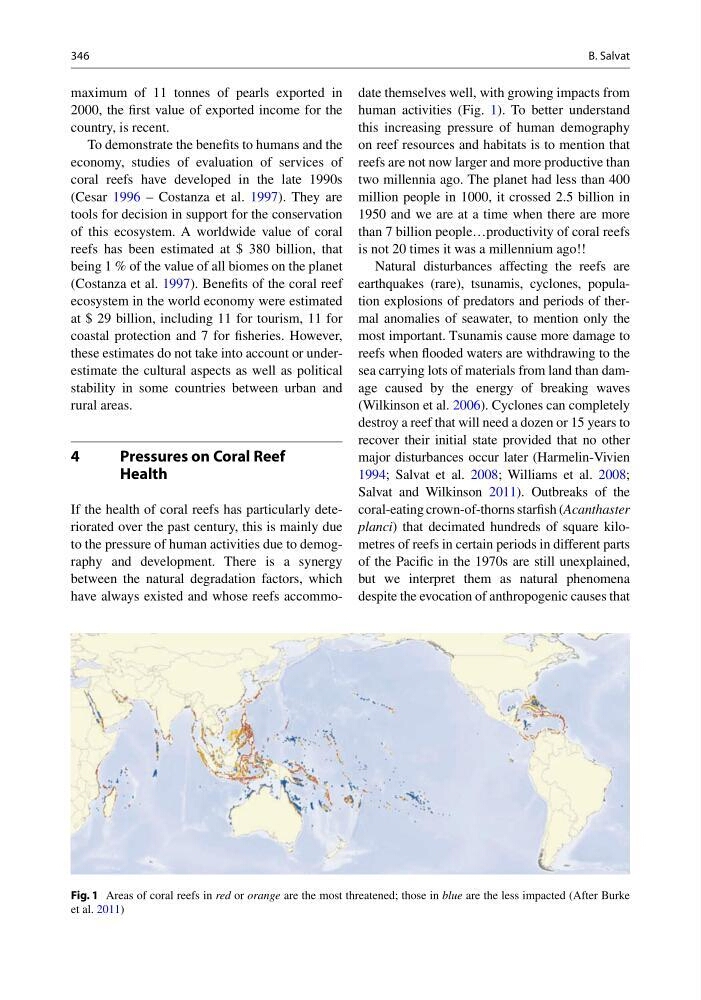
have always existed and whose reefs accommodate themselves well, with growing impacts from
human activities (Fig. 1 ). To better understand
this increasing pressure of human demography
on reef resources and habitats is to mention that
reefs are not now larger and more productive than
two millennia ago. The planet had less than 400
million people in 1000, it crossed 2.5 billion in
1950 and we are at a time when there are more
than 7 billion people…productivity of coral reefs
is not 20 times it was a millennium ago!!
Natural disturbances affecting the reefs are
earthquakes (rare), tsunamis, cyclones, population explosions of predators and periods of thermal anomalies of seawater, to mention only the
most important. Tsunamis cause more damage to
reefs when fl ooded waters are withdrawing to the
sea carrying lots of materials from land than damage caused by the energy of breaking waves
(Wilkinson et al. 2006 ). Cyclones can completely
destroy a reef that will need a dozen or 15 years to
recover their initial state provided that no other
major disturbances occur later (Harmelin-Vivien
1994 ; Salvat et al. 2008 ; Williams et al. 2008 ;
Salvat and Wilkinson 2011 ). Outbreaks of the
coral-eating crown-of-thorns starfi sh ( Acanthaster
planci ) that decimated hundreds of square kilometres of reefs in certain periods in different parts
of the Pacifi c in the 1970s are still unexplained,
but we interpret them as natural phenomena
despite the evocation of anthropogenic causes that
Fig. 1 Areas of coral reefs in red or orange are the most threatened; those in blue are the less impacted (After Burke
et al. 2011 )
B. Salvat
maximum of 11 tonnes of pearls exported in
2000, the fi rst value of exported income for the
country, is recent.
To demonstrate the benefi ts to humans and the
economy, studies of evaluation of services of
coral reefs have developed in the late 1990s
(Cesar 1996 – Costanza et al. 1997 ). They are
tools for decision in support for the conservation
of this ecosystem. A worldwide value of coral
reefs has been estimated at $ 380 billion, that
being 1 % of the value of all biomes on the planet
(Costanza et al. 1997 ). Benefi ts of the coral reef
ecosystem in the world economy were estimated
at $ 29 billion, including 11 for tourism, 11 for
coastal protection and 7 for fi sheries. However,
these estimates do not take into account or underestimate the cultural aspects as well as political
stability in some countries between urban and
rural areas.
4
Pressures on Coral Reef
Health
If the health of coral reefs has particularly deteriorated over the past century, this is mainly due
to the pressure of human activities due to demography and development. There is a synergy
between the natural degradation factors, which
have always existed and whose reefs accommodate themselves well, with growing impacts from
human activities (Fig. 1 ). To better understand
this increasing pressure of human demography
on reef resources and habitats is to mention that
reefs are not now larger and more productive than
two millennia ago. The planet had less than 400
million people in 1000, it crossed 2.5 billion in
1950 and we are at a time when there are more
than 7 billion people…productivity of coral reefs
is not 20 times it was a millennium ago!!
Natural disturbances affecting the reefs are
earthquakes (rare), tsunamis, cyclones, population explosions of predators and periods of thermal anomalies of seawater, to mention only the
most important. Tsunamis cause more damage to
reefs when fl ooded waters are withdrawing to the
sea carrying lots of materials from land than damage caused by the energy of breaking waves
(Wilkinson et al. 2006 ). Cyclones can completely
destroy a reef that will need a dozen or 15 years to
recover their initial state provided that no other
major disturbances occur later (Harmelin-Vivien
1994 ; Salvat et al. 2008 ; Williams et al. 2008 ;
Salvat and Wilkinson 2011 ). Outbreaks of the
coral-eating crown-of-thorns starfi sh ( Acanthaster
planci ) that decimated hundreds of square kilometres of reefs in certain periods in different parts
of the Pacifi c in the 1970s are still unexplained,
but we interpret them as natural phenomena
despite the evocation of anthropogenic causes that
Fig. 1 Areas of coral reefs in red or orange are the most threatened; those in blue are the less impacted (After Burke
et al. 2011 )
B. Salvat