

288
Sargassum thunbergii (Mertens ex Roth) Kuntze;
and seagrass, Z. marina , were harvested and used
for fertiliser until the 1950s (Anon 2012 ). This
practice recycles nutrients from the sea to the
land via human activity.
3.2
The Effect of Gaps in Seagrass
Beds on Fish
Climax ecosystems tend to have low biodiversity
due to monotonous habitats, while optimal successional ecosystems produce rich biodiversity
and high productivity (Ogushi 2009 ). In the Seto
Inland Sea, seagrass meadows are the most
important habitat. When seagrass meadows reach
a climax community, the dense leaves reduce
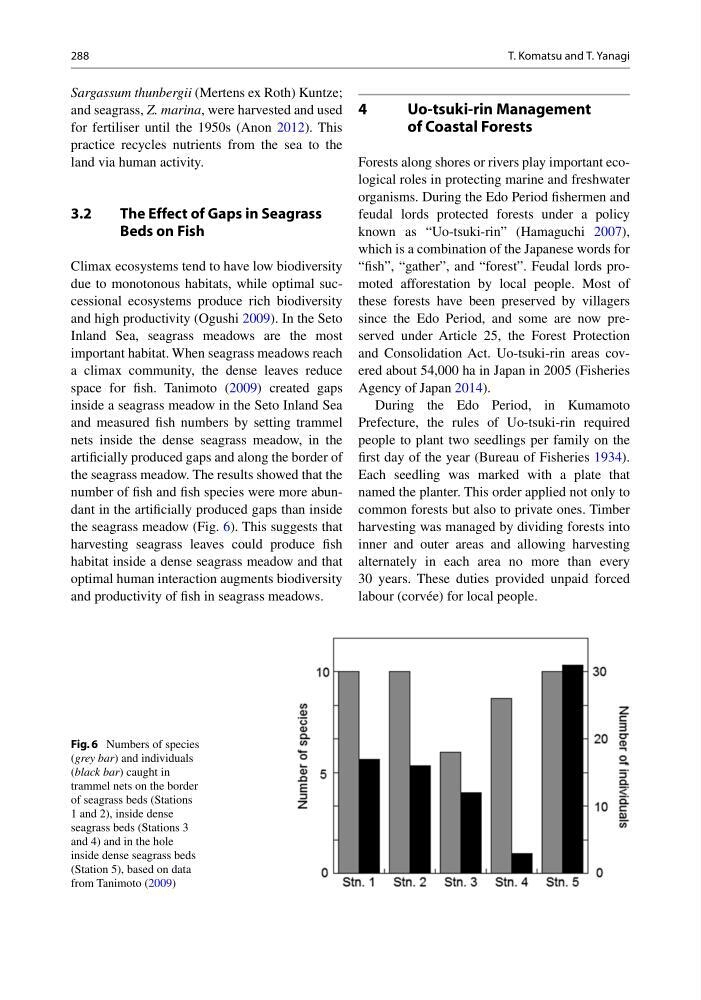
space for fi sh. Tanimoto ( 2009 ) created gaps
inside a seagrass meadow in the Seto Inland Sea
and measured fi sh numbers by setting trammel
nets inside the dense seagrass meadow, in the
artifi cially produced gaps and along the border of
the seagrass meadow. The results showed that the
number of fi sh and fi sh species were more abundant in the artifi cially produced gaps than inside
the seagrass meadow (Fig. 6 ). This suggests that
harvesting seagrass leaves could produce fi sh
habitat inside a dense seagrass meadow and that
optimal human interaction augments biodiversity
and productivity of fi sh in seagrass meadows.
4
Uo-tsuki-rin Management
of Coastal Forests
Forests along shores or rivers play important ecological roles in protecting marine and freshwater
organisms. During the Edo Period fi shermen and
feudal lords protected forests under a policy
known as “Uo-tsuki-rin” (Hamaguchi 2007 ),
which is a combination of the Japanese words for
“fi sh”, “gather”, and “forest”. Feudal lords promoted afforestation by local people. Most of
these forests have been preserved by villagers
since the Edo Period, and some are now preserved under Article 25, the Forest Protection
and Consolidation Act. Uo-tsuki-rin areas covered about 54,000 ha in Japan in 2005 (Fisheries
Agency of Japan 2014 ).
During the Edo Period, in Kumamoto
Prefecture, the rules of Uo-tsuki-rin required
people to plant two seedlings per family on the
fi rst day of the year (Bureau of Fisheries 1934 ).
Each seedling was marked with a plate that
named the planter. This order applied not only to
common forests but also to private ones. Timber
harvesting was managed by dividing forests into
inner and outer areas and allowing harvesting
alternately in each area no more than every
30 years. These duties provided unpaid forced
labour (corvée) for local people.
Fig. 6 Numbers of species
( grey bar ) and individuals
( black bar ) caught in
trammel nets on the border
of seagrass beds (Stations
1 and 2), inside dense
seagrass beds (Stations 3
and 4) and in the hole
inside dense seagrass beds
(Station 5), based on data
from Tanimoto ( 2009 )
T. Komatsu and T. Yanagi
Sargassum thunbergii (Mertens ex Roth) Kuntze;
and seagrass, Z. marina , were harvested and used
for fertiliser until the 1950s (Anon 2012 ). This
practice recycles nutrients from the sea to the
land via human activity.
3.2
The Effect of Gaps in Seagrass
Beds on Fish
Climax ecosystems tend to have low biodiversity
due to monotonous habitats, while optimal successional ecosystems produce rich biodiversity
and high productivity (Ogushi 2009 ). In the Seto
Inland Sea, seagrass meadows are the most
important habitat. When seagrass meadows reach
a climax community, the dense leaves reduce
space for fi sh. Tanimoto ( 2009 ) created gaps
inside a seagrass meadow in the Seto Inland Sea
and measured fi sh numbers by setting trammel
nets inside the dense seagrass meadow, in the
artifi cially produced gaps and along the border of
the seagrass meadow. The results showed that the
number of fi sh and fi sh species were more abundant in the artifi cially produced gaps than inside
the seagrass meadow (Fig. 6 ). This suggests that
harvesting seagrass leaves could produce fi sh
habitat inside a dense seagrass meadow and that
optimal human interaction augments biodiversity
and productivity of fi sh in seagrass meadows.
4
Uo-tsuki-rin Management
of Coastal Forests
Forests along shores or rivers play important ecological roles in protecting marine and freshwater
organisms. During the Edo Period fi shermen and
feudal lords protected forests under a policy
known as “Uo-tsuki-rin” (Hamaguchi 2007 ),
which is a combination of the Japanese words for
“fi sh”, “gather”, and “forest”. Feudal lords promoted afforestation by local people. Most of
these forests have been preserved by villagers
since the Edo Period, and some are now preserved under Article 25, the Forest Protection
and Consolidation Act. Uo-tsuki-rin areas covered about 54,000 ha in Japan in 2005 (Fisheries
Agency of Japan 2014 ).
During the Edo Period, in Kumamoto
Prefecture, the rules of Uo-tsuki-rin required
people to plant two seedlings per family on the
fi rst day of the year (Bureau of Fisheries 1934 ).
Each seedling was marked with a plate that
named the planter. This order applied not only to
common forests but also to private ones. Timber
harvesting was managed by dividing forests into
inner and outer areas and allowing harvesting
alternately in each area no more than every
30 years. These duties provided unpaid forced
labour (corvée) for local people.
Fig. 6 Numbers of species
( grey bar ) and individuals
( black bar ) caught in
trammel nets on the border
of seagrass beds (Stations
1 and 2), inside dense
seagrass beds (Stations 3
and 4) and in the hole
inside dense seagrass beds
(Station 5), based on data
from Tanimoto ( 2009 )
T. Komatsu and T. Yanagi