

287
3
Harvesting Seagrass
for Fertiliser
3.1
Harvest of Seagrass
in the Seto Inland Sea
Seagrass meadows and seaweed forests are very
important habitats in coastal waters. They infl uence light (Komatsu 1989 ), dissolved oxygen
(Komatsu 1989 ), pH ( Komatsu and Kawai 1986 ),
water temperature (Komatsu 1985 ; Komatsu
et al. 1982 , 1994 ) and water motion (Komatsu
1996 ; Komatsu and Murakami 1994 ). Costanza
et al. ( 1997 ) classifi ed their social value as very
high based on ecological services such as nutrient cycling, food supply, etc. However, economic
development in Japan since the 1960s has
destroyed many seagrass beds through reclamation and eutrophication ( Komatsu 1997 ). From
the Edo Period through to the 1960s, seagrasses
and seaweeds were preserved and used as fertiliser for rice, vegetable and fruit fi elds. During
this period, coastal villages were divided into villages of fi shermen and villages of farmers who
fi shed during the off-seasons of farming. The
latter collected sardines and seagrasses for
fertiliser (Hamaguchi 2007 ).
The prize-winning fi lm “A Naked Island” by
famed Japanese fi lm-maker Kaneto Shindo
depicts the ordinary life of a family on a small
island in the Seto Inland Sea just after World War
II. In this fi lm, the family harvests seagrass,
Zostera marina L., using two bamboo poles per
person on a boat during the rainy season. The
rainy season produces luxuriant growth of Z.
marina in June in the Seto Inland Sea. Only the
above-ground parts of Z. marina are harvested. Z.
marina has both sexual and asexual reproduction.
In a well-developed Z. marina bed, seeds do not
germinate, due to low light caused by the canopy
of leaves. In this situation, the plant reproduces
asexually by producing new shoots from the root
system. Thus, harvest of only the above-ground
parts does not impact reproduction in welldeveloped seagrass meadows. Harvested leaves
of seagrass and Sargassum spp., which wash up
on shore, are also used as fertiliser on farm fi elds.
In the brackish Lake Nakaumi in Shimane
Prefecture, Japan, red algae, Gracilaria vermiculophylla (Ohmi) Papenfuss ; brown algae,
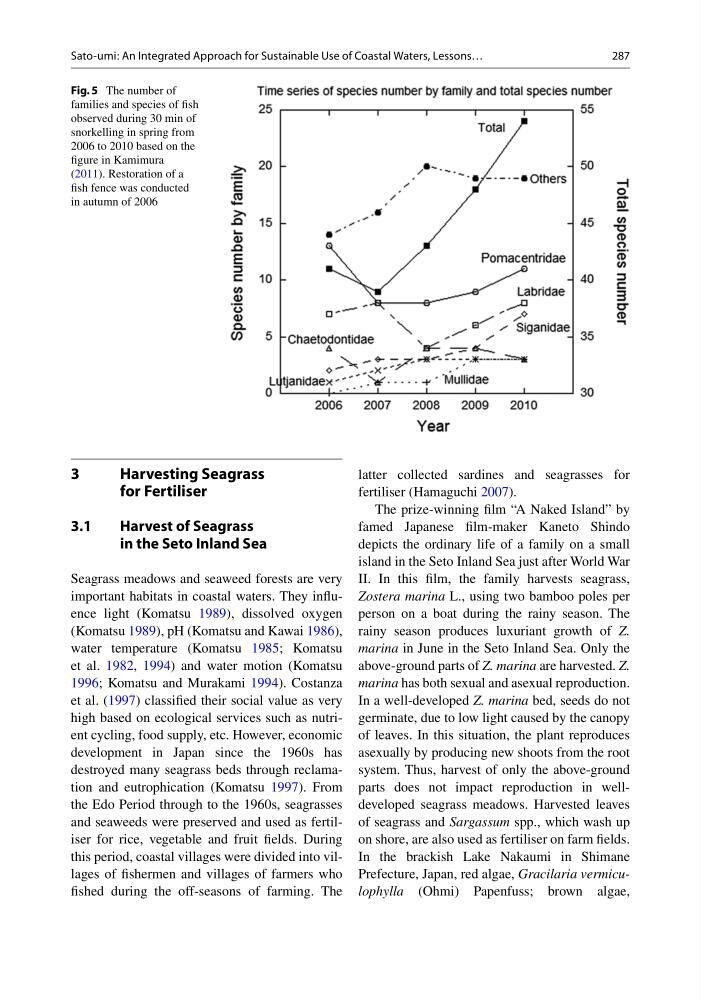
Fig. 5 The number of
families and species of fi sh
observed during 30 min of
snorkelling in spring from
2006 to 2010 based on the
fi gure in Kamimura
( 2011 ). Restoration of a
fi sh fence was conducted
in autumn of 2006
Sato-umi: An Integrated Approach for Sustainable Use of Coastal Waters, Lessons…
3
Harvesting Seagrass
for Fertiliser
3.1
Harvest of Seagrass
in the Seto Inland Sea
Seagrass meadows and seaweed forests are very
important habitats in coastal waters. They infl uence light (Komatsu 1989 ), dissolved oxygen
(Komatsu 1989 ), pH ( Komatsu and Kawai 1986 ),
water temperature (Komatsu 1985 ; Komatsu
et al. 1982 , 1994 ) and water motion (Komatsu
1996 ; Komatsu and Murakami 1994 ). Costanza
et al. ( 1997 ) classifi ed their social value as very
high based on ecological services such as nutrient cycling, food supply, etc. However, economic
development in Japan since the 1960s has
destroyed many seagrass beds through reclamation and eutrophication ( Komatsu 1997 ). From
the Edo Period through to the 1960s, seagrasses
and seaweeds were preserved and used as fertiliser for rice, vegetable and fruit fi elds. During
this period, coastal villages were divided into villages of fi shermen and villages of farmers who
fi shed during the off-seasons of farming. The
latter collected sardines and seagrasses for
fertiliser (Hamaguchi 2007 ).
The prize-winning fi lm “A Naked Island” by
famed Japanese fi lm-maker Kaneto Shindo
depicts the ordinary life of a family on a small
island in the Seto Inland Sea just after World War
II. In this fi lm, the family harvests seagrass,
Zostera marina L., using two bamboo poles per
person on a boat during the rainy season. The
rainy season produces luxuriant growth of Z.
marina in June in the Seto Inland Sea. Only the
above-ground parts of Z. marina are harvested. Z.
marina has both sexual and asexual reproduction.
In a well-developed Z. marina bed, seeds do not
germinate, due to low light caused by the canopy
of leaves. In this situation, the plant reproduces
asexually by producing new shoots from the root
system. Thus, harvest of only the above-ground
parts does not impact reproduction in welldeveloped seagrass meadows. Harvested leaves
of seagrass and Sargassum spp., which wash up
on shore, are also used as fertiliser on farm fi elds.
In the brackish Lake Nakaumi in Shimane
Prefecture, Japan, red algae, Gracilaria vermiculophylla (Ohmi) Papenfuss ; brown algae,
Fig. 5 The number of
families and species of fi sh
observed during 30 min of
snorkelling in spring from
2006 to 2010 based on the
fi gure in Kamimura
( 2011 ). Restoration of a
fi sh fence was conducted
in autumn of 2006
Sato-umi: An Integrated Approach for Sustainable Use of Coastal Waters, Lessons…