

285
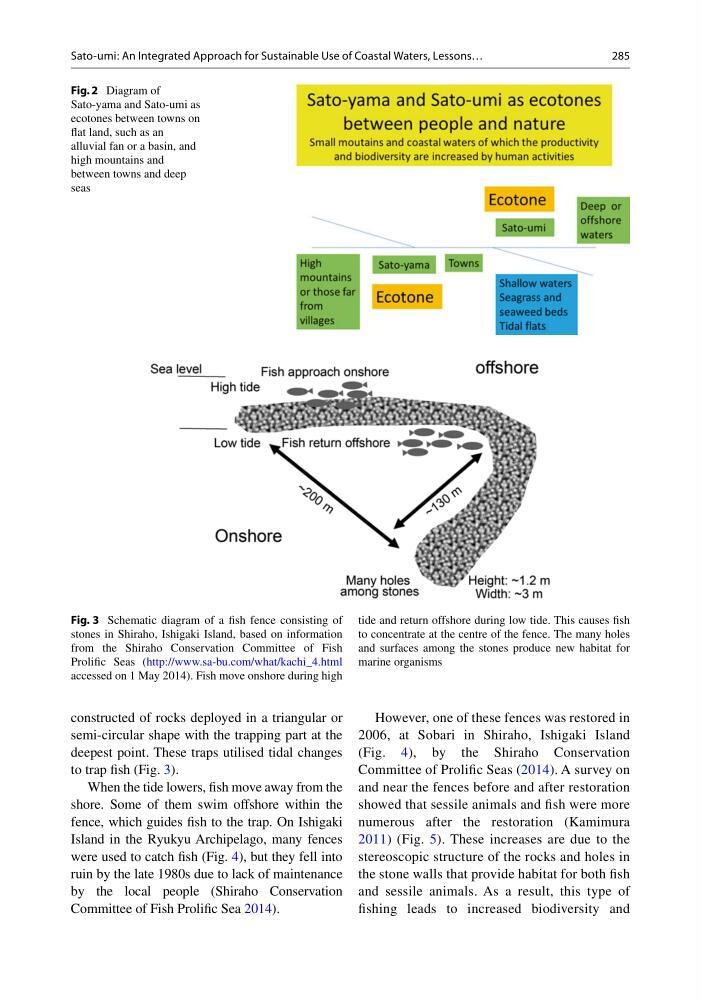
constructed of rocks deployed in a triangular or
semi-circular shape with the trapping part at the
deepest point. These traps utilised tidal changes
to trap fi sh (Fig. 3 ).
When the tide lowers, fi sh move away from the
shore. Some of them swim offshore within the
fence, which guides fi sh to the trap. On Ishigaki
Island in the Ryukyu Archipelago, many fences
were used to catch fi sh (Fig. 4 ), but they fell into
ruin by the late 1980s due to lack of maintenance
by the local people (Shiraho Conservation
Committee of Fish Prolifi c Sea 2014 ).
However, one of these fences was restored in
2006, at Sobari in Shiraho, Ishigaki Island
(Fig. 4 ), by the Shiraho Conservation
Committee of Prolifi c Seas ( 2014 ). A survey on
and near the fences before and after restoration
showed that sessile animals and fi sh were more
numerous after the restoration (Kamimura
2011 ) (Fig. 5 ). These increases are due to the
stereoscopic structure of the rocks and holes in
the stone walls that provide habitat for both fi sh
and sessile animals. As a result, this type of
fi shing leads to increased biodiversity and
Fig. 2 Diagram of
Sato-yama and Sato-umi as
ecotones between towns on
fl at land, such as an
alluvial fan or a basin, and
high mountains and
between towns and deep
seas
Fig. 3 Schematic diagram of a fi sh fence consisting of
stones in Shiraho, Ishigaki Island, based on information
from the Shiraho Conservation Committee of Fish
Prolifi c Seas ( http://www.sa-bu.com/what/kachi_4.html
accessed on 1 May 2014). Fish move onshore during high
tide and return offshore during low tide. This causes fi sh
to concentrate at the centre of the fence. The many holes
and surfaces among the stones produce new habitat for
marine organisms
Sato-umi: An Integrated Approach for Sustainable Use of Coastal Waters, Lessons…
constructed of rocks deployed in a triangular or
semi-circular shape with the trapping part at the
deepest point. These traps utilised tidal changes
to trap fi sh (Fig. 3 ).
When the tide lowers, fi sh move away from the
shore. Some of them swim offshore within the
fence, which guides fi sh to the trap. On Ishigaki
Island in the Ryukyu Archipelago, many fences
were used to catch fi sh (Fig. 4 ), but they fell into
ruin by the late 1980s due to lack of maintenance
by the local people (Shiraho Conservation
Committee of Fish Prolifi c Sea 2014 ).
However, one of these fences was restored in
2006, at Sobari in Shiraho, Ishigaki Island
(Fig. 4 ), by the Shiraho Conservation
Committee of Prolifi c Seas ( 2014 ). A survey on
and near the fences before and after restoration
showed that sessile animals and fi sh were more
numerous after the restoration (Kamimura
2011 ) (Fig. 5 ). These increases are due to the
stereoscopic structure of the rocks and holes in
the stone walls that provide habitat for both fi sh
and sessile animals. As a result, this type of
fi shing leads to increased biodiversity and
Fig. 2 Diagram of
Sato-yama and Sato-umi as
ecotones between towns on
fl at land, such as an
alluvial fan or a basin, and
high mountains and
between towns and deep
seas
Fig. 3 Schematic diagram of a fi sh fence consisting of
stones in Shiraho, Ishigaki Island, based on information
from the Shiraho Conservation Committee of Fish
Prolifi c Seas ( http://www.sa-bu.com/what/kachi_4.html
accessed on 1 May 2014). Fish move onshore during high
tide and return offshore during low tide. This causes fi sh
to concentrate at the centre of the fence. The many holes
and surfaces among the stones produce new habitat for
marine organisms
Sato-umi: An Integrated Approach for Sustainable Use of Coastal Waters, Lessons…